
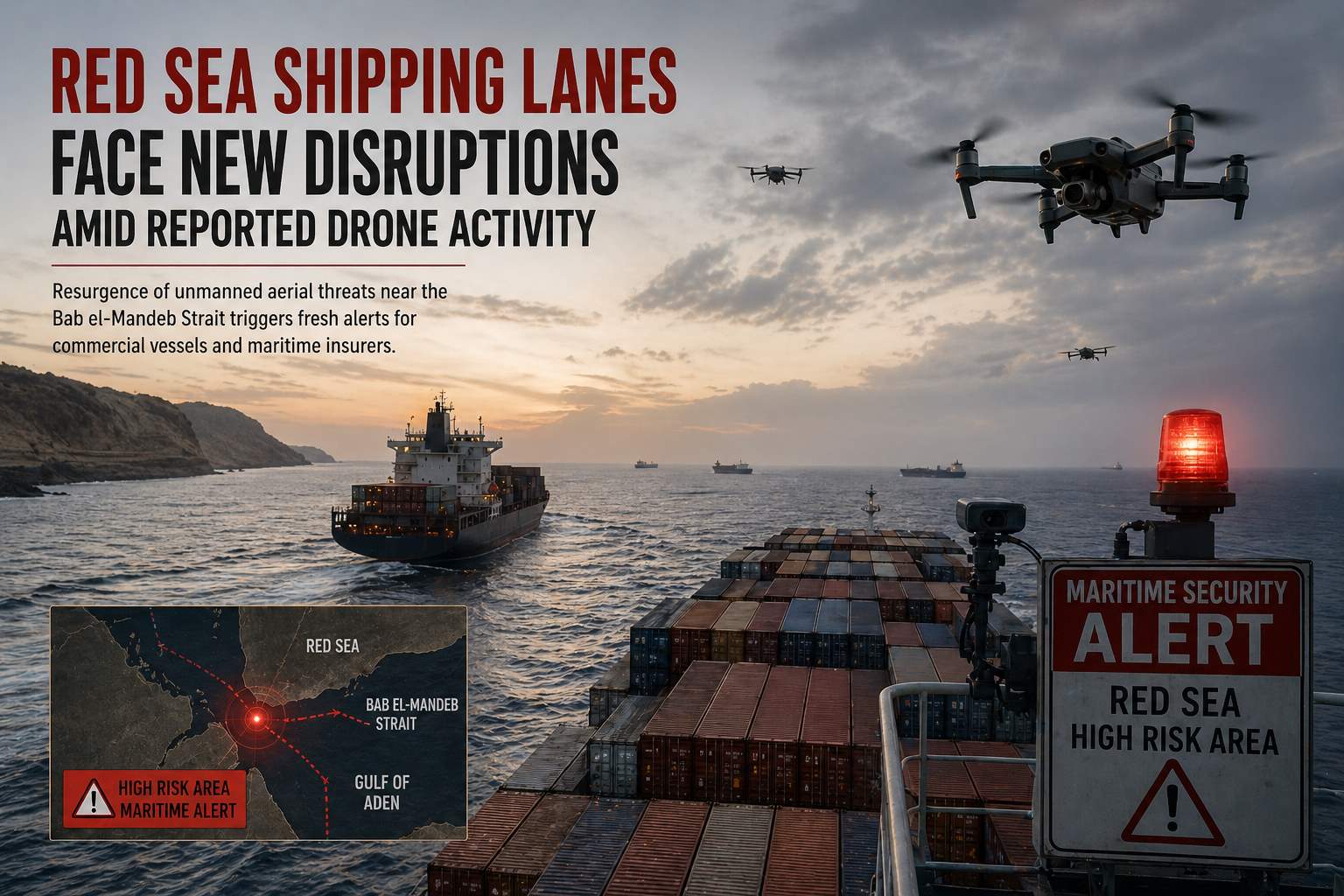
Resurgence of unmanned aerial threats near the Bab el-Mandeb Strait triggers fresh alerts for commercial vessels and maritime insurers.
April 27, 2026
Last updated: April 27, 2026
By Global War News Editorial
Renewed reports of drone activity over critical shipping lanes in the Red Sea have prompted a fresh wave of security alerts for international maritime traffic. According to monitoring data and preliminary reports from the United Kingdom Maritime Trade Operations (UKMTO), multiple unmanned aerial systems (UAS) were detected on Sunday and early Monday operating in proximity to commercial vessels transiting the southern Red Sea.
While no direct hits on merchant ships have been confirmed in the last 24 hours, the presence of these systems has led several major carriers to issue immediate precautionary instructions to their fleets. This uptick in activity follows a period of relatively diminished strikes and comes as regional powers warn of potential escalations linked to the broader conflict involving Iran and its regional affiliates.
Background: A Persistent Maritime Threat
The Red Sea and the Gulf of Aden have remained high-risk zones since late 2023, following the commencement of a campaign by Houthi militants in Yemen against international shipping. While US-led coalition efforts, including Operation Prosperity Guardian, have intercepted hundreds of threats, the persistence of cheap, massed drone technology continues to challenge established naval defense doctrines.
In April 2026, the maritime security environment has been further complicated by the ongoing naval blockade of Iranian ports and the “dual blockade” scenario in the Strait of Hormuz. Analysts suggest that the Red Sea remains a secondary but highly sensitive front where regional actors can exert economic pressure on global supply chains with minimal direct military investment.
Economic Impact: Insurance and Rerouting Risks
The resurgence of drone sightings has an immediate and measurable impact on the global economy. Approximately 12% to 15% of world trade traditionally passes through the Suez Canal and the Red Sea. Ongoing instability has forced a significant portion of this traffic to continue utilizing the Cape of Good Hope route around Africa, adding roughly 10 to 14 days to transit times.
Key economic indicators affected by the latest reports include:
- Insurance Premiums: Maritime insurers have reportedly maintained “war risk” premiums at elevated levels, with some firms considering further hikes for vessels that do not have private security details or naval escorts.
- Freight Rates: According to industry data from mid-April, shipping rates for the Asia-to-Europe corridor remain 25% to 40% higher than pre-crisis levels. Any sustained increase in drone activity is expected to prevent these rates from normalizing.
- Energy Volatility: The Red Sea is a vital artery for non-Russian oil and liquefied natural gas (LNG) headed to Europe. Disruptions here compound the energy crisis caused by the semi-permanent closure of the Strait of Hormuz.
Analysis: “Cheap Kill” vs. Expensive Defense
The current situation highlights a significant strategic imbalance in modern naval warfare. In a posture statement earlier this month, US Admiral Samuel Paparo noted that the “commoditization of cheap, massed, unmanned systems” is forcing a reassessment of how global powers protect trade.
Observers note that while a single one-way attack drone may cost only a few thousand dollars, the interceptor missiles used by Western navies to down them often cost millions. This “cost curve” disadvantage is a primary driver behind the continued rerouting of ships. By simply maintaining a presence in the skies, even without successful strikes, militant groups can effectively remain “uninsurable,” achieving a blockade through economic risk rather than physical destruction.
Current Status and Outlook
As of late Monday, naval patrols from the EU’s Operation Aspides and the US-led coalition have increased surveillance flights in the southern Red Sea. Shipping agencies are advising vessels to maintain a 24-hour lookout and to report any suspicious sightings immediately to the nearest naval coordination center.
The outlook for May depends heavily on the stability of the fragile ceasefires reported in other theaters of the regional conflict. If drone activity continues to rise, the “maritime bypass” around Africa—once seen as a temporary measure, may become a permanent feature of the 2026 global trade map, with long-term inflationary consequences for European and Asian consumers.
Sources:
- United Kingdom Maritime Trade Operations (UKMTO) daily briefings (April 26–27, 2026).
- Reporting from Reuters and The Associated Press on maritime security updates.
- April 2026 Posture Statement by Admiral Samuel Paparo to the US Congress.
- Economic data on shipping rates from Lloyd’s List and Suaid Global.
- Analysis of the 2026 Strait of Hormuz crisis and its spillover effects.
This article is based on publicly available reporting from named international news agencies and attributed official statements. All claims about ongoing events are attributed to their original sources. Analysis sections represent the editorial interpretation of reported facts and do not constitute advocacy for any party to the described conflict. AI tools may be utilized for image generation to assist in explaining complex concepts, as well as for refining grammar, spelling, and other linguistic enhancements. However, all original content is produced, fact-checked, and revised by the editorial team. This publication does not take political positions on active military conflicts.