
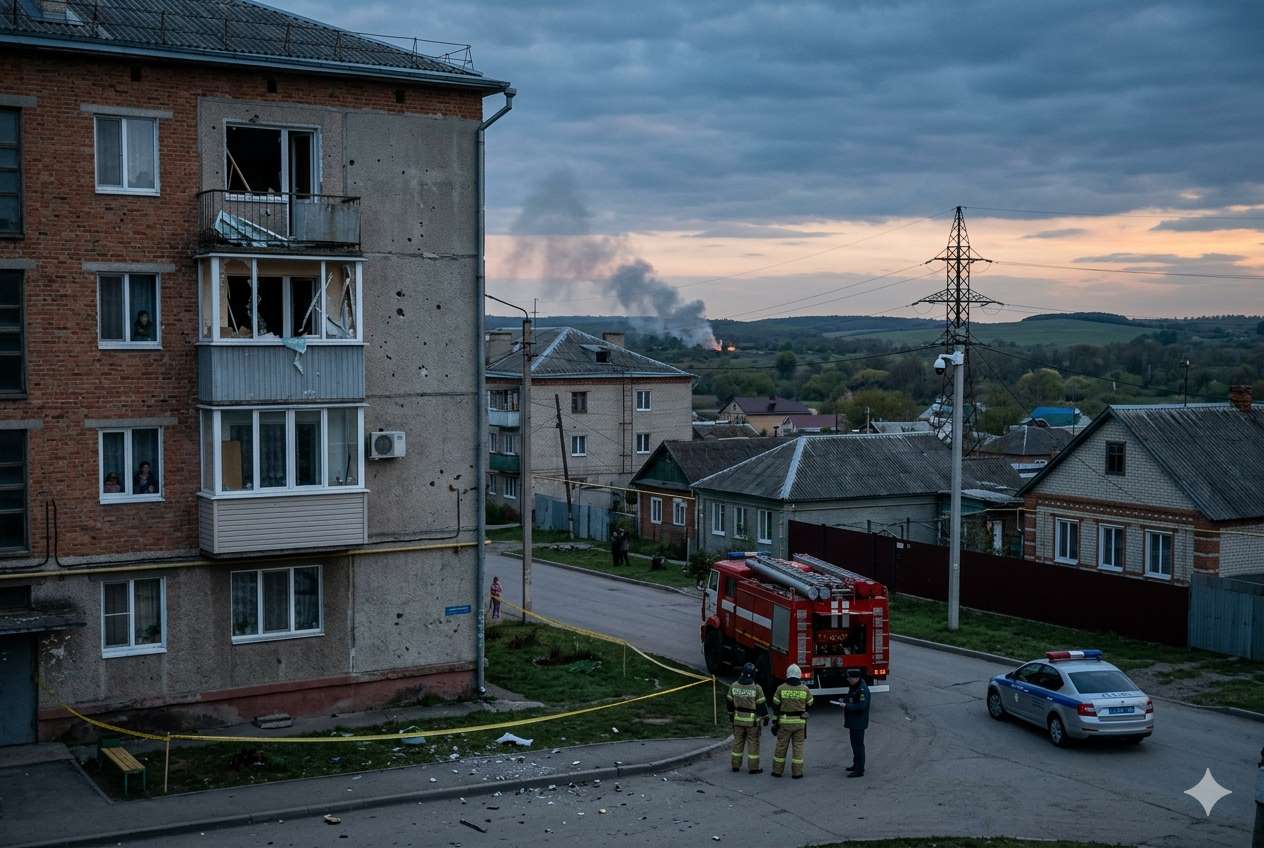
Local authorities in Belgorod and Kursk report structural damage while independent monitors track a shift in aerial tactics.
April 16, 2026
Last Updated: 02:15 PM
By Staff Writer, Global War News
A new wave of unmanned aerial vehicle (UAV) activity has been reported across Russia’s western border regions over the last 12 hours. According to statements released via Telegram by the governors of the Belgorod, Kursk, and Bryansk Oblasts, air defense units were engaged in intercepting multiple “aircraft-type” drones. While the Russian Ministry of Defence has stated that the majority of the threats were neutralized, local reports suggest that debris from these interceptions has caused localized fires and damage to civilian infrastructure.
These incidents come as independent monitoring groups, including those tracking transponder data and social media footage, note a persistent increase in the frequency of long-range drone deployments. While the source of the drones is not officially confirmed in every instance, Russian regional officials have consistently attributed these incursions to the Ukrainian military.
Interceptions in Belgorod and Kursk
In Belgorod, Governor Vyacheslav Gladkov reported that air defense systems shot down at least six drones approaching the regional capital. According to Gladkov’s public statement, falling debris struck a residential rooftop in a suburban district, though no casualties were reported. He stated that emergency services were on-site to extinguish a small fire caused by a ruptured power line.
Simultaneously, the Governor of the Kursk Oblast, Alexey Smirnov, issued a series of alerts via his official social media channel. He reported that four UAVs were intercepted near the town of Kurchatov. According to Smirnov, the interceptions occurred several kilometers from the Kursk Nuclear Power Plant, and he emphasized that radiation levels at the facility remain within the normal range. Independent monitors have not verified the exact proximity of the drone flight paths to the plant, but the frequency of activity in this sector has prompted heightened security protocols.
Independent Monitoring and Technical Shifts
Independent monitoring groups, such as those associated with the Conflict Intelligence Team (CIT), have noted that the current wave of activity involves a variety of UAV models. Some observers suggest that the flight patterns indicate an attempt to probe the response times of Russian electronic warfare (EW) units. According to a report from a named researcher at a European defense think tank, the drones appear to be utilizing lower altitudes and updated navigation systems to circumvent established jamming corridors.
While the Russian Ministry of Defence claimed in a morning briefing that all “hostile targets” were successfully neutralized by “standard air defense assets,” local residents in Bryansk posted unverified footage of smoke plumes near an industrial site. Global War News could not independently verify the authenticity of this footage, and regional authorities have not confirmed any strikes on industrial assets in that specific district.
Analysis: The War of Attrition in the Air
Analysts suggest that this persistent drone activity serves two primary purposes. First, it forces the redeployment of high-end air defense systems, such as the S-400 and Pantsir-S1, away from the frontlines to protect domestic infrastructure. Second, it creates a psychological impact on the populations of border regions, making the distant conflict a daily reality.
According to military observers, this “asymmetric” approach allows a smaller force to project power deep into the territory of a larger adversary at a relatively low cost. However, the reliance on unverified local reports and governor statements creates a “fog of war” that makes it difficult to assess the actual success rate of these missions. Analysts note that as long as the frontlines in the Donbas remain static, both sides are likely to increase the tempo of these long-range aerial exchanges.
Current Status and Civil Defense
As of Thursday afternoon, air raid warnings remain in effect for several districts in the Belgorod Oblast. Local administrations have reinforced “volunteer security patrols” to monitor for unexploded debris. While the immediate physical damage from this wave appears limited to minor property destruction, the cumulative strain on regional logistics and the energy grid remains a concern for local planners.
Sources: This article is based on official statements from the Governors of Belgorod, Kursk, and Bryansk, official briefings from the Russian Ministry of Defence, and reports from the Associated Press and Reuters. Technical observations were cross-referenced with analysis from independent military monitoring groups.
This article is based on publicly available reporting from named international news agencies and attributed official statements. All claims about ongoing events are attributed to their original sources. Analysis sections represent the editorial interpretation of reported facts and do not constitute advocacy for any party to the described conflict. AI tools may be utilized for image generation to assist in explaining complex concepts, as well as for refining grammar, spelling, and other linguistic enhancements. However, all original content is produced, fact-checked, and revised by the editorial team. This publication does not take political positions on active military conflicts.