
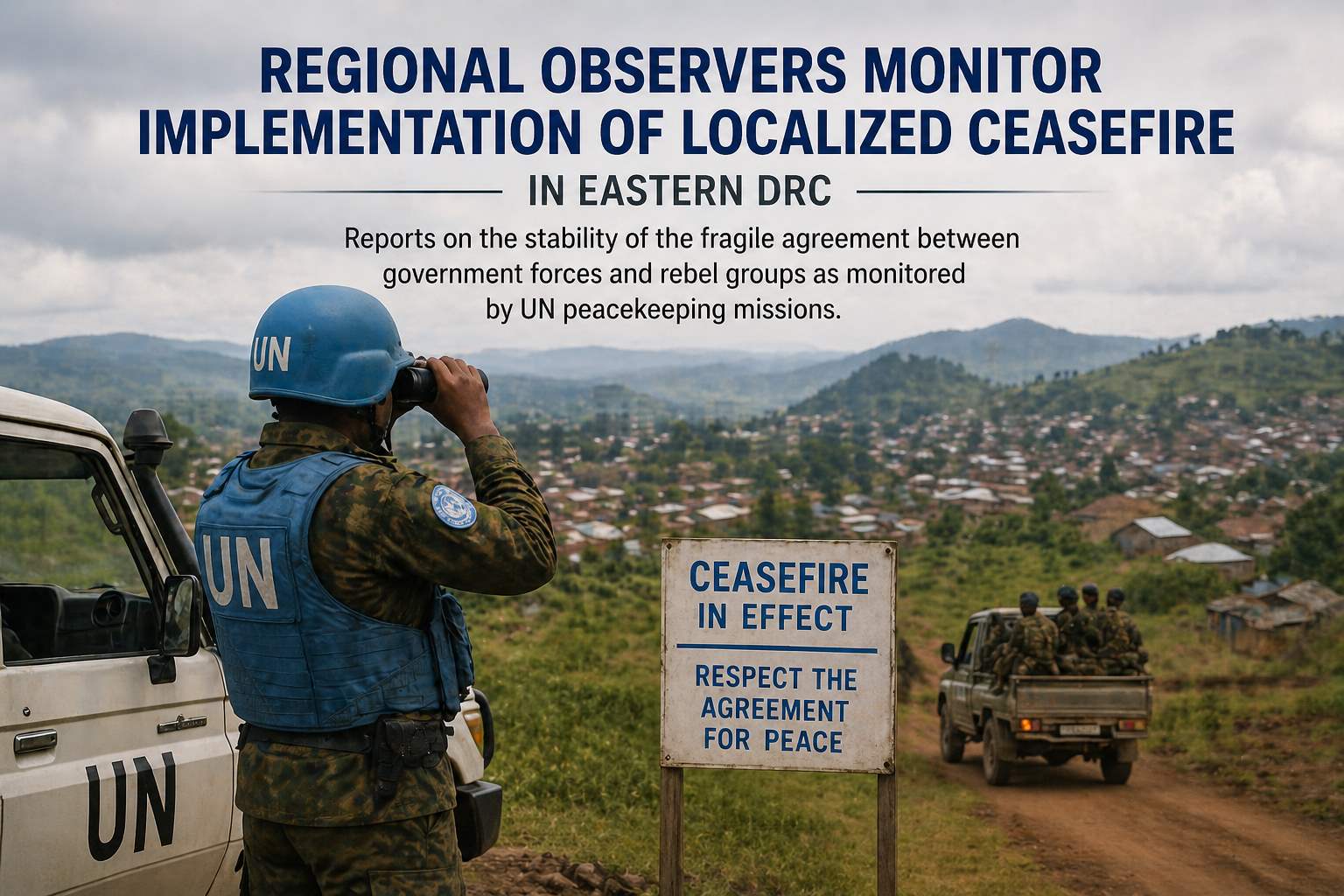
UN peacekeeping missions and regional monitors report a precarious stability following the Washington Accords and Montreux talks, as heavy weaponry remains a primary concern.
April 28, 2026
Last Updated: April 28, 2026
By Global War News Editorial
Regional observers and United Nations peacekeeping officials are closely monitoring a fragile localized ceasefire in the eastern Democratic Republic of the Congo (DRC) following renewed diplomatic efforts in Montreux and Washington. According to reports from the United Nations Organization Stabilization Mission in the DR Congo (MONUSCO), the cessation of hostilities between the Armed Forces of the Democratic Republic of the Congo (FARDC) and the Alliance Fleuve Congo/M23 movement has largely held over the weekend, though tactical positioning remains aggressive.
The current truce, mediated through the “Doha Process” and supported by the US-mediated Washington Accords of December 2025, aims to de-escalate a conflict that has displaced millions and severely disrupted the region’s mineral-rich economy. While official battlefield engagements have decreased, MONUSCO Head James Swan warned during a visit to Goma on Friday that “effective and transparent monitoring” is the only barrier preventing a return to full-scale kinetic warfare.
The stability of the agreement is currently being tested by reports of GPS spoofing and the continued use of offensive drones by non-state actors. Regional monitors from the International Conference on the Great Lakes Region (ICGLR) have noted that while the frontlines near Goma have stabilized, the “gray zone” between combatants remains a site of frequent small-arms skirmishes.
Strengthening the Verification Mechanism
According to a MONUSCO statement released on April 19, 2026, progress was made in Switzerland during talks between government representatives and M23 leadership. A central achievement of these discussions was the operationalization of the Expanded Joint Verification Mechanism Plus (EJVM+). This body is tasked with investigating alleged ceasefire violations and documenting the movement of heavy artillery within restricted zones.
The EJVM+ operates in coordination with the Joint Intelligence Fusion Center. According to UN officials, the primary challenge to the ceasefire’s credibility is the lack of “full freedom of movement” for peacekeepers. Reports from the ground suggest that while state forces have largely complied with monitoring protocols, certain rebel-held corridors remain inaccessible to international observers, complicating efforts to verify the withdrawal of foreign-backed elements.
Humanitarian Corridors and Civilian Impact
The humanitarian cost of the conflict remains the primary driver for the current ceasefire. According to the UN Office for the Coordination of Humanitarian Affairs (OCHA), the strategic city of Goma—which has been under significant pressure since early 2025—is central to current stabilization efforts.
The ceasefire has reportedly allowed for the limited reopening of supply routes that were previously blocked. According to regional trade monitors, the price of basic foodstuffs in Goma has decreased by approximately 12% since the Montreux progress report was publicized. However, NGOs operating in North Kivu, including Médecins Sans Frontières (MSF), report that “judicial protection” for civilians remains absent in areas where administrative authority is still contested.
Analysis: The Mineral Dimension and Strategic Stalemate
Analysts suggest that the current localized ceasefire may be a tactical pause rather than a permanent resolution. The eastern DRC is home to vast reserves of coltan and other critical minerals, and control over these extraction sites remains a powerful incentive for all parties to the conflict.
According to a briefing from the Security Council Report in April 2026, international observers note that:
- Resource Conflict: Illegal mining activities are deeply intertwined with the conflict dynamics. Without addressing the economic supply chains of armed groups, localized truces often serve as opportunities for groups to regroup and refortify mining assets.
- Regional Tensions: Persisting mistrust between the DRC and Rwanda continues to undermine the Washington Accords. While the DRC is pressured to neutralize groups like the FDLR, Rwanda is consistently called upon by the UN to withdraw support from the M23.
- Monitoring Limitations: The ceasefire is often described as a “dead letter” in rural sectors where monitoring technology is absent. The recent demand by MONUSCO for an end to GPS jamming highlights the evolving technological nature of this warfare.
Closing Summary
As of late Tuesday, the localized ceasefire appears to be holding in the immediate vicinity of Goma and Sake, though tensions remain high in the Masisi and Rutshuru territories. The International Board of Peace continues to press for a formal signing of all eight protocols outlined in the Doha Framework. We will continue to monitor official reports from the EJVM+ as they verify recent claims of unauthorized troop movements.
Sources: This report is based on official statements from MONUSCO, the UN Security Council Report (April 2026 Monthly Forecast), and press releases from the Southern African Development Community (SADC). Additional data provided by the International Conference on the Great Lakes Region (ICGLR) and ReliefWeb.
This article is based on publicly available reporting from named international news agencies and attributed official statements. All claims about ongoing events are attributed to their original sources. Analysis sections represent the editorial interpretation of reported facts and do not constitute advocacy for any party to the described conflict. AI tools may be utilized for image generation to assist in explaining complex concepts, as well as for refining grammar, spelling, and other linguistic enhancements. However, all original content is produced, fact-checked, and revised by the editorial team. This publication does not take political positions on active military conflicts.