
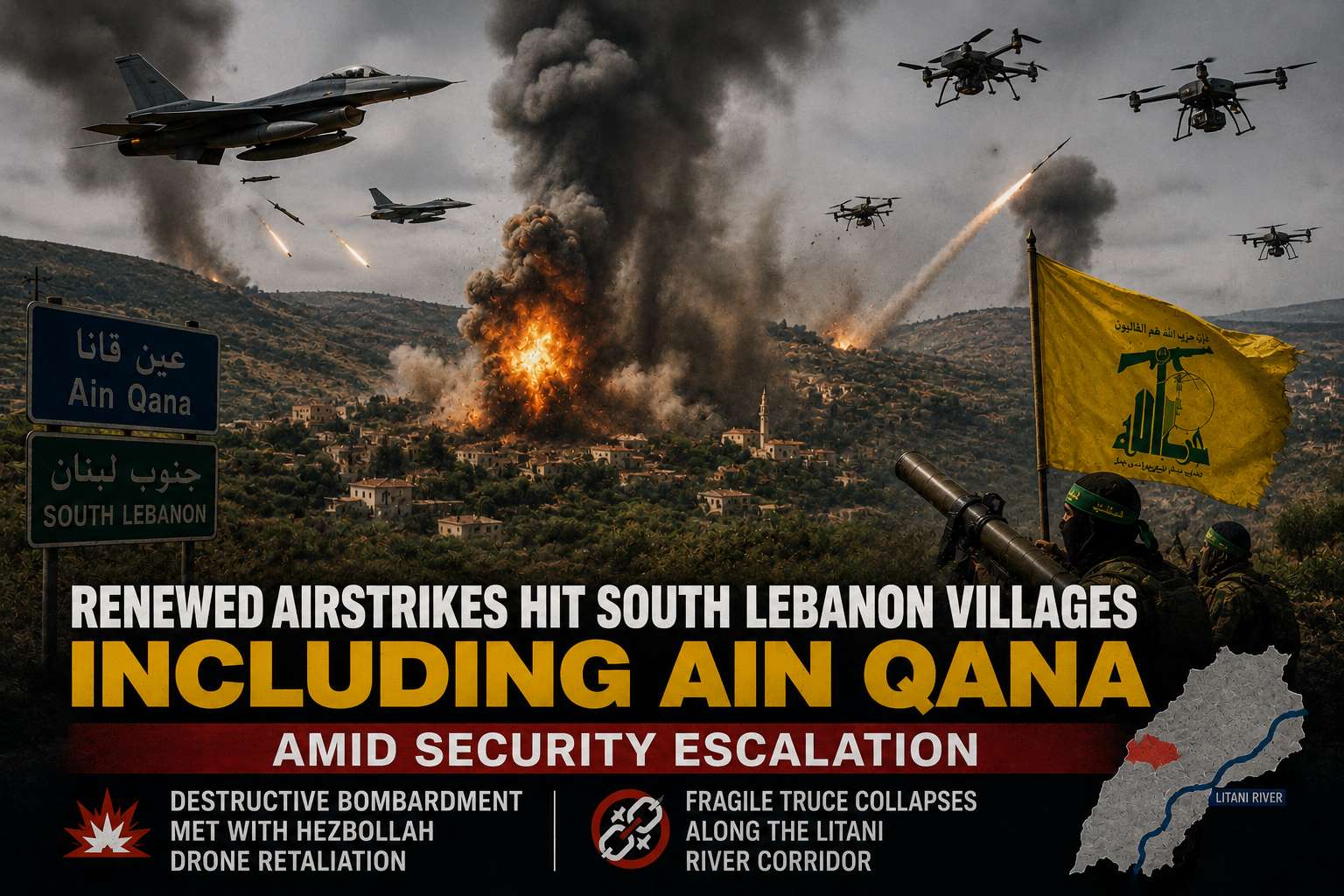
Destructive Bombardment Met with Hezbollah Drone Retaliation as Fragile Truce Collapses Along the Litani River Corridor
Publication Date: June 1, 2026
Last Updated: June 1, 2026
Byline: Global War News Editorial
Air operations intensified significantly across southern Lebanon over the weekend as the conflict between the Israel Defense Forces (IDF) and Hezbollah shattered a series of nominal diplomatic extensions. According to field reports published by the Lebanese National News Agency, Israeli fighter jets and unmanned aerial vehicles conducted heavy bombardment cycles targeting residential neighborhoods and tactical infrastructure across multiple towns, including Ain Qana, Nabatieh al-Fawqa, Kfarjouz, and Haboush.
The strike on Ain Qana, located in the Iqlim al-Tuffah ridge section, followed an explicit forced evacuation order issued by the Israeli military. Footage acquired by the Associated Press confirmed that Israeli warplanes struck the central perimeter of the village approximately one hour after the IDF distributed emergency digital notices instructing remaining residents to evacuate their homes and move at least 1,000 meters into open land. The subsequent missile strikes destroyed multiple residential structures and sent large columns of smoke over the mountainous terrain, though initial municipal assessments did not confirm immediate civilian fatalities due to the prior exit warning.
In response to the widening aerial campaign, Hezbollah launched a series of retaliatory operations utilizing explosive-laden first-person view (FPV) drones and short-range rocket salvos directed at military staging grounds in northern Israel. In separate operational communiqués released via its media channels, the group claimed responsibility for 21 targeted strikes within a 24-hour window, including drone attacks on an IDF staging area near the Shlomi settlement and localized artillery barrages hitting Nahariya.
Context and Background
The current war in Lebanon erupted on March 2, 2026, following a severe breakdown of the long-standing November 2024 truce. While a temporary, US-mediated ceasefire was conceptually established on April 16, 2026, and subsequent agreements extended the nominal pause—including a 45-day extension signed on May 15—the security framework has suffered from continuous erosion on the ground. Israeli authorities have maintained that localized kinetic strikes are required to enforce border demilitarisation terms and prevent a renewed militant infrastructure buildup. Conversely, Lebanese state representatives have condemned the operations as persistent violations of sovereign airspace and signed truces.
The strategic focus of the war shifted fundamentally on May 31, 2026, when the IDF released verified operational footage showing armored columns crossing the Litani River for the first time in the campaign. Following this crossing, Israeli forces advanced to capture the historic Beaufort Castle and its adjacent ridge line, which overlooks the Litani Valley and the city of Nabatieh.
Israeli Prime Minister Benjamin Netanyahu announced on Sunday that he had formally instructed the military to expand its ground maneuvers in Lebanon. This territorial push north of the Litani River prompted the immediate expansion of Israeli air raid alerts and evacuation notices, pushing the active combat zone toward the Zahrani River line and directly entangling defensive positions in villages like Ain Qana.
Economic and Humanitarian Impact
The renewed expansion of the combat zone has aggravated an unprecedented humanitarian emergency within the country. According to consolidated data published by the Lebanese Health Ministry on May 31, the cumulative death toll inside Lebanon since March 2 has reached 3,371 individuals, with another 10,129 registered as wounded. Over 1.2 million citizens—representing more than 20 percent of Lebanon’s total domestic population—have been displaced from their municipalities, overwhelming public shelters in Beirut and Mount Lebanon.
The material destruction of basic infrastructure has severely disrupted the agrarian economy of southern Lebanon. UN agencies, including the Food and Agriculture Organization (FAO) and the World Food Programme (WFP), reported that early 2026 projections indicated roughly 961,000 people across Lebanon would face acute food insecurity by mid-summer. Analysts note that the systematic bombardment of small agricultural towns like Ain Qana, paired with the structural destruction of the main bridges spanning the Litani River, has effectively severed vital regional distribution networks, causing local market access to collapse.
On the northern Israeli side of the frontier, the economic toll is reflected in the prolonged displacement of tens of thousands of residents from the Upper Galilee. Local administrative registries indicate that persistent tracking of Hezbollah suicide drones has frozen regional agricultural output and caused tourism revenues to drop to near zero, with municipal tracking services recording two civilian fatalities within Israel alongside dozens of localized structural impacts since the March escalation began.
International Reactions and Stalled Diplomacy
The sudden surge in kinetic activity beyond the Litani River has drawn sharp international rebukes and complicated broader geopolitical negotiations. French Foreign Ministry representatives issued an urgent call for restraint, stating that the expansion of ground maneuvers and the bombardment of evacuated villages directly undermine the diplomatic protocols established during the mid-May talks. Diplomatic sources indicated that France has requested an emergency consultation block within the United Nations Security Council to review adherence to Resolution 1701.
The military escalation is deeply linked to wider regional dynamics. A separate, fragile United States–Iran diplomatic understanding reached in April has been heavily tested by the resumption of full-scale war along the Blue Line. While regional mediators in Doha and Islamabad had attempted to argue that broader truces should encompass the Lebanese theater, US and Israeli officials have consistently stated that operations to disarm Hezbollah remain independent of external diplomatic tracks.
The Lebanese government has publicly criticized Hezbollah’s independent rocket actions for exposing the state to catastrophic damage, even as it formally protested the IDF’s destruction of civilian housing and healthcare facilities to international legal bodies.
Analysis: What This Could Mean
Military analysts suggest that the airstrikes hitting Ain Qana and surrounding villages represent a preparatory softening of territory designed to insulate the IDF’s newly established positions on the Beaufort Ridge. By utilizing highly precise aerial munitions to dismantle suspected firing positions and storage nodes within the Iqlim al-Tuffah hills, the Israeli military is attempting to push Hezbollah’s tactical rocket teams beyond effective striking distance of the advancing ground forces.
However, observers note that this strategy faces severe operational limitations. The extensive use of low-altitude, radar-evading FPV drones by Hezbollah demonstrates that territorial displacement does not automatically eliminate asymmetric retaliatory capacity. Because these unmanned aerial systems require minimal physical infrastructure to launch and can navigate low topographies, they allow mobile militant cells to inflict precise damage on armored vehicles and assembly points even within zones heavily monitored by conventional air superiority platforms.
With the IDF actively moving toward the outer perimeters of Nabatieh and repeating instructions for civilian populations to flee north of the Zahrani River, the conflict appears to be transitioning into a prolonged war of attrition. Unless the upcoming diplomatic rounds scheduled in Washington can forge an enforceable disarmament mechanism that satisfies Israel’s security requirements while respecting Lebanese territorial integrity, the border regions of both nations remain locked in a destructive cycle that threatens to completely depopulate the southern governance districts through the remainder of 2026.
Source Disclosure: This report is compiled using official field bulletins from the Lebanese National News Agency, public video evidence from the Associated Press, and formal operational press briefs issued by the Israel Defense Forces Spokesperson Unit. Statistical data concerning casualties and internal displacement scales are drawn from official updates by the Lebanese Ministry of Public Health, alongside crisis situation analyses published by ReliefWeb and the United Nations World Food Programme. Supplemental tracking of border engagements and political positions is derived from international wire dispatches via Reuters, Agence France-Presse (AFP), and Qatar News Agency (QNA).
This article is based on publicly available reporting from named international news agencies and attributed official statements. All claims about ongoing events are attributed to their original sources. Analysis sections represent the editorial interpretation of reported facts and do not constitute advocacy for any party to the described conflict. AI tools may be utilized for image generation to assist in explaining complex concepts, as well as for refining grammar, spelling, and other linguistic enhancements. However, all original content is produced, fact-checked, and revised by the editorial team. This publication does not take political positions on active military conflicts.