
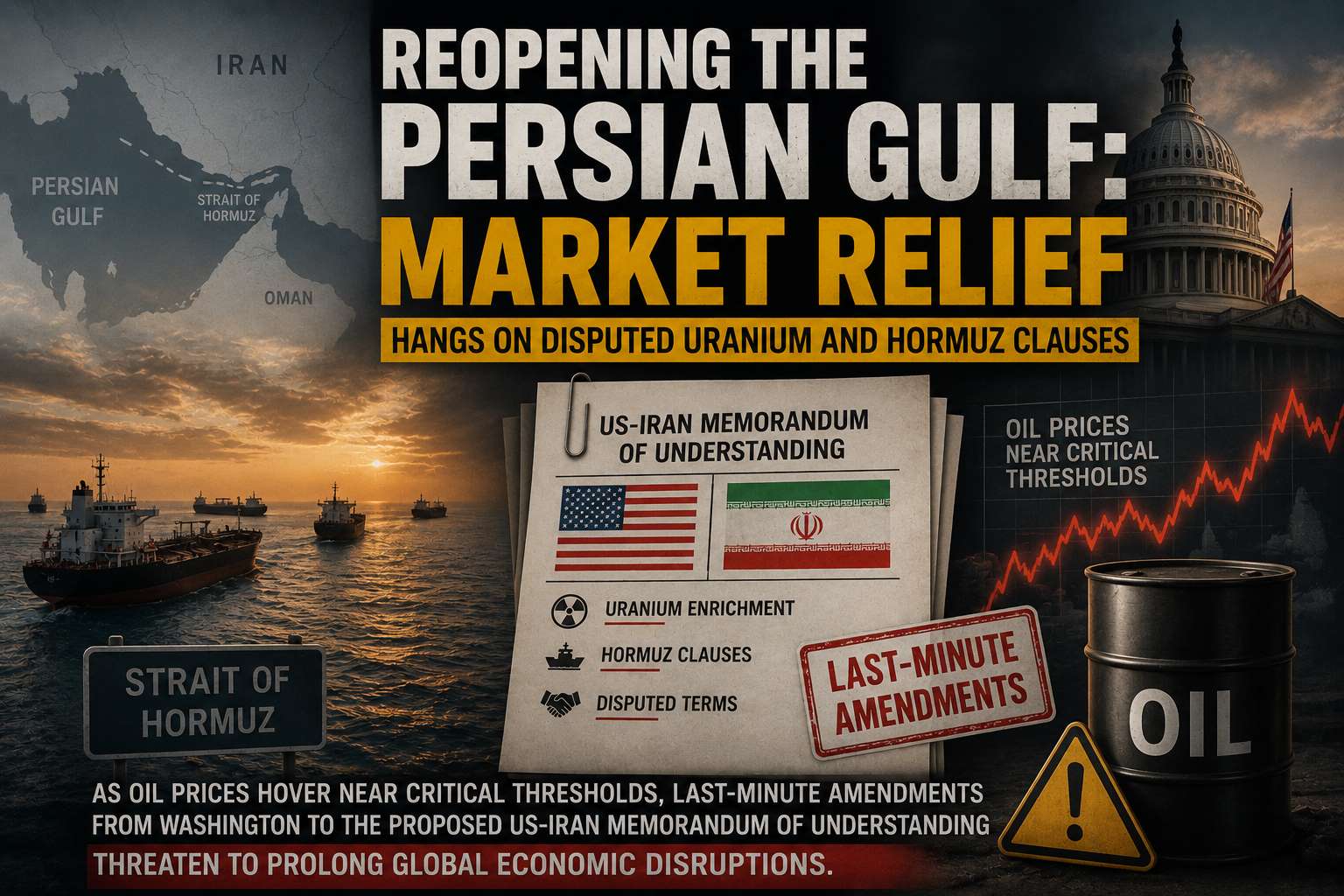
As oil prices hover near critical thresholds, last-minute amendments from Washington to the proposed US-Iran memorandum of understanding threaten to prolong global economic disruptions.
Publication Date: June 1, 2026
Last Updated: June 1, 2026
Byline: Staff Writer, Global War News
Efforts to finalize a 60-day ceasefire framework aimed at ending the war between the United States, Israel, and Iran face a fresh round of diplomatic hurdles. US President Donald Trump has returned the draft text of the memorandum of understanding to negotiators, demanding substantial revisions. The required amendments focus on two highly contentious points: the immediate destruction or removal of Iran’s highly enriched uranium stockpile, and stricter, toll-free enforcement mechanisms for the reopening of the Strait of Hormuz.
The introduction of these tougher terms comes just as global energy markets signaled cautious optimism over a potential de-escalation. International commodity desks had begun factoring in a return of unhindered crude traffic through the Persian Gulf, which previously handled approximately 20% of global oil supplies. However, the emerging diplomatic friction between Washington’s demands and Tehran’s public pushback has injected fresh volatility into global supply chains, leaving commercial shipping firms and central banks in a state of suspended anticipation.
While the White House seeks definitive timelines for verifying the neutralization of Iran’s buried nuclear materials, Iranian state media and official sources have heavily disputed these assertions. Tehran maintains that its domestic nuclear program remains outside the scope of the current truce framework, insisting instead on the immediate unfreezing of assets held in foreign banks and a formal lifting of the maritime blockades.
The Core Disputes: Uranium and Waterways
The potential breakthrough hinges on a 60-day truce mediated primarily by Pakistan and Qatar. Under the baseline framework reported by Axios, the United States would suspend its naval blockade of Iranian ports, which has been maintained since April 13. In return, Iran would be required to clear naval mines from the Strait of Hormuz, halt hostilities across regional fronts, including Lebanon, and allow commercial shipping to resume.
The latest friction point centers on what happens to the highly enriched uranium that Iran amassed following the infrastructure strikes of June 2025. According to senior US administrative officials cited by international media outlets, President Trump requested his national security team to insert explicit verification protocols regarding how and when the United States can secure and oversee the removal of roughly ten warheads’ worth of highly enriched material.
Tehran has consistently pushed back against these additions. The state-affiliated Fars News Agency, citing well-informed diplomatic sources, categorized the claims regarding mandated uranium destruction as fundamentally baseless. Iranian Foreign Ministry statements have reinforced that a preliminary consensus on financial adjustments and maritime access must precede any technical talks concerning its atomic infrastructure.
Equally problematic is the legal framework governing the Strait of Hormuz. President Trump asserted via social media that the waterway must immediately open with no transiting fees, an interpretation supported by US Secretary of State Marco Rubio, who noted the goal is a completely unencumbered flow of commerce. Conversely, Iranian maritime authorities have indicated that the strait will remain under localized “special measures.” This implies a framework where Tehran intends to enforce traffic tracking and potentially restrict vessels it designates as hostile, directly challenging traditional interpretations of international maritime law.
Global Economic Significance
The financial implications of these delayed negotiations are immediately visible across international energy indices. The prolonged closure of the Strait of Hormuz has already pushed crude benchmarks above the $100-per-barrel mark, triggering localized fuel inflation across import-dependent economies in East Asia and Europe.
| Strait of Hormuz Closure | Economic Toll |
| Pre-War Global Crude Conduit | Roughly 20% of global daily consumption |
| Key Commodity Indices Impacted | Brent Crude, West Texas Intermediate |
| Primarily Affected Import Regions | European Union, India, China |
| Secondary Logistical Disruptions | Global fertilizer shortages, elevated maritime insurance premiums |
Beyond the immediate price of oil, the halting of maritime traffic through the Persian Gulf has disrupted secondary supply chains. Maritime insurance premiums for commercial vessels operating within the western Indian Ocean have remained at record highs. Furthermore, global agricultural sectors are dealing with a shortage of specific chemical fertilizers and feedstocks originating from Gulf petrochemical plants, compounding existing food inflation worries.
Analysis: The Transactional Pivot
What This Could Mean: Political analysts note that the current diplomatic posture represents a significant shift from the maximalist rhetoric observed earlier in the conflict. In March 2026, Washington had publicly insisted on an unconditional surrender from Tehran. The shift toward a negotiated 60-day memorandum of understanding indicates that economic realities, particularly domestic energy price pressures and unstable global financial markets, have driven both administrations toward a transactional arrangement.
However, the late-stage demands introduced by the White House illustrate the deep mistrust underlying the mediation process. By centering the dialogue on the physical removal of the uranium stockpile, the US administration appears determined to secure tangible non-proliferation concessions before granting permanent sanctions relief.
For Iran, the strategy centers on a sequenced “trust and verify” approach. Western intelligence reports suggest that despite extensive damage to Iranian naval and air assets over the past year, a substantial portion of its defensive missile systems remains operational. Consequently, Tehran feels it possesses sufficient asymmetric leverage within the shipping lanes to resist accepting nuclear conditions as a prerequisite for a basic ceasefire.
What to Watch
The immediate path forward depends on the formal response from Iranian negotiators via Pakistani intermediaries in Islamabad. Observers should monitor whether the White House will accept a phased implementation schedule, where the reopening of the strait occurs concurrently with initial verification steps, or if Washington will maintain its stance that nuclear compliance must occur prior to lifting the embargo.
Meanwhile, commercial shipping entities are closely following the actions of the US Navy’s Central Command, which recently issued updated notices to mariners regarding ongoing minesweeping operations north of the Musandam Peninsula. Until a unified text is signed by both capitals, the risk of localized tactical miscalculations in the waterway remains elevated, keeping the global economic outlook highly uncertain.
Source Disclosure Note: This report compiles verified details from international news agencies, including Reuters, the Associated Press, Agence France-Presse (AFP), and regional reporting from Axios, The Times of Israel, and The Guardian. Official statements from the US Executive Branch and the Iranian Foreign Affairs Ministry were used to verify respective diplomatic positions. Financial data points are derived from public commodity market tracking indices.
This article is based on publicly available reporting from named international news agencies and attributed official statements. All claims about ongoing events are attributed to their original sources. Analysis sections represent the editorial interpretation of reported facts and do not constitute advocacy for any party to the described conflict. AI tools may be utilized for image generation to assist in explaining complex concepts, as well as for refining grammar, spelling, and other linguistic enhancements. However, all original content is produced, fact-checked, and revised by the editorial team. This publication does not take political positions on active military conflicts.