
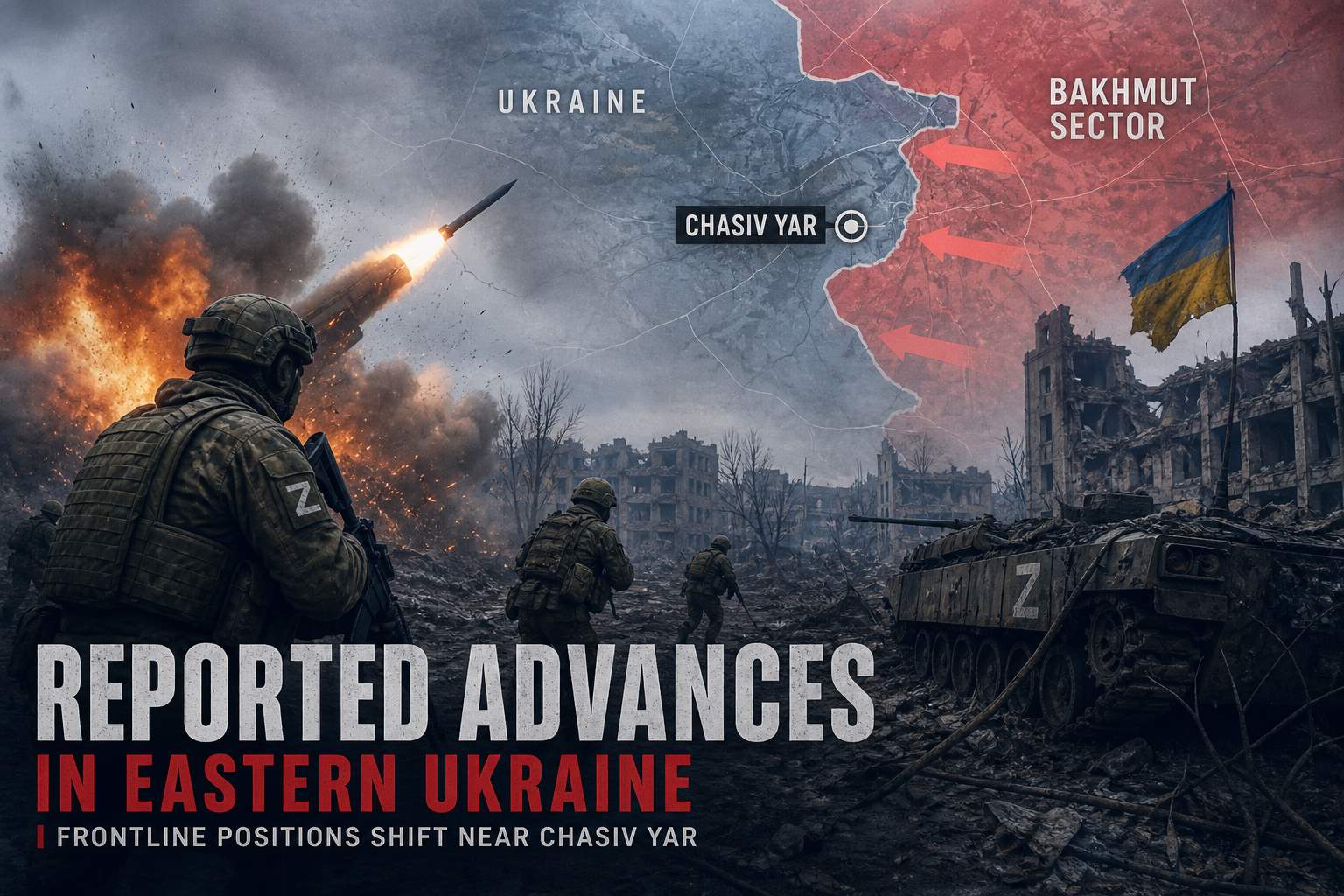
Russian forces reportedly gain ground in the Bakhmut sector as Ukrainian defenses face intensifying artillery and drone strikes.
May 4, 2026
Last Updated: May 4, 2026
By Staff Writer, Global War News
The frontline in eastern Ukraine has seen a series of tactical shifts over the past 48 hours, particularly centered around the strategically significant heights of Chasiv Yar. According to reports from the Ukrainian General Staff and independent military observers, Russian forces have increased the tempo of their offensive operations in the Donetsk region, attempting to capitalize on gaps in local air defense and a persistent advantage in artillery munitions.
Military analysts suggest that the current Russian push is aimed at seizing the high ground of Chasiv Yar, which would provide a significant vantage point for targeting the larger logistics hubs of Kramatorsk and Sloviansk. While the Ukrainian Ministry of Defense stated that its forces continue to hold the majority of the urban center, they acknowledged “difficult conditions” and localized retreats to more defensible positions in the outlying suburban districts.
This escalation follows several weeks of positional warfare characterized by heavy drone usage and electronic warfare interference. The situation remains fluid, with frontline reports indicating that several village outskirts have changed hands multiple times since the start of the week.
The Strategic Importance of Chasiv Yar
Chasiv Yar is located on a ridge that overlooks the surrounding Donbas plains. Since the fall of Bakhmut in 2023, the town has served as a primary defensive anchor for the Ukrainian military. According to a briefing from the UK Ministry of Defence, losing control of this elevation would likely expose Ukrainian supply lines to direct fire and facilitate a broader Russian advance toward the western borders of the Donetsk Oblast.
The town’s defense is complicated by the Siverskyi Donets-Donbas Canal, which serves as a natural barrier but also limits the mobility of defending forces if bridges are compromised. Reuters reported that Russian aviation has intensified the use of “glide bombs”, heavy munitions equipped with guidance wings, to strike fortified Ukrainian positions from distances that remain outside the reach of most tactical air defenses.
Recent Field Reports and Tactical Shifts
According to a report by the Institute for the Study of War (ISW), geolocated footage indicates that Russian motorized units have advanced into the easternmost “Kanal” micro-district. However, Ukrainian officials maintained in a public statement that these units have not yet established a permanent presence and are being engaged by mobile reserve groups.
The intensity of the fighting is reflected in the high volume of reported strikes. Local Ukrainian military administrators reported over 200 instances of shelling within a 24-hour period. Conversely, the Russian Ministry of Defense claimed in its daily briefing that its forces had “improved their tactical positions” and repelled several Ukrainian counterattacks in the vicinity. These claims could not be independently verified by international news agencies.
Analysis: What This Means for the Summer Campaign
Observers note that the pressure on Chasiv Yar appears to be part of a broader Russian strategy to overstretch Ukrainian reserves ahead of the summer months. By forcing Ukraine to commit its most experienced brigades to the defense of the Donbas, Russian planners may be seeking to create vulnerabilities in other sectors, such as Kharkiv to the north or Zaporizhzhia to the south.
The timing of this advance is also significant from an economic and logistical perspective. Analysts have suggested that Russia is attempting to achieve a major breakthrough before the full volume of newly approved Western military aid reaches the frontline. If Russian forces manage to bypass the canal and secure the ridge, the cost of a Ukrainian counter-effort would increase significantly, both in terms of manpower and Western-supplied hardware.
Outlook
As of May 4, the situation at Chasiv Yar remains the most active and volatile sector of the conflict. The ability of Ukrainian forces to hold the high ground will likely depend on the speed of ammunition deliveries and the effectiveness of their drone-jamming capabilities. Meanwhile, the continued Russian reliance on glide bombs suggests that the air superiority contest over the Donbas will be the decisive factor in whether the frontline stabilizes or continues to shift westward.
Source Disclosure: This report relies on official statements from the Ukrainian General Staff and the Russian Ministry of Defense. Secondary reporting was sourced from Reuters, the Associated Press (AP), and the Institute for the Study of War (ISW). Topographical and strategic context was provided by UK Ministry of Defence intelligence updates.
This article is based on publicly available reporting from named international news agencies and attributed official statements. All claims about ongoing events are attributed to their original sources. Analysis sections represent the editorial interpretation of reported facts and do not constitute advocacy for any party to the described conflict. AI tools may be utilized for image generation to assist in explaining complex concepts, as well as for refining grammar, spelling, and other linguistic enhancements. However, all original content is produced, fact-checked, and revised by the editorial team. This publication does not take political positions on active military conflicts.