
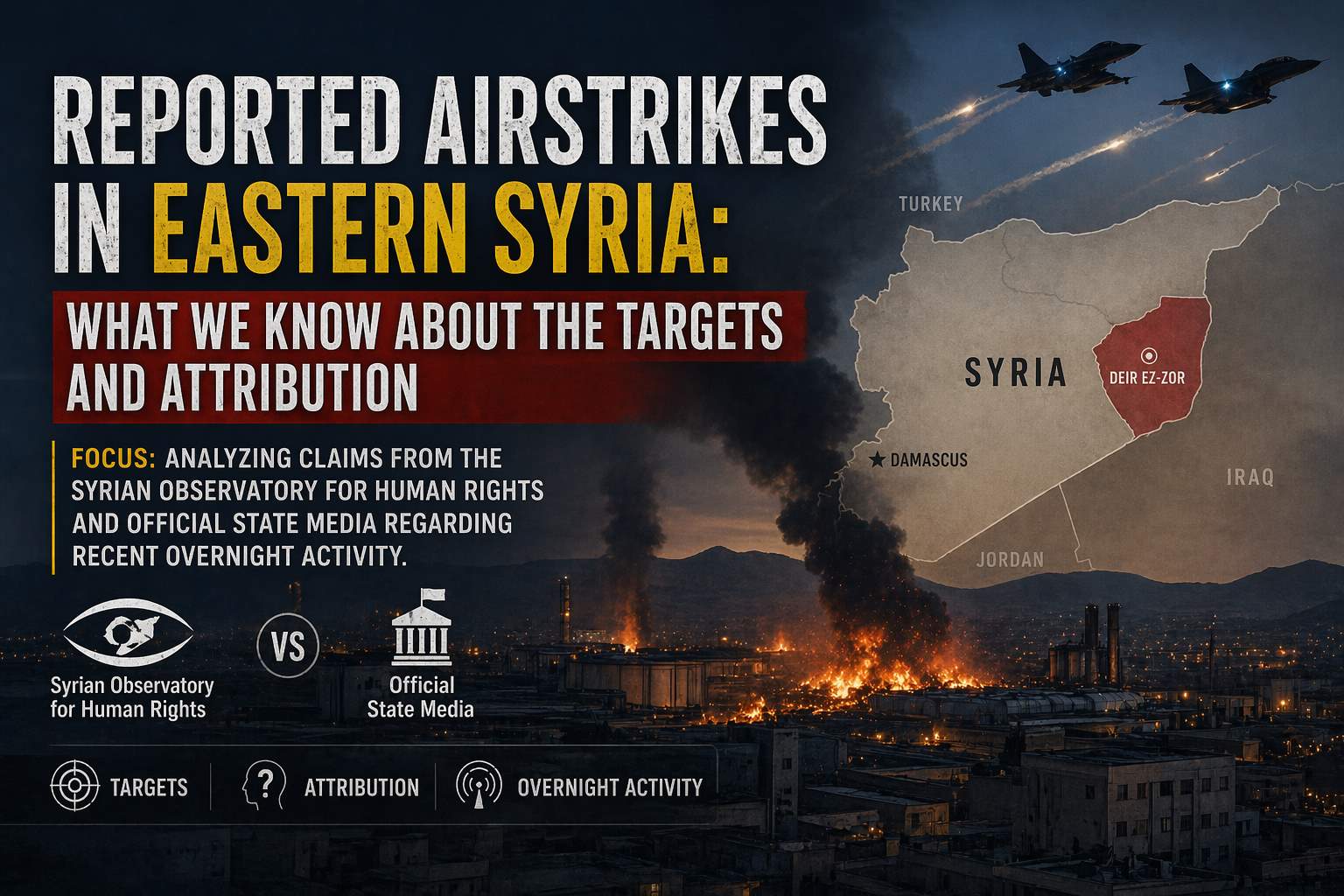
Overnight activity in the Deir ez-Zor region highlights a complex landscape of shifting alliances and persistent insurgencies
April 24, 2026
Last Updated: 16:30 UTC
By Staff Writer, Global War News
Recent reports of overnight airstrikes in Eastern Syria have once again focused international attention on the Deir ez-Zor Governorate, a region that remains a volatile flashpoint for global and local powers. According to reports from the UK-based Syrian Observatory for Human Rights (SOHR) and Syrian state media outlets, several explosions were heard in the vicinity of known military installations and logistical hubs.
While details remain fluid, the activity follows a period of significant territorial shifts in early 2026. Following a Syrian government offensive in January, much of the eastern countryside was transitioned from the control of Kurdish-led forces to the Syrian transitional government under a US-brokered ceasefire. The recent strikes suggest that despite these political agreements, the security environment in the Euphrates River valley remains highly contested.
The Nature of the Targets
The strikes reported overnight appear to have targeted two distinct types of infrastructure, according to monitoring groups and local witnesses:
- Insurgent Hideouts: SOHR reported that several strikes hit “desert hideouts” in the Ma’adan and Al-Bukamal regions. These areas have seen a resurgence of Islamic State (ISIS) activity in recent months. Analysts note that these strikes likely targeted mobile cells and small-scale training camps.
- Logistical Nodes: Syrian state media reported that “hostile aircraft” targeted infrastructure near the Deir ez-Zor military airport. While official statements did not specify the nature of the damage, independent observers suggest these sites often serve as warehouses for redirected fuel and military supplies.
The geographic focus on Deir ez-Zor is significant. As a hub for the country’s remaining oil and gas fields, control over its infrastructure is essential for the economic stability of the Syrian state.
Claims and Attribution
As is common with activity in this sector, attribution remains a matter of significant dispute between regional actors.
- SOHR Reports: The monitoring group has attributed several recent waves of activity to the ongoing US-led “Operation Hawkeye Strike.” According to SOHR, these operations are specifically designed to prevent extremist groups from regrouping in the vacuum left by shifting frontline positions.
- Official State Media: Syria’s state-run news agency has characterized the strikes as “aggression” but has often been cautious in naming a specific perpetrator immediately following overnight events. In previous instances this month, state media has blamed “foreign entities” seeking to destabilize the January ceasefire.
- International Silence: As of the time of publication, no member of the US-led coalition has issued a formal statement regarding activity within the last 24 hours. Historically, coalition forces confirm strikes only after detailed damage assessments are completed.
Analysts have suggested that the ambiguity in attribution serves multiple parties, allowing for tactical operations to proceed without immediate diplomatic escalation.
Context: A Fractured Security Landscape
To understand why Eastern Syria remains under fire, it is necessary to look at the current security map. Since January 2026, the Syrian government has assumed control of international border crossings and major oil fields previously held by the Syrian Democratic Forces (SDF).
This transition has been complicated by the resurfacing of ISIS cells. According to reports from the International Crisis Group, these groups have taken advantage of the transition period to launch hit-and-run attacks on government convoys. Consequently, the air campaign—whether conducted by the Syrian air force, its allies, or international coalitions—has become a permanent feature of the regional landscape.
Analysis: The Conflict of Interests
Observers note that Eastern Syria is currently a theater where multiple “shadow wars” overlap. While the primary stated goal for most air activity is the elimination of extremist cells, the strikes also serve as a mechanism for different powers to signal their presence.
For the Syrian transitional government, maintaining security in Deir ez-Zor is a test of its ability to govern the territories ceded by the SDF. For international actors, continued air operations ensure that the region does not revert to a safe haven for global terror networks. It remains unclear how long this “policing from the air” can remain effective without a more permanent stabilization force on the ground.
Closing Summary
The overnight activity in Eastern Syria confirms that the Deir ez-Zor region remains the epicenter of an unresolved security crisis. With conflicting reports from state media and independent monitors, the full scope of the damage and the identity of the actors involved may take several days to clarify. What is certain is that the strategic importance of the Syrian east ensures that it will remain under close aerial surveillance for the foreseeable future.
Sources:
This article is based on reports from the Syrian Observatory for Human Rights (SOHR), the Syrian Arab News Agency (SANA), and recent briefings from the UN Security Council on the political and humanitarian situation in Syria. Tactical details regarding “Operation Hawkeye Strike” were sourced from US military statements released earlier in 2026.
This article is based on publicly available reporting from named international news agencies and attributed official statements. All claims about ongoing events are attributed to their original sources. Analysis sections represent the editorial interpretation of reported facts and do not constitute advocacy for any party to the described conflict. AI tools may be utilized for image generation to assist in explaining complex concepts, as well as for refining grammar, spelling, and other linguistic enhancements. However, all original content is produced, fact-checked, and revised by the editorial team. This publication does not take political positions on active military conflicts.