
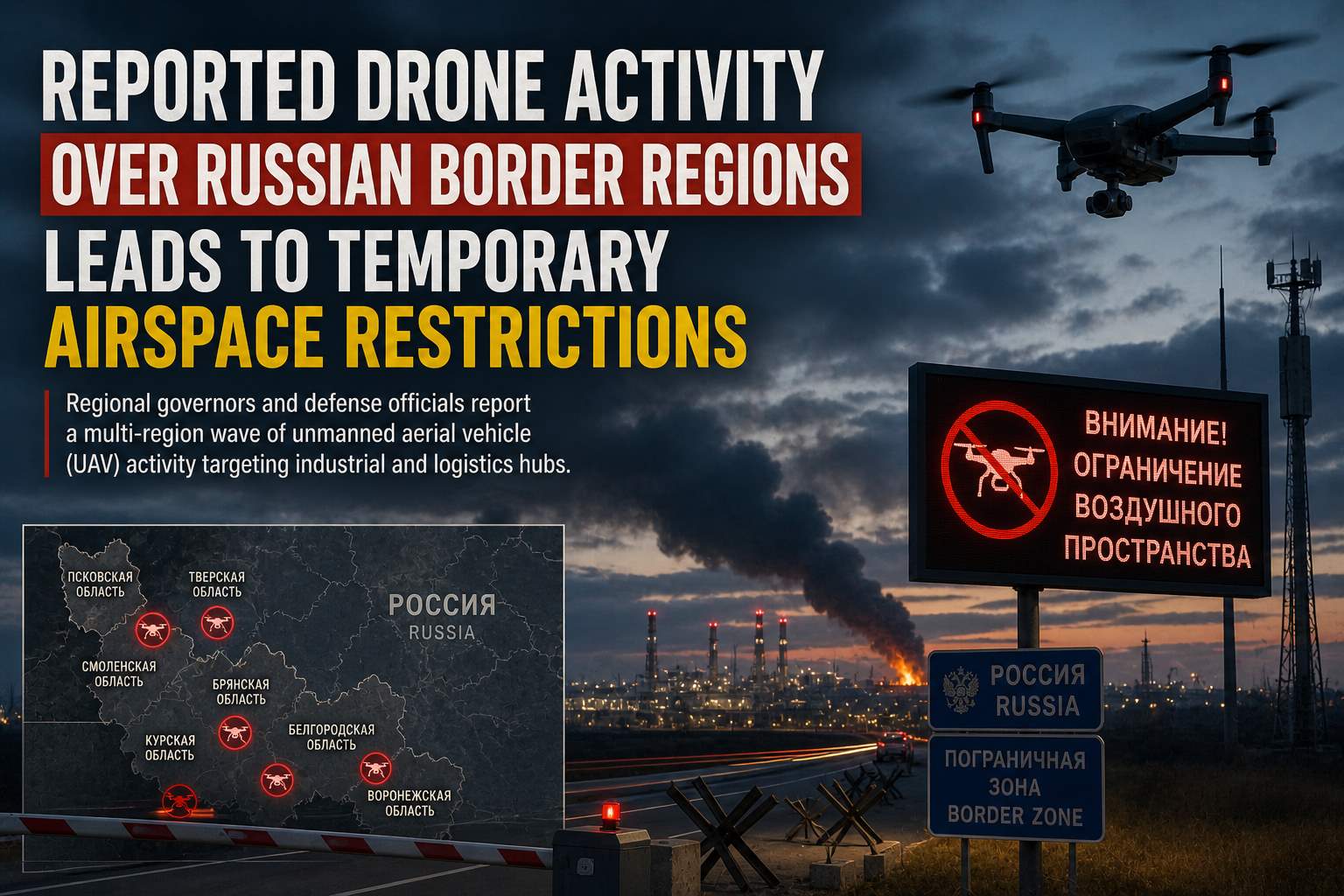
Regional governors and defense officials report a multi-region wave of unmanned aerial vehicle (UAV) activity targeting industrial and logistics hubs.
May 5, 2026
By Global War News Editorial
Authorities in several Russian border and central regions reported a significant wave of drone activity overnight into Tuesday, leading to temporary airspace restrictions and the activation of air defense systems across a broad geographic arc. According to a briefing from the Russian Ministry of Defense, on-duty air defense units intercepted and destroyed at least 43 fixed-wing unmanned aerial vehicles (UAVs) between 7:00 a.m. and 9:00 a.m. Moscow time today.
The activity spanned the territories of the Bryansk, Kursk, Kaluga, Smolensk, Tula, and Volgograd regions, as well as the Moscow region and the Republic of Adygea. Regional governors reported varied levels of impact, with Governor Alexander Drozdenko of the Leningrad region confirming a fire at the Kirishinefteorgsintez (KINEF) oil refinery—one of Russia’s largest northwestern petroleum facilities. Drozdenko stated that while the fire in the industrial zone had been contained, the “enemy’s main target” appeared to be the refinery’s infrastructure.
Context and Background
The surge in UAV activity follows a month of intensified cross-border engagements. Throughout April 2026, both Russian and Ukrainian forces reported record-breaking numbers of drone launches, marking a shift toward sustained, long-range aerial attrition. The targeting of oil refineries and military-industrial facilities has become a primary tactical focus for Ukrainian long-range units seeking to disrupt Russian fuel logistics and the production of high-precision components.
Airspace restrictions in Russia are managed by the Federal Air Transport Agency (Rosaviatsia). When “unidentified objects” are detected, “Carpet” plans are often activated, requiring all civilian aircraft to land or exit a designated area immediately. This has led to frequent delays at major hubs, including Pulkovo in St. Petersburg and airports in the Moscow aviation cluster, complicating domestic logistics and commercial travel.
Analysis: Industrial Vulnerability and Defensive Stretches
The geographic spread of the May 5 attacks—stretching from the Leningrad region in the northwest to Volgograd in the south—indicates a significant reach by Ukrainian-operated drones. Analysts suggest that these operations are designed to force a redistribution of Russian air defense assets away from the frontline to protect critical interior infrastructure.
A notable development in this wave is the reported strike on the KINEF refinery. Analysis of the facility’s output suggests it processes approximately 17 to 20 million tons of crude oil annually. Damage to such large-scale refineries can lead to localized fuel shortages and inflationary pressure on the Russian domestic economy. Furthermore, reports of a strike in Cheboksary, nearly 1,200 kilometers from the Ukrainian border, suggest the deployment of new classes of long-range cruise-missiles and drones, such as the “Flamingo” model cited by Ukrainian officials. These incidents underscore a growing vulnerability in industrial sites previously considered out of range for tactical engagement.
Current Status and Outlook
As of Tuesday afternoon, airspace restrictions in the affected regions have reportedly been lifted, though local emergency services remain on high alert. The Kremlin has proposed a unilateral ceasefire for May 9 to mark Victory Day, though Ukrainian President Volodymyr Zelenskyy has stated that any pause would be met with “responses in kind” rather than a formal acceptance of terms. With the Victory Day parade approaching, security measures in Moscow and surrounding regions are expected to remain at their highest levels, including increased electronic warfare jamming that may continue to disrupt mobile and GPS signals for civilian users.
Source Disclosure: This report is based on official statements from Russian regional governors Alexander Drozdenko and Oleg Nikolayev, briefings from the Russian Ministry of Defense, reporting from Reuters and The Moscow Times, and operational updates from the Ukrainian General Staff.
This article is based on publicly available reporting from named international news agencies and attributed official statements. All claims about ongoing events are attributed to their original sources. Analysis sections represent the editorial interpretation of reported facts and do not constitute advocacy for any party to the described conflict. AI tools may be utilized for image generation to assist in explaining complex concepts, as well as for refining grammar, spelling, and other linguistic enhancements. However, all original content is produced, fact-checked, and revised by the editorial team. This publication does not take political positions on active military conflicts.