
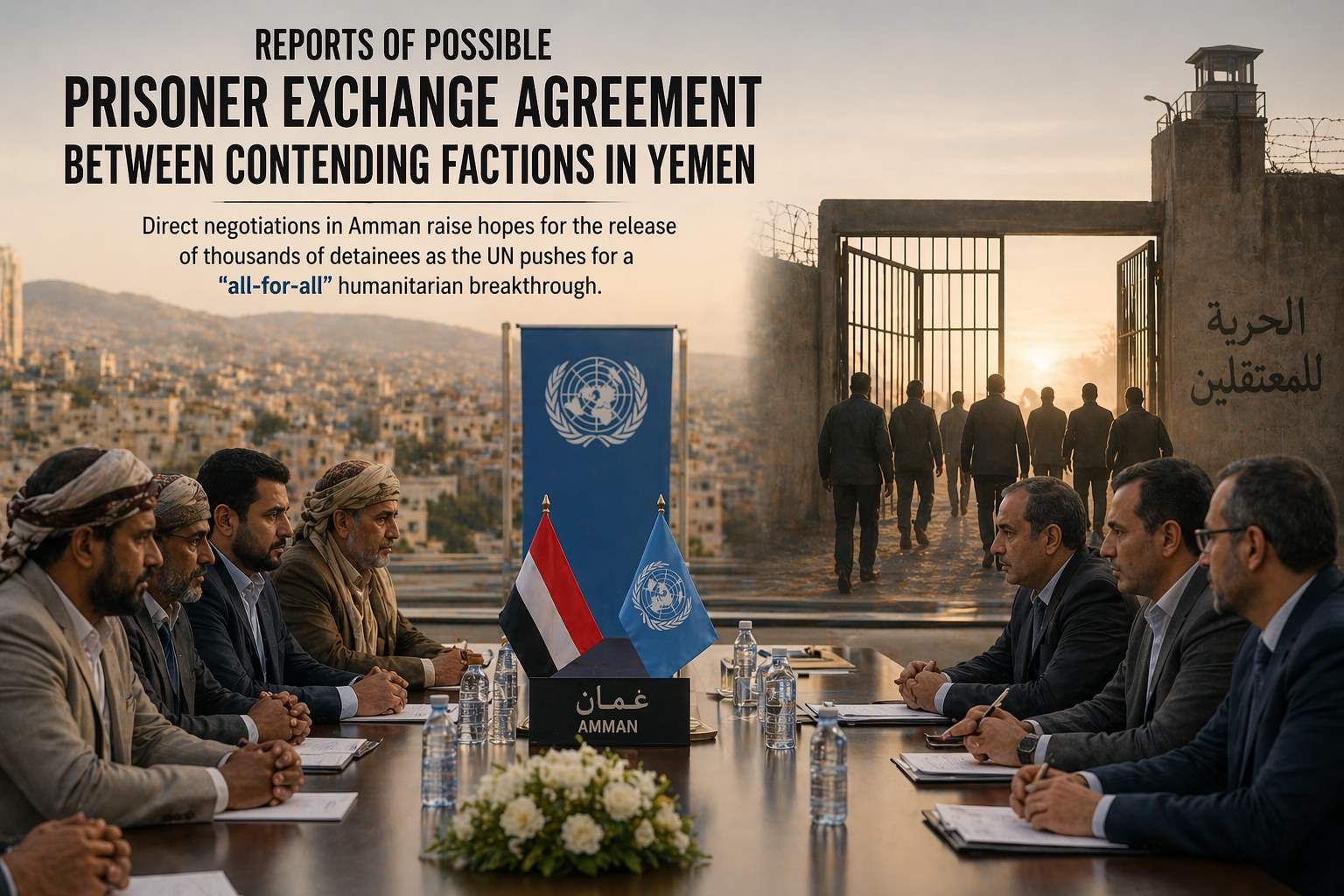
Direct negotiations in Amman raise hopes for the release of thousands of detainees as the UN pushes for a “all-for-all” humanitarian breakthrough.
April 22, 2026
Last Updated: April 22, 2026
By Global War News Editorial
Renewed diplomatic efforts to secure a large-scale prisoner exchange in Yemen have gained momentum this week following high-level briefings at the United Nations. Hans Grundberg, the UN Special Envoy for Yemen, informed the Security Council that the internationally recognized government and the Houthi movement (Ansar Allah) have been engaged in intensive, direct negotiations in Amman, Jordan, to finalize the names for a significant release operation.
The current talks represent the longest continuous round of negotiations on the detainee file since the conflict began over a decade ago. While a formal implementation date has not yet been set, the discussions build upon a preliminary framework established in Muscat in late 2025, which proposed the exchange of approximately 2,900 individuals.
For the millions of Yemenis affected by the war, a successful exchange is viewed not only as a humanitarian necessity but as a vital confidence-building measure that could stabilize the current “de facto” ceasefire and pave the way for a broader political settlement.
The Scope of the Proposed Swap
According to reports from the UN and the International Committee of the Red Cross (ICRC), the proposed agreement is expected to be the largest since the conflict’s inception. The deal reportedly involves the release of 1,700 Houthi-affiliated detainees in exchange for 1,200 individuals held by the Houthis, including soldiers from the government-aligned coalition and several foreign nationals.
While the parties have agreed on the general figures, the “Amman Round” focuses on the technical verification of lists—a process that has historically been the primary cause of delays. According to reporting from Xinhua, both sides have recently traded accusations over the accuracy of these lists, with government advisors suggesting the Houthis have used the delay for political leverage, while Houthi representatives claim the government failed to submit finalized data within the agreed timeframe.
Context: The Stockholm Agreement and the “All-for-All” Principle
The framework for these exchanges is rooted in the 2018 Stockholm Agreement, in which both factions committed to the “all-for-all” principle—the total release of all conflict-related detainees. Despite this commitment, progress has been incremental. The last major exchange occurred in April 2023, when approximately 900 prisoners were released with the assistance of the ICRC.
Human rights organizations, including the Syrian-based Monitoring Group for Human Rights and international observers, estimate that approximately 15,000 to 20,000 individuals remain in custody across various detention centers in Yemen. Many have been held for years without formal charges, often in conditions that the UN describes as lacking basic medical care and due process.
Analysis: A Measure of Trust in a Fragmented Conflict
Analysts suggest that the detainee file is one of the few areas where the contending factions maintain a functional line of communication. “The prisoner exchange is often the ‘litmus test’ for the broader peace process,” says a regional security consultant. “If they cannot agree on the names of individuals, they are unlikely to agree on the much more complex issues of revenue sharing or constitutional reform.”
However, the current negotiations are complicated by external pressures. According to reports from the Security Council, the ongoing maritime crisis in the Red Sea and the designation of the Houthis as a “Specially Designated Global Terrorist” group by the United States have created a tense backdrop. Observers note that while the Amman talks are strictly humanitarian, the political climate remains heavily influenced by regional escalations involving the “axis of resistance.”
Economically, the release of thousands of breadwinners could provide a minor but necessary reprieve to families in a country where 22 million people, nearly half the population, require humanitarian aid.
Challenges and Obstacles to Implementation
Despite the “significant progress” cited by Special Envoy Grundberg, two major hurdles remain:
- Political Linkage: There are concerns that one or both sides may link the prisoner release to other contested files, such as the reopening of roads in Taiz or the lifting of restrictions on Houthi-controlled ports.
- The Detention of Aid Workers: The UN has recently raised alarms regarding the arbitrary detention of 73 of its own personnel and other NGO workers by Houthi authorities. UN officials have stressed that a credible prisoner agreement must eventually include the unconditional release of these international staff members.
The ICRC remains on standby to facilitate the logistics of the transfer, which would likely involve multiple flights between Sana’a, Aden, and potentially regional capitals. As Ramadan approaches, mediators are urging both parties to redouble their efforts to allow families to be reunited during the holy month.
Sources: This article is based on official briefings to the UN Security Council, reports from the Office of the Special Envoy for Yemen (OSESGY), and reporting from Reuters, the Associated Press, Xinhua, and TRT World.
This article is based on publicly available reporting from named international news agencies and attributed official statements. All claims about ongoing events are attributed to their original sources. Analysis sections represent the editorial interpretation of reported facts and do not constitute advocacy for any party to the described conflict. AI tools may be utilized for image generation to assist in explaining complex concepts, as well as for refining grammar, spelling, and other linguistic enhancements. However, all original content is produced, fact-checked, and revised by the editorial team. This publication does not take political positions on active military conflicts.