
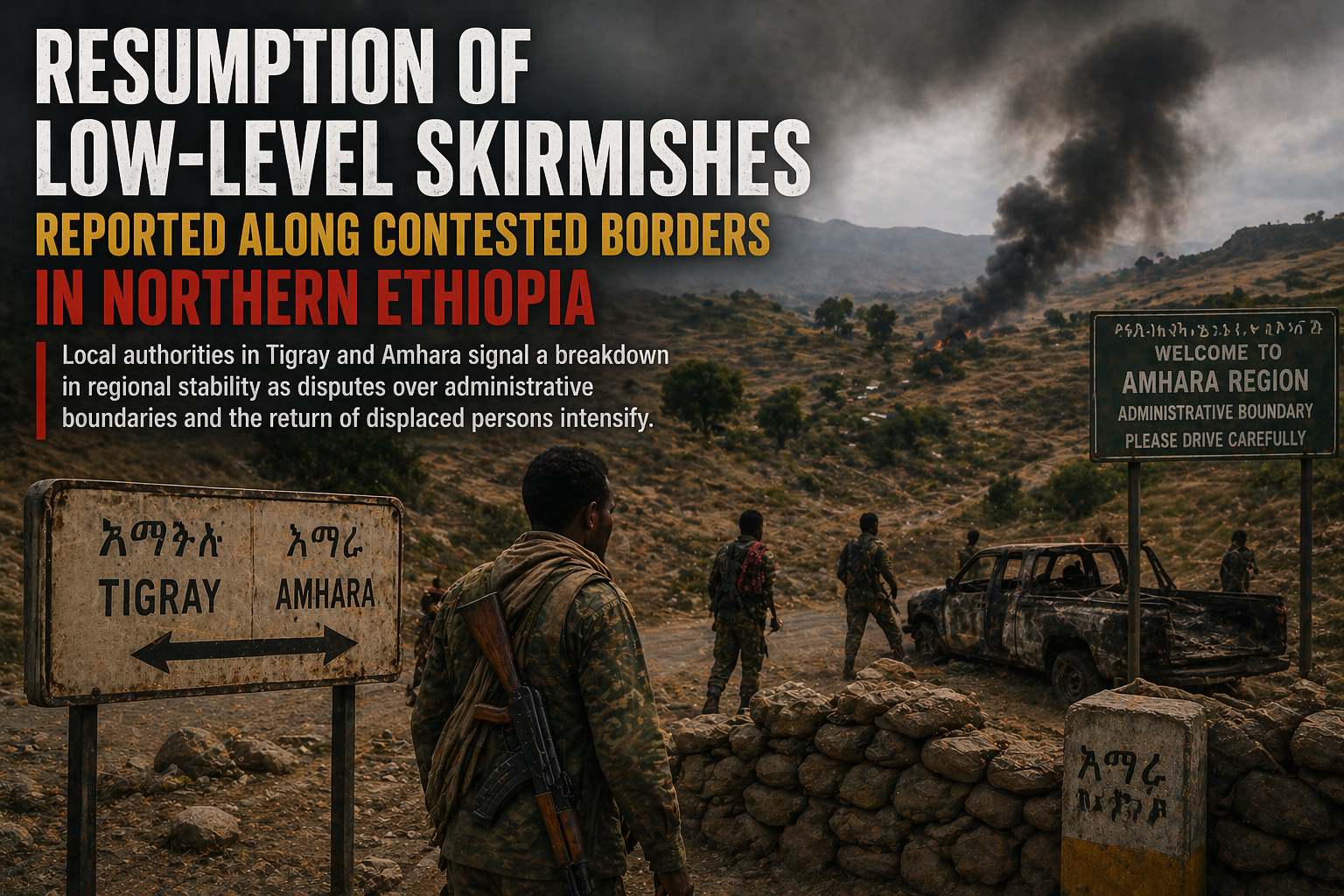
Local authorities in Tigray and Amhara signal a breakdown in regional stability as disputes over administrative boundaries and the return of displaced persons intensify.
April 23, 2026
Last Updated: April 23, 2026
By Global War News Editorial
Recent situation reports from northern Ethiopia indicate a resumption of low-level border skirmishes between regional militias and federal security forces. Local authorities in the contested southern and western zones of Tigray have reported localized exchanges of small-arms fire and mortar shelling over the past 48 hours. According to statements from regional administrators, these clashes are primarily centered around the Raya and Welkait districts, areas where both the Amhara and Tigrayan regions assert historical and administrative claims.
The uptick in violence follows a major political shift on April 19, 2026, when the Tigray People’s Liberation Front (TPLF) declared its intent to restore its pre-war regional executive and legislature. This move has been characterized by federal officials as a “clear repudiation” of the 2022 Pretoria Agreement, which had established a transitional interim administration. The collapse of this political framework has reportedly exacerbated long-standing grievances regarding the slow pace of returning hundreds of thousands of internally displaced persons (IDPs) to their homes in these contested zones.
Flashpoints and Military Movement
The most acute skirmishes have been recorded near the towns of Alamata and Korem. According to reporting from Reuters, local militias aligned with the Amhara region, frequently referred to as Fano, have reinforced their positions in the Raya district, citing a need to defend against what they describe as “Tigrayan encroachment.” Simultaneously, Tigrayan defense forces have reportedly moved closer to the administrative boundaries, asserting their right to re-establish control over territories they managed prior to the 2020 conflict.
According to a situation report from the Ethiopian National Defense Force (ENDF), federal troops have been deployed to “buffer zones” to prevent these localized skirmishes from escalating into a wider regional confrontation. However, local eyewitnesses, as reported by the BBC, describe a “highly porous” frontline where small units frequently engage in hit-and-run tactics, leading to civilian casualties and fresh displacement in nearby villages.
The Role of External Actors
The security situation is further complicated by the reported presence of Eritrean forces in the northern border regions. According to a report from Human Rights Watch released on April 22, 2026, Eritrean troops continue to occupy pockets of territory near the towns of Zalambessa and Adigrat.
Analysts suggest that the continued presence of foreign troops, despite the terms of the Pretoria Agreement, serves as a significant catalyst for regional paranoia. While the Eritrean government has repeatedly denied active involvement in current skirmishes, local military sources cite frequent “infiltrations” that distract federal forces and undermine the stability of northern Ethiopia.
Analysis: The Fragmentation of the Pretoria Peace
The resumption of skirmishes highlights the fundamental fragility of the “peace” established in late 2022. Observers note that the Pretoria Agreement successfully ended large-scale conventional warfare but failed to resolve the underlying territorial disputes that originally fueled the conflict.
“We are witnessing the tactical fallout of a stalled political process,” says a regional security analyst at the Horn of Africa Research Initiative. “When the federal government and regional leaders cannot agree on a legal path for border delimitation or a referendum, the actors on the ground revert to the only leverage they have, physical territory.”
Economically, the return of low-level combat is devastating for the region’s recovery. According to data from the World Food Programme (WFP), northern Ethiopia remains in the grip of a severe food security crisis. The closure of roads due to skirmishes has reportedly prevented the delivery of aid to over 200,000 people in the last week alone, raising the risk of localized famine in isolated districts.
Looking Ahead
It remains unclear if the federal government will utilize drone strikes, a tactic used in early 2026 during previous clashes, to suppress the current unrest. According to reports from Al Jazeera, Prime Minister Abiy Ahmed’s administration has maintained a policy of “maximum restraint” in its public rhetoric while quietly moving heavy weaponry toward the Tigray-Amhara border.
The international community, led by the African Union, is reportedly calling for an emergency summit in Nairobi to address the “catastrophic threat” posed by the TPLF’s recent political declaration. Without a renewed commitment to the post-war administrative structure, these “low-level” skirmishes are widely seen as the precursor to a more significant regional escalation.
Sources: This article is based on reporting and official statements from Reuters, the BBC, Human Rights Watch, the Ethiopian National Defense Force (ENDF), the Tigray People’s Liberation Front (TPLF), and the World Food Programme (WFP).
This article is based on publicly available reporting from named international news agencies and attributed official statements. All claims about ongoing events are attributed to their original sources. Analysis sections represent the editorial interpretation of reported facts and do not constitute advocacy for any party to the described conflict. AI tools may be utilized for image generation to assist in explaining complex concepts, as well as for refining grammar, spelling, and other linguistic enhancements. However, all original content is produced, fact-checked, and revised by the editorial team. This publication does not take political positions on active military conflicts.