
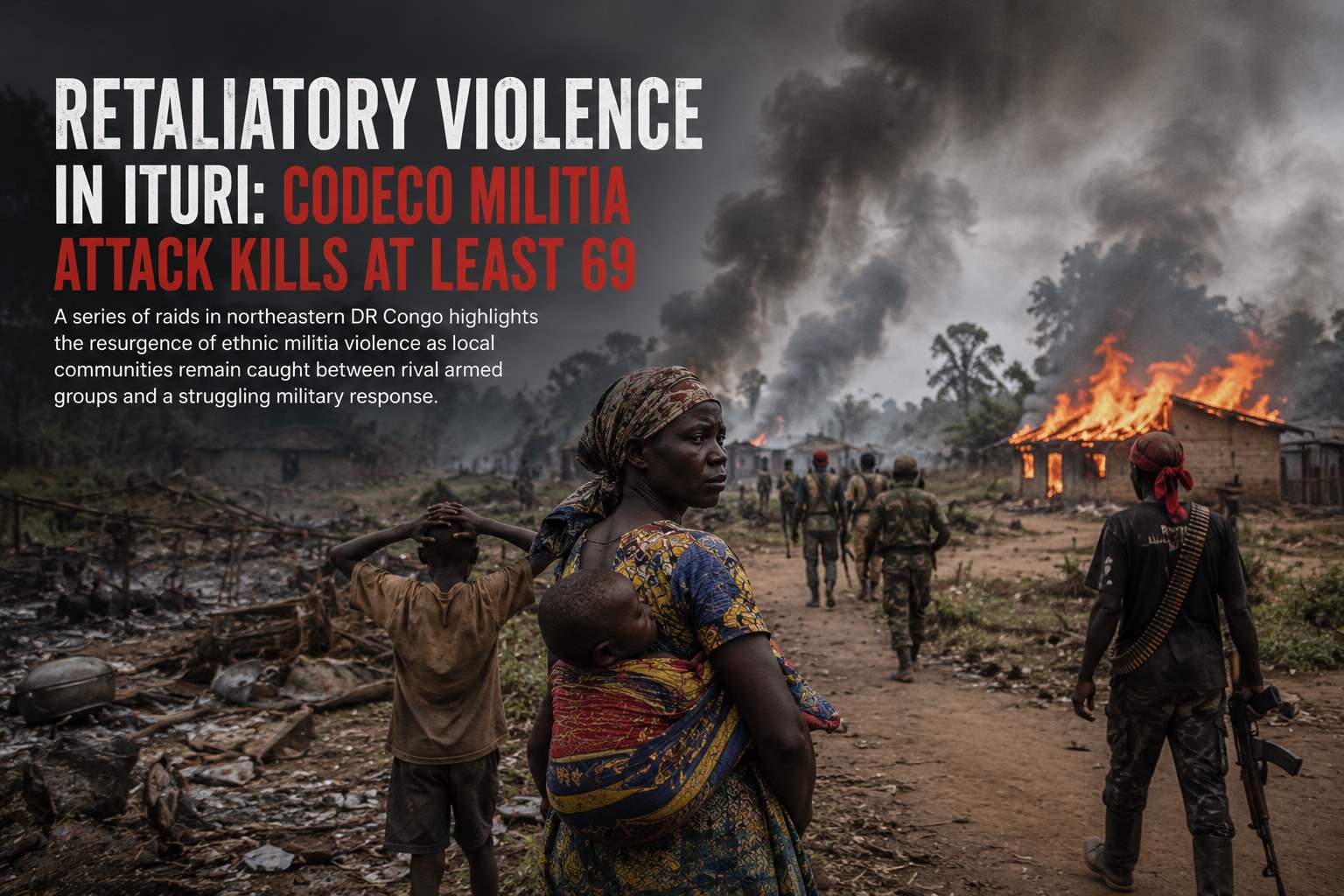
A series of raids in northeastern DR Congo highlights the resurgence of ethnic militia violence as local communities remain caught between rival armed groups and a struggling military response.
May 12, 2026
Global War News Editorial
At least 69 people have been killed following a wave of attacks by the CODECO militia in the Ituri province of the Democratic Republic of Congo (DRC). The raids, which reportedly occurred in late April but were only fully confirmed this week, targeted several villages in the gold-rich northeastern region.
Security sources and local officials informed news agencies on Saturday that the discovery of the bodies was delayed for several days due to the continued presence of armed fighters in the area. The violence marks a significant escalation in the long-running ethnic conflict between the Lendu and Hema communities, further complicating an already dire humanitarian situation in eastern DRC.
The Dynamics of the Attack
The Cooperative for the Development of Congo (CODECO), a militia group that claims to protect the interests of the farming Lendu community, is alleged to have carried out the raids on April 28. According to reports from AFP and local civil society leaders, the attacks were a retaliatory response to a previous assault by a rival group, the Convention for the Popular Revolution (CRP), which represents the Hema community.
Dieudonne Losa, a prominent civil protection official in the region, stated that the death toll likely exceeds 70. “Only 25 bodies have been buried so far,” Losa said on Saturday, explaining that many remains were left strewn in the fields near the village of Bassa. Security sources confirmed that the dead include a mix of civilians, militia members, and soldiers from the Congolese army (FARDC).
A Province in Crisis
Ituri has faced a resurgence of violence since early 2025, driven by the re-emergence of the CRP, a group founded by convicted warlord Thomas Lubanga. Despite Lubanga’s previous conviction by the International Criminal Court for recruiting child soldiers, his group has reportedly resumed operations against both the FARDC and CODECO.
The United Nations Organization Stabilization Mission in the DRC (MONUSCO) issued a statement on Saturday strongly condemning the “wave of deadly attacks.” UN officials confirmed they had rescued nearly 200 people caught in the crossfire during the initial CRP assault in late April, but were unable to prevent the subsequent CODECO retaliation.
The humanitarian impact is staggering. Data from the UN Office for the Coordination of Humanitarian Affairs (OCHA) indicates that nearly one million people are now internally displaced within Ituri province alone. The region is also under threat from the Allied Democratic Forces (ADF), an ISIL-affiliated group that has reportedly killed at least 50 civilians in neighboring localities over the past week.
ANALYSIS: The Failure of Deterrence
Observers note that the Congolese government’s reliance on “delegated security”, where it occasionally utilizes certain local militias to combat other, more aggressive groups like the M23 or ADF, has frequently backfired. By allowing groups like CODECO to maintain their arms under the guise of community defense, the state has inadvertently facilitated a cycle of local vendettas.
The delay in recovering bodies in Ituri suggests that the FARDC remains unable to project authority in rural areas, leaving a power vacuum that ethnic militias are eager to fill. Analysts suggest that without a more robust state presence and a genuine disarmament process for community-based groups, the “tit-for-tat” violence in Ituri will continue to undermine larger peace efforts in the eastern DRC.
What to Watch
- Retaliation Risks: The Ente association, representing the Hema community, has labeled the killings a “massacre” and urged its members to avoid further retaliation, though local tensions remain high.
- MONUSCO Withdrawal: The ongoing drawdown of UN peacekeepers from the DRC raises questions about who will provide civilian protection as local militias expand their territorial reach.
- Gold Mine Control: Ituri’s mineral wealth remains a primary driver of conflict; watch for shifts in control over artisanal mining sites following these village raids.
Source Disclosure:Reporting based on accounts from AFP, Al Jazeera, The Hindu Bureau, and Xinhua News Agency. Humanitarian data provided by UN OCHA and MONUSCO official statements. Local figures attributed to civil society leader Dieudonne Losa and regional security sources.
This article is based on publicly available reporting from named international news agencies and attributed official statements. All claims about ongoing events are attributed to their original sources. Analysis sections represent the editorial interpretation of reported facts and do not constitute advocacy for any party to the described conflict. AI tools may be utilized for image generation to assist in explaining complex concepts, as well as for refining grammar, spelling, and other linguistic enhancements. However, all original content is produced, fact-checked, and revised by the editorial team. This publication does not take political positions on active military conflicts.