
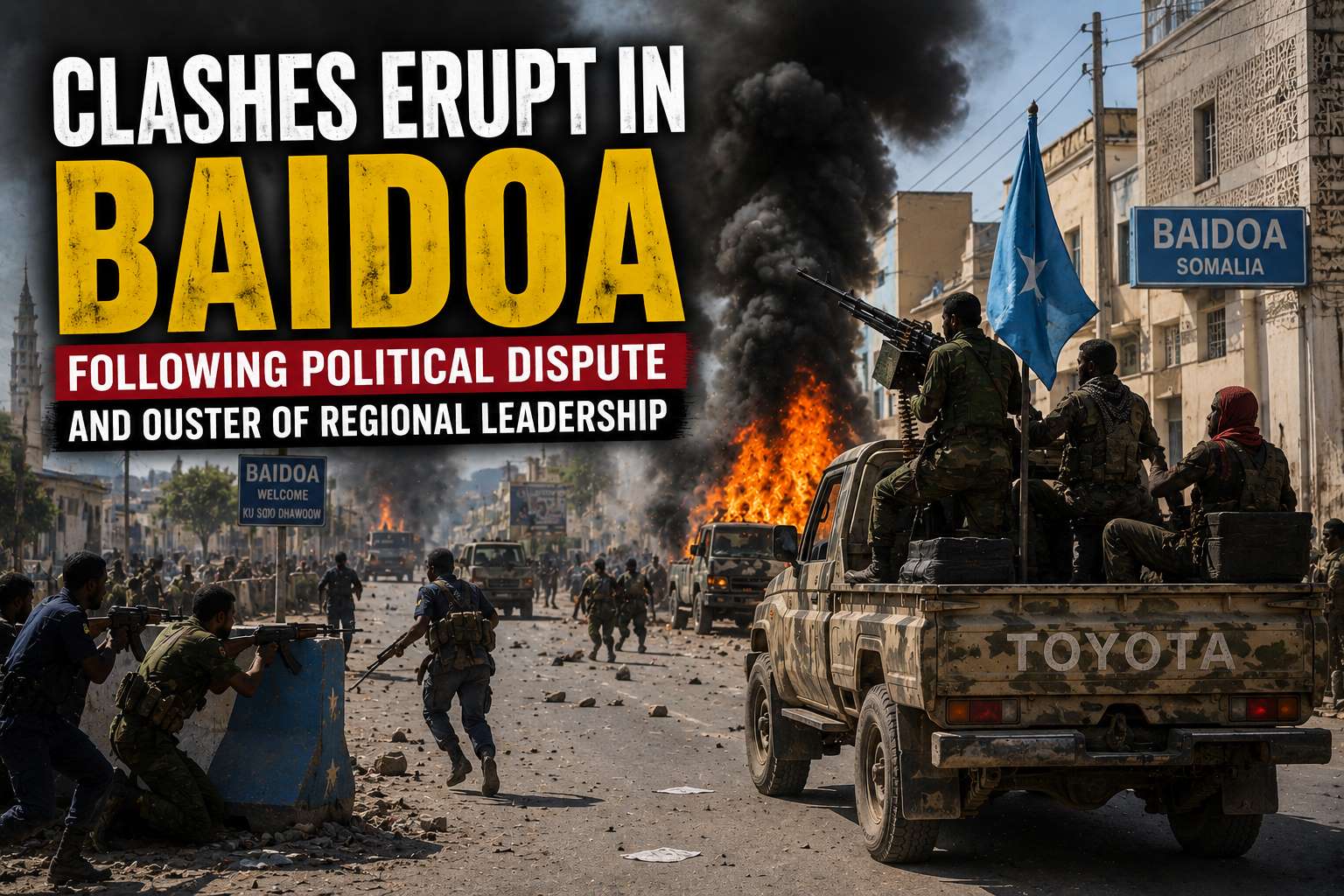
Armed encounters break out between federal troops and forces loyal to the ousted regional president as political gridlock shifts into military confrontation.
Published: June 2, 2026
Last Updated: June 2, 2026
Byline: Staff Writer, Global War News
Heavy fighting has erupted in Baidoa, the administrative capital of Somalia’s Southwest State, as armed factions loyal to the region’s ousted president launched a coordinated incursion into the city. The assault led to direct encounters with Somali federal forces and allied regional police, who took control of the city following a political intervention earlier this year.
The clashes timed with preparations to swear in newly elected members of the regional legislature following a contested local election process. Local witnesses reported intense exchanges of gunfire and the deployment of heavy weaponry across several neighborhoods, forcing civilians to seek cover. While security officials maintain that the city has been stabilized, the recurrence of urban combat underscores a volatile power struggle that risks spreading to other federal member states.
The confrontation marks a severe escalation in a long-running dispute over constitutional legitimacy and the path of national elections. Security sources have confirmed casualties among both combatants and civilians, though independent verification of total numbers remains difficult due to active operations on the ground.
The Battle for Baidoa
According to reports from Agence France-Presse (AFP), fighters loyal to the former Southwest State President, Abdiaziz Hassan Mohamed, widely known as Laftagareen, advanced into Baidoa early in the morning. Witnesses stated that the anti-government forces briefly took control of sections of the city before facing pushback from federal troops.
Briefing reporters after the main exchange, the Police Commander of the Bay Region, Sadiq Doodishe, stated that armed elements had entered the city with the intent to manufacture instability. Commander Doodishe asserted that security forces successfully repelled the advance and that the administrative center was entirely secure.
However, accounts from residents indicated that the scale of the fighting was significant. A local resident, Mohamud Ibrahim, told reporters by telephone that he observed the bodies of four combatants and two civilians who had been struck by stray bullets. A military commander, Hussein Ali, stated that government troops recovered the bodies of at least six attackers, characterizing them as young men exploited by political actors.
Origins of the Leadership Crisis
The violence is directly tied to a federal intervention that occurred on March 30, when national army forces entered Baidoa and unseated Laftagareen. The move followed weeks of escalating tension between Mogadishu and the regional administration after Laftagareen rejected federal electoral guidelines and attempted to hold a snap local re-election. Following the military deployment, Laftagareen resigned under pressure and departed for Nairobi, Kenya, though he has since claimed he remains the legitimate leader of the state and has vowed to sustain armed resistance.
At the core of the broader political impasse is a fierce national debate over comprehensive amendments to Somalia’s provisional constitution, signed into law by federal President Hassan Sheikh Mohamud. The reforms alter terms of office from four to five years and seek to transition the country from a clan-based indirect voting system to universal suffrage.
The changes have faced deep opposition. Authorities in Southwest State suspended institutional ties with Mogadishu prior to the ouster, mirroring actions taken by leaders in Puntland and Jubaland. Opponents argue the federal administration is acting unilaterally, claiming its mandate under the previous provisional framework technically lapsed, a position the federal government rejects by pointing to the newly ratified legal extensions.
ANALYSIS
Fragmentation Risks and Humanitarian Toll
The return of factional warfare to Baidoa demonstrates the high stakes of Somalia’s transition away from its traditional, clan-brokered political system. While the federal government has sought to assert authority and enforce its legislative agenda through direct security interventions, the reliance on military force appears to have deepened regional alienation rather than resolving structural gridlock.
Observers note that by dismantling sub-national administrations that resist constitutional updates, the federal center risks overextending its security apparatus. The local communities in Southwest State are highly fragmented, and the use of national troops to manage regional political outcomes provides ousted leaders with a pretext to mobilize clan-based militias.
Furthermore, the state apparatus is facing parallel military pressures. In an official statement following the initial clashes, the Somali National Army claimed its forces had actually foiled an early-morning attack orchestrated by al-Shabaab-linked militants. Whether the attackers were exclusively Laftagareen loyalists or an exploitation of the chaos by regional insurgents, the division within pro-government security structures creates tactical opportunities for active insurgent groups.
The security vacuum is also expanding beyond Baidoa. Reports of troop movements and political polarization between regional authorities and the federal government in Galmudug State have raised concerns that similar armed confrontations could break out in other capitals.
The humanitarian fallout of this political deterioration is immediate. Figures cited by United Nations monitoring officials indicate that initial operations and subsequent instability in the region have displaced thousands of civilians, compounding the vulnerability of a population already dealing with severe food insecurity and historic displacement. Continued factional fighting inside major urban centers will likely force non-governmental organizations to suspend logistics, choking off essential aid lines.
What to Watch
Moving forward, the primary indicator of stability will be whether the federal-backed interim administration in Southwest State can successfully conclude parliamentary and speaker elections without triggering prolonged urban guerrilla warfare. If forces loyal to the former administration can sustain asymmetric attacks inside Baidoa, it will signal that a clean political transition is unlikely.
Additionally, the response of regional neighbors—particularly Ethiopia, which maintains a substantial military presence in Southwest State as part of international stabilization efforts—will be critical. Should external forces shift from passive neutrality to active containment, the dynamic of the rebellion could change. Observers will also monitor whether opposition coalitions in Puntland and Jubaland offer political or material coordination to the anti-Mogadishu factions, which would turn a localized leadership dispute into a coordinated national crisis.
Source Disclosure Note; This report compiles verified accounts and field updates from international wire services, including Reuters, Associated Press (AP), and Agence France-Presse (AFP), alongside official press briefings from the Bay Region Police Command and the Somali National Army. Background policy details are drawn from records maintained by the United Nations Security Council Report and the International Crisis Group.
This article is based on publicly available reporting from named international news agencies and attributed official statements. All claims about ongoing events are attributed to their original sources. Analysis sections represent the editorial interpretation of reported facts and do not constitute advocacy for any party to the described conflict. AI tools may be utilized for image generation to assist in explaining complex concepts, as well as for refining grammar, spelling, and other linguistic enhancements. However, all original content is produced, fact-checked, and revised by the editorial team. This publication does not take political positions on active military conflicts.