
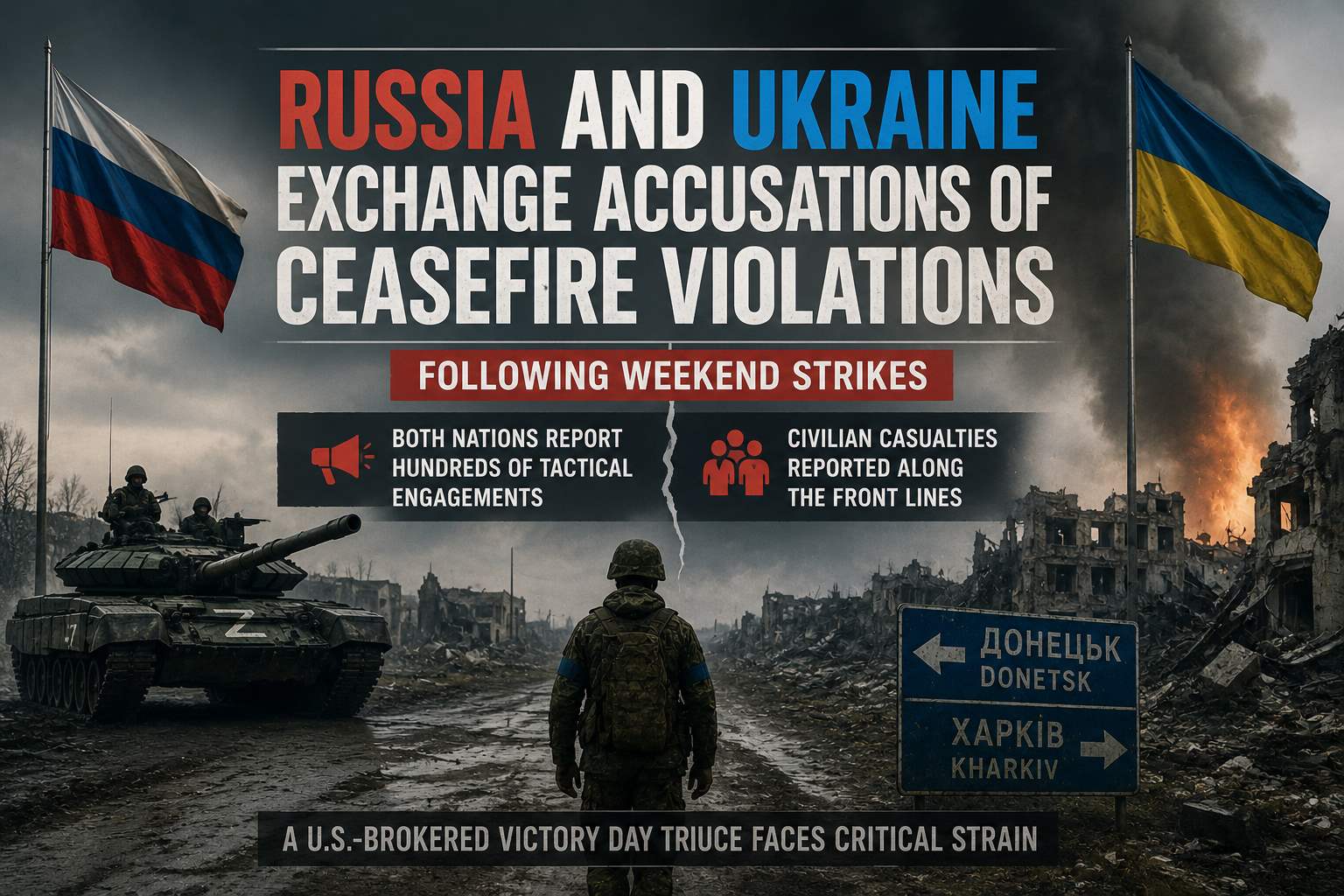
A U.S.-brokered Victory Day truce faces critical strain as both nations report hundreds of tactical engagements and civilian casualties along the front lines.
Monday, May 11, 2026
Last updated: 11:15 AM GMT
Global War News Editorial
Russia and Ukraine have traded sharp accusations of violating a three-day, U.S.-brokered ceasefire intended to coincide with the May 9 Victory Day celebrations. While both Moscow and Kyiv initially agreed to the pause in major hostilities starting Saturday, officials from both sides reported hundreds of tactical engagements, drone strikes, and artillery exchanges throughout the weekend.
According to the Ukrainian General Staff, Russian forces conducted over 150 ground assaults and 100 artillery strikes between Saturday and Sunday. Ukrainian President Volodymyr Zelensky stated in his evening address that while large-scale missile salvos had paused, Moscow was not “even particularly trying” to observe the truce in frontline areas. Conversely, the Russian Ministry of Defense alleged that Ukrainian “armed groups” committed over 16,000 violations of the ceasefire regime within a 24-hour period, prompting Russian forces to respond “in kind.”
The ceasefire, which is scheduled to conclude late Monday, was paired with a planned exchange of 1,000 prisoners of war (POWs) from each side. Despite the ongoing skirmishes, President Zelensky confirmed on Sunday that Ukraine has submitted its list of detainees and expects the swap to proceed under American guarantees.
Reported Casualties and Frontline Activity
The violence over the weekend resulted in several reported deaths and injuries, primarily in eastern and southern Ukraine. Ivan Fedorov, head of the Zaporizhzhia regional military administration, reported that one person was killed and three others were injured by Russian artillery and drone strikes. Local officials in Kharkiv reported that eight people, including two children, were wounded during drone attacks on the regional capital and surrounding settlements.
On the Russian-occupied side, Moscow-installed leader Vladimir Saldo reported that two people were injured by Ukrainian shelling in the Kherson region. While the intensity of aerial bombardments on major cities like Kyiv and Moscow appeared to decrease compared to previous weeks, military analysts from the Institute for the Study of War (ISW) noted that both armies utilized the lull in large-scale attacks to regroup, fortify positions, and conduct localized tactical missions.
The Victory Day Context
The ceasefire was specifically timed to overlap with Russia’s May 9 Victory Day, a major holiday marking the defeat of Nazi Germany in 1945. This year’s parade in Moscow was notably scaled back, lasting only 45 minutes and featuring no tanks or heavy armored vehicles for the first time in nearly two decades.
In a move described by some observers as “psychological signaling,” President Zelensky had mockingly declared Red Square “off-limits” for Ukrainian strikes during the parade to allow the event to proceed. While the parade occurred without disruption, Russian President Vladimir Putin used the occasion to claim that Russia’s victory is “inevitable,” even as he vaguely suggested the war could be nearing a conclusion.
Analysis: The Fragility of Unmonitored Truces
The current situation highlights the persistent difficulty of maintaining ceasefires that lack formal monitoring mechanisms or clear dispute-resolution processes. Analysts note that without neutral third-party observers on the ground, both Russia and Ukraine can claim “retaliatory” status for every tactical engagement, leading to a cycle of violence that renders the term “ceasefire” largely symbolic.
Furthermore, the discrepancy in reported violation numbers—ranging from dozens reported by Ukraine to tens of thousands claimed by Russia—indicates a significant gap in how each side defines a “violation.” For the 1,000 families awaiting the promised prisoner exchange, the success of the remaining hours of the truce is critical. However, if tactical combat persists at this level, it remains unclear whether the logistical corridors necessary for a safe POW swap can be maintained.
Source Disclosure: This report is based on official statements from the Ukrainian General Staff, the Russian Ministry of Defense (via TASS and Xinhua), and the office of the Ukrainian President. Casualties were reported by regional governors in Zaporizhzhia, Kharkiv, and Kherson. Additional context and battlefield analysis were sourced from the Associated Press (AP), Reuters, CBS News, and the Institute for the Study of War (ISW).
This article is based on publicly available reporting from named international news agencies and attributed official statements. All claims about ongoing events are attributed to their original sources. Analysis sections represent the editorial interpretation of reported facts and do not constitute advocacy for any party to the described conflict. AI tools may be utilized for image generation to assist in explaining complex concepts, as well as for refining grammar, spelling, and other linguistic enhancements. However, all original content is produced, fact-checked, and revised by the editorial team. This publication does not take political positions on active military conflicts.