
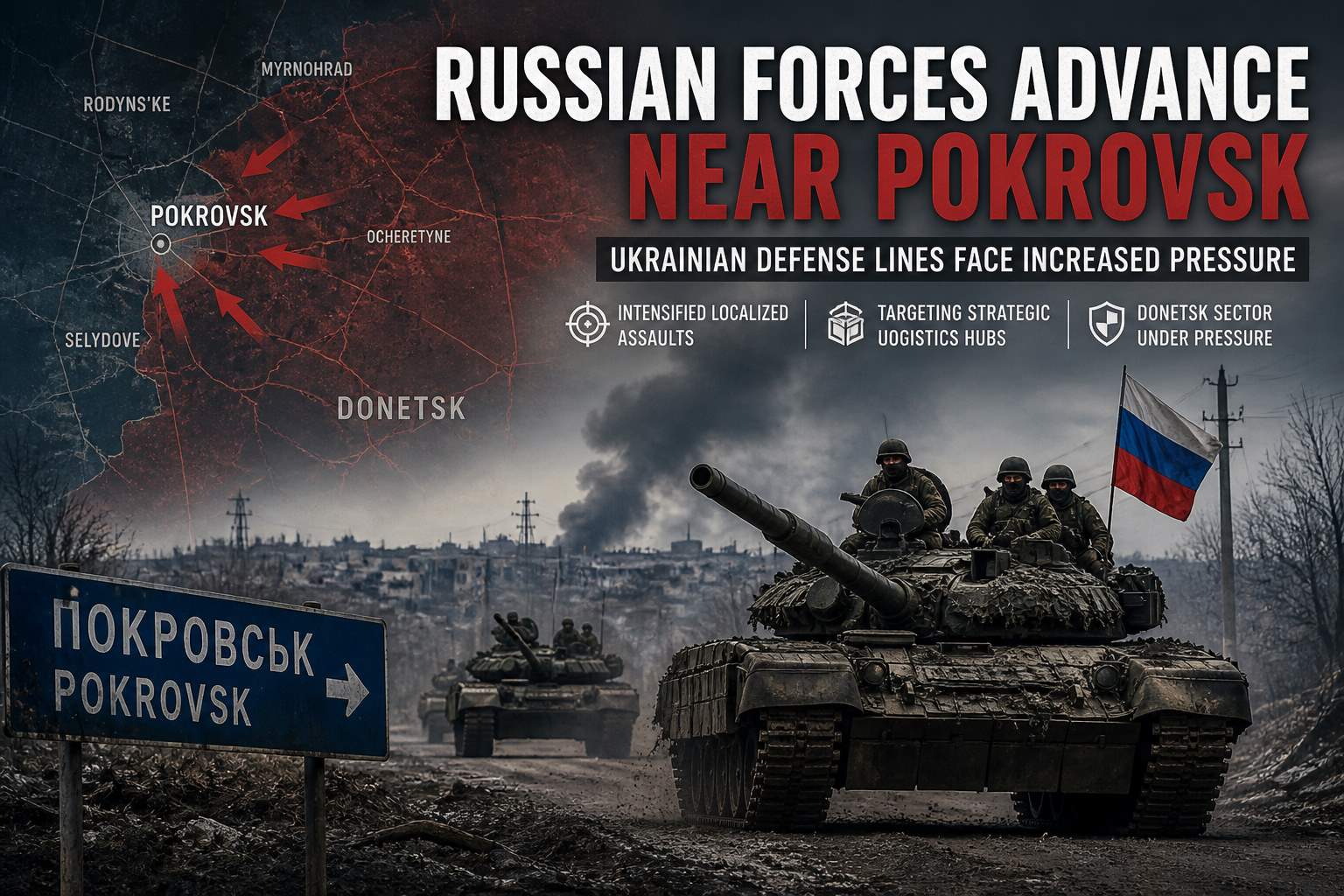
Battlefield updates and official briefings indicate intensified localized assaults against strategic logistics hubs in the Donetsk sector.
May 5, 2026
By Global War News Editorial
Russian military units have reportedly secured tactical gains in the vicinity of Pokrovsk over the last 48 hours, according to verified battlefield mapping updates and official briefings from the Ukrainian General Staff. Reports indicate that Russian forces conducted 24 separate assault actions in this sector, targeting the settlements of Udachne and Rodynske. The General Staff stated that Ukrainian defenders have “stopped” a significant portion of these maneuvers, but acknowledged that the intensity of fighting remains at its highest level in months.
The push toward Pokrovsk is being characterized by what analysts describe as “infiltration tactics,” where small infantry groups attempt to bypass primary defensive fortifications under the cover of heavy glide-bomb strikes. According to an operational update from the Ukrainian military, Russian aviation deployed over 270 guided bombs and nearly 10,000 kamikaze drones across the frontline in a single 24-hour period. These strikes are reportedly focused on disrupting the supply lines that connect Pokrovsk to the broader defensive network in eastern Ukraine.
Context and Background
Pokrovsk has long served as a critical operational pivot for the Ukrainian Armed Forces in the Donbas. As a rail and road junction, it facilitates the movement of troops and supplies between the central and eastern regions. Throughout 2025 and into early 2026, the area has remained a priority objective for Russian commanders seeking to collapse the Ukrainian salient in Donetsk.
Strategically, the fall of Pokrovsk would not only threaten the tactical integrity of the Ukrainian front but would also have significant industrial repercussions. The region is home to some of Ukraine’s largest metallurgical coal deposits, essential for the nation’s remaining steel production. Previous reports from the National Bank of Ukraine have already linked a 31% drop in hard coal production to the proximity of active combat in the Pokrovsk mining district.
Analysis: Incremental Gains and Attrition
The current Russian advance represents a continuation of an attritional strategy designed to stretch Ukrainian reserves. Observers note that while the rate of Russian territorial gain has slowed in 2026 compared to 2025, averaging approximately 2.9 square kilometers per day, the localized pressure on Pokrovsk is intense.
Analysis from the Institute for the Study of War (ISW) suggests that the Kremlin is increasingly using infiltration tactics to create a perception of constant momentum. This methodology often involves seizing “grey zones” where neither side has total control. It remains unclear whether Russian forces possess the mechanized reserves necessary to turn these tactical filtrations into a decisive operational breakthrough. However, the sustained use of glide bombs, which can be launched from up to 70 kilometers away, has proven difficult for Ukrainian air defenses to intercept, contributing significantly to the pressure on frontline positions.
Current Status and Outlook
As of May 5, the situation around Pokrovsk remains fluid. Ukrainian officials report that their forces have neutralized nearly 70 Russian troops in the sector over the past day, but Russian units continue to commit significant resources to the offensive. In the coming weeks, the primary indicators of stability will be whether Ukrainian forces can maintain control over the Udachne-Rodynske rail corridor and if the recently announced ceasefire efforts, reportedly set for discussion on May 6, gain any diplomatic traction.
Source Disclosure: This report is based on operational updates from the General Staff of the Armed Forces of Ukraine, battlefield mapping assessments from the Institute for the Study of War (ISW), and economic data from the National Bank of Ukraine and the Centre for Economic Strategy.
This article is based on publicly available reporting from named international news agencies and attributed official statements. All claims about ongoing events are attributed to their original sources. Analysis sections represent the editorial interpretation of reported facts and do not constitute advocacy for any party to the described conflict. AI tools may be utilized for image generation to assist in explaining complex concepts, as well as for refining grammar, spelling, and other linguistic enhancements. However, all original content is produced, fact-checked, and revised by the editorial team. This publication does not take political positions on active military conflicts.