
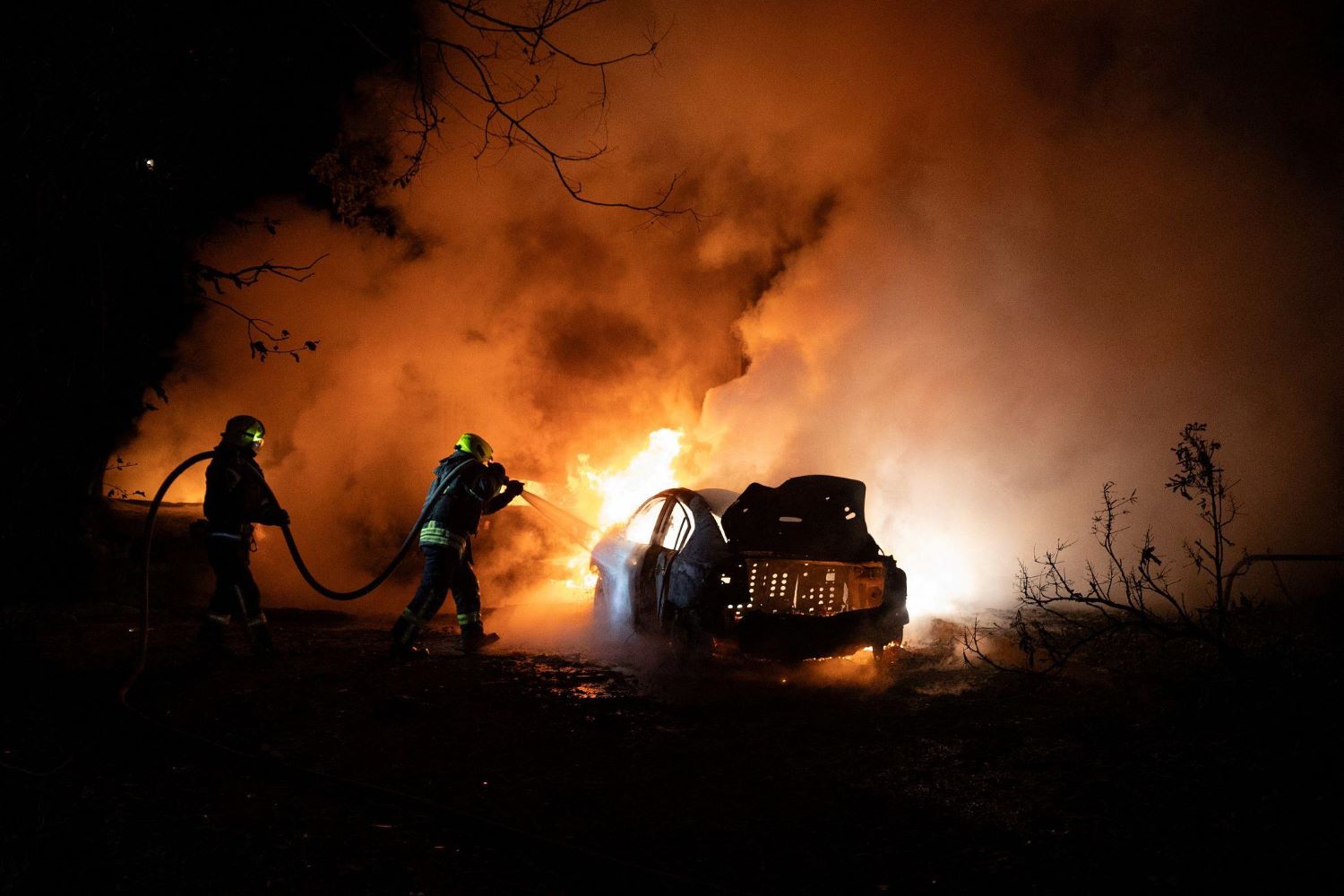
Air defenses intercept hundreds of unmanned aerial vehicles as falling debris and missile strikes cause localized damage across the Dnipropetrovsk and Odesa regions.
Publication Date: May 18, 2026
Last Updated: May 18, 2026
Byline: Global War News Editorial
Russian military forces have executed a large-scale, coordinated wave of overnight missile and drone strikes against multiple municipal and energy targets across Ukraine. The extensive aerial operations, which took place during the late evening of May 17 and into the early morning of May 18, 2026, triggered air defense alerts in multiple provinces, causing localized structural damage and infrastructure disruptions.
According to data released by the Ukrainian Air Force command, the assault involved a combination of ground-based ballistic missiles and hundreds of low-altitude attack drones. Ukrainian defense teams reported the successful interception of the vast majority of the inbound unmanned aerial vehicles. However, local authorities confirmed that several missiles penetrated defensive screens, striking targets in the central and southern sectors of the country.
The renewed bombardment follows several days of heavy symmetric aerial warfare between the two nations, which included a major long-range Ukrainian drone operation directed at the Russian capital region over the weekend. In Kyiv, government officials stated that the latest Russian strikes were aimed primarily at crippling logistics networks and civilian energy infrastructure ahead of expected summer deployment cycles.
Technical Breakdown and Interception Performance
The Ukrainian Air Force command published a detailed technical breakdown of the incoming vectors on social media, indicating that tracking systems detected over 500 aerial threats. The attack reportedly featured more than 520 attack drones of the Shahed and Gerbera types, alongside approximately 22 ground-launched ballistic and cruise missiles fired from the Rostov region and the Crimean peninsula.
Ukrainian mobile fire groups, anti-aircraft missile units, and electronic warfare teams engaged the targets over several hours. According to preliminary statements from military spokesmen, defensive forces successfully neutralized or electronically suppressed 503 unmanned aerial vehicles and four Iskander-K cruise missiles.
Despite the high statistical rate of interception, the sheer volume of the incoming wave resulted in hits across 34 distinct locations. Military commentators noted that the high proportion of decoy drones utilized by Russian forces during the raid appeared deliberately calculated to saturate radar arrays, allowing higher-velocity cruise and ballistic missiles to bypass local air defense rings in key urban sectors.
Regional Impact on Infrastructure and Casualties
The primary focus of the kinetic strikes was the Dnipropetrovsk region in central Ukraine, with significant activity reported near the industrial hubs of Dnipro and Kryvyi Rih. Regional Governor Serhiy Lysak stated via his official communication channels that overnight detonations and falling drone debris wounded at least eight civilians. Lysak noted that multiple residential buildings sustained external blast damage, and emergency crews were deployed to restore localized power grids severed during the engagement.
In the southern port city of Odesa, secondary air defense engagements resulted in falling wreckage hitting warehouse structures near the commercial shipping lanes. Local administrative officials reported that while no human casualties were recorded within the city limits, the resulting fires caused temporary logistics delays at transport hubs.
Further north, in the Chernihiv and Zaporizhzhia regions, localized hits on utility facilities were confirmed by regional authorities. The state-operated energy sector maintained that while individual distribution points suffered minor disruptions, the national power grid did not suffer a systemic collapse, and rolling blackouts would be minimized through emergency adjustments.
Context and Background: The Broken Truce and Symmetric Attrition
The heavy cross-border aerial exchanges come in the wake of a brief, unstable three-day ceasefire that had been established earlier in May to mark regional holidays. That temporary truce collapsed quickly, leading to successive waves of strategic strikes by both combatants as the conflict enters its fifth year of high-intensity operations.
The current escalation cycle intensified sharply between May 13 and 16, when Russian forces launched consecutive missile and drone barrages across Ukraine, resulting in over twenty civilian fatalities in the capital. In direct retaliation, Ukrainian forces executed one of their largest long-range drone strikes of the war on May 17, launching hundreds of drones toward 14 Russian provinces and the Moscow region, which resulted in four deaths and targeted microelectronics facilities and fuel depots.
Recent Aerial Exchanges: May 13-18, 2026
May 17–18: Russian military forces deployed more than 500 drones and missiles, with major attacks focused on the Dnipro and Odesa sectors.
May 13–15: Russian forces launched consecutive waves of missile attacks, including a strike on a Kyiv apartment building that reportedly killed 24 people.
May 16–17: Ukraine responded with a large-scale long-range drone barrage targeting 14 Russian regions, including the Moscow area.
International security analysts note that both nations have significantly ramped up their domestic assembly lines for unmanned platforms. The extensive reliance on cheaper, mass-produced attack drones has transformed the sky into a highly contested domain where defensive survival depends entirely on the continuous supply of anti-aircraft ammunition and automated electronic jamming capabilities.
Analysis: The Logistics of Continuous Air Defense Saturation
Observers note that the latest Russian operation demonstrates a clear shift toward a saturation strategy designed to drain Ukraine’s stockpile of Western-supplied air defense interceptors. By launching more than 500 cheap decoy and attack drones in a single evening, Moscow forces Ukrainian commanders to expend expensive, limited surface-to-air missiles to protect vital civic nodes.
For the Ukrainian military command, the primary challenge remains the defense of its industrial interior while simultaneously shielding frontline troops from tactical aviation. The high interception rate achieved by mobile fire groups highlights the tactical adaptability of Ukrainian forces, but the fact that 18 missiles successfully reached their targets underscores the vulnerabilities that persist when air defense rings are stretched across multiple geographic regions.
Furthermore, the timing of the strike indicates a desire by the Kremlin to overshadow the political impact of Ukraine’s weekend strikes on Moscow. By launching an immediate, high-volume counter-strike, the Russian military command seeks to demonstrate to its domestic audience that it retains full offensive initiative, ensuring that the war of attrition remains intense across all operational sectors.
What to Watch
In the coming days, international monitors will watch closely to see if the high frequency of these massive drone waves causes a critical shortage in specific Ukrainian air defense ammunition types, which could force a reallocation of systems away from the southern ports to protect central industrial cities.
On the diplomatic front, the focus remains on whether European partners will expedite the delivery of additional electronic warfare units to help Ukraine counter the evolving mix of decoy and strike drones without relying exclusively on kinetic missile intercepts.
Source Disclosure Note: This report is based on official operational summaries published by the Ukrainian Air Force command and statements from Dnipropetrovsk Governor Serhiy Lysak and Odesa regional administrators. Russian tactical context is drawn from official briefings by the Russian Ministry of Defense carried via state media channels. Additional independent data regarding regional flight paths and target impacts is sourced from reporting by Reuters, Agence France-Presse, and the Institute for the Study of War.
This article is based on publicly available reporting from named international news agencies and attributed official statements. All claims about ongoing events are attributed to their original sources. Analysis sections represent the editorial interpretation of reported facts and do not constitute advocacy for any party to the described conflict. AI tools may be utilized for image generation to assist in explaining complex concepts, as well as for refining grammar, spelling, and other linguistic enhancements. However, all original content is produced, fact-checked, and revised by the editorial team. This publication does not take political positions on active military conflicts.