
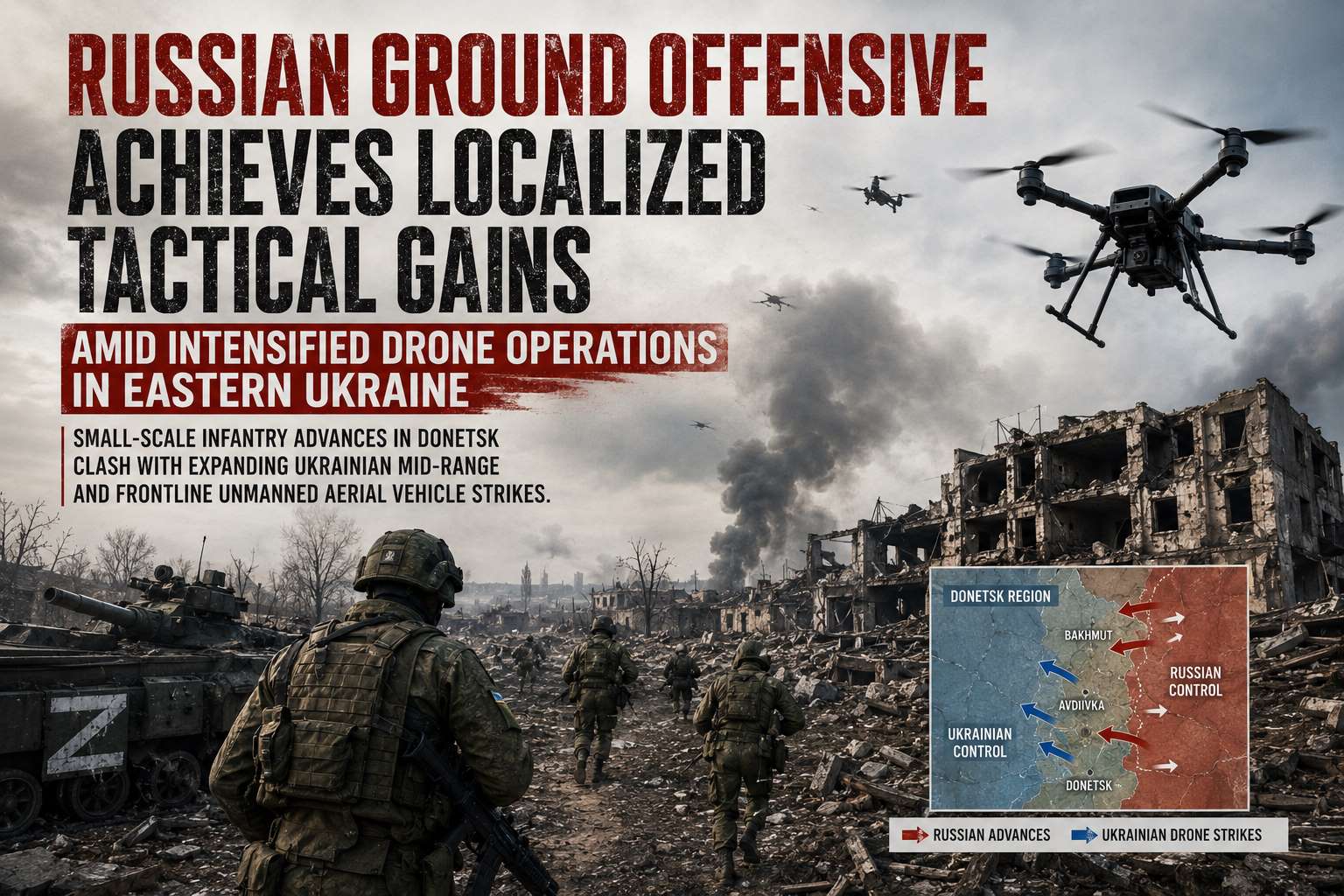
Small-scale infantry advances in Donetsk clash with expanding Ukrainian mid-range and frontline unmanned aerial vehicle strikes.
Publication Date: June 1, 2026
Last Updated: June 1, 2026
Byline: Global War News Editorial
Russian forces have secured localized tactical gains across several sectors of eastern Ukraine following intensified infantry operations. The advances, concentrated primarily in the Donetsk region, reflect a continuing reliance on small-group infiltration tactics. According to data published by the Center for Strategic and International Studies (CSIS), these grinding operations have yielded highly incremental progress, with average forward movements measuring between 15 and 70 meters per day in the most contested sectors such as Pokrovsk and Chasiv Yar.
Simultaneously, the Ukrainian military has accelerated what officials term a “logistics lockdown,” deploying expanded mid-range and frontline unmanned aerial vehicle (UAV) networks. Analysts from the Institute for the Study of War (ISW) reported that these drone operations are actively degrading Russian ground lines of communication (GLOCs) and slowing the transfer of personnel and ammunition to the front lines. The convergence of these two dynamics underscores a highly contested operational environment where territorial adjustments remain marginal but resource depletion is high.
Current Situation on the Eastern Front
Field updates from the Ukrainian General Staff and independent military observers indicate that Russian motorized rifle units have marginally advanced inside the administrative boundaries of the Donetsk oblast. The operations rely on small infantry groups moving through tree lines and ruined settlements, avoiding large armor formations which remain vulnerable to aerial surveillance.
However, the Ukrainian Unmanned Systems Forces (USF) have expanded their tactical footprint. On May 30, Ukrainian officials reported successful precision drone strikes against Russian military assets, including the Tryokhizbenko training ground in the Luhansk region and the Primorsky Posad training ground in occupied Zaporizhia. According to public statements from Major Robert Brovdi, commander of the 414th Unmanned Strike Aircraft Battalion, these operations resulted in confirmed personnel casualties and the destruction of secondary military hardware.
The Evolution of Drone Warfare and Logistics Interdiction
The spring of 2026 has marked a distinct shift toward “middle-strike” operations—UAV campaigns targeting assets situated 30 to 200 kilometers behind the immediate line of contact. This operational layer bridges the gap between short-range first-person view (FPV) loitering munitions and strategic long-range drones targeting deep infrastructure.
Ukrainian Defense Ministry statements indicate a systematic focus on degrading Russian air defense capabilities. According to figures released by the Ukrainian General Staff, dozens of Russian air defense systems and radar complexes have been neutralized since March. Notable recent engagements include drone strikes against a Nebo-SV early-warning radar station in Luhansk and components of Buk-M2 and S-350 Vityaz missile systems in the Donetsk and Zaporizhia sectors. The reduction in radar coverage has left localized Russian supply routes increasingly exposed to daytime aerial interdiction.
Economic and Strategic Implications
The current rhythm of operations carries significant consequences for the domestic war economies of both combatants. For Russia, maintaining the high volume of artillery fire and infantry recruitment necessary to sustain even minor forward momentum has placed its manufacturing sector under sustained pressure. The CSIS analysis highlights that despite official state declarations of battlefield momentum, the vast material cost of these slow advances limits broader macroeconomic productivity.
On the other side, Ukraine’s reliance on high-technology, lower-cost unmanned systems is driven by a need to offset asymmetrical balances in conventional artillery and manpower. The implementation of competitive domestic tenders for drone procurement represents an effort to maintain high production scaling. Observers note that the financial viability of this strategy remains dependent on international supply chains for electronic components and specialized microelectronics.
Analysis: What This Means for the Summer Campaign
The localized tactical successes achieved by Russian infantry demonstrate a persistent capability to execute offensive actions despite high attrition rates. By utilizing infiltration methods, Russian commanders have partially mitigated the threat of immediate detection by Ukrainian reconnaissance assets.
Nevertheless, the expansion of Ukraine’s mid-range drone envelope introduces a compounding logistical challenge for the Kremlin. If supply lines connecting occupied southern Ukraine to the Donbas face prolonged disruptions, sustaining localized ground advances through the summer months will become mathematically difficult. Both military forces are locked in a race between Russian infantry replacement rates and Ukrainian technological scaling, with neither side currently demonstrating the capacity to force a systemic breakthrough along the wider 1,200-kilometer front line.
Source Disclosure Note: This report compiles verified updates from the Ukrainian Ministry of Defense and the Ukrainian Unmanned Systems Forces. It incorporates independent battlefield assessments and data from the Institute for the Study of War (ISW) and the Center for Strategic and International Studies (CSIS). Information regarding Russian territorial control and regional incidents incorporates statements from local administrative officials on record.
This article is based on publicly available reporting from named international news agencies and attributed official statements. All claims about ongoing events are attributed to their original sources. Analysis sections represent the editorial interpretation of reported facts and do not constitute advocacy for any party to the described conflict. AI tools may be utilized for image generation to assist in explaining complex concepts, as well as for refining grammar, spelling, and other linguistic enhancements. However, all original content is produced, fact-checked, and revised by the editorial team. This publication does not take political positions on active military conflicts.