
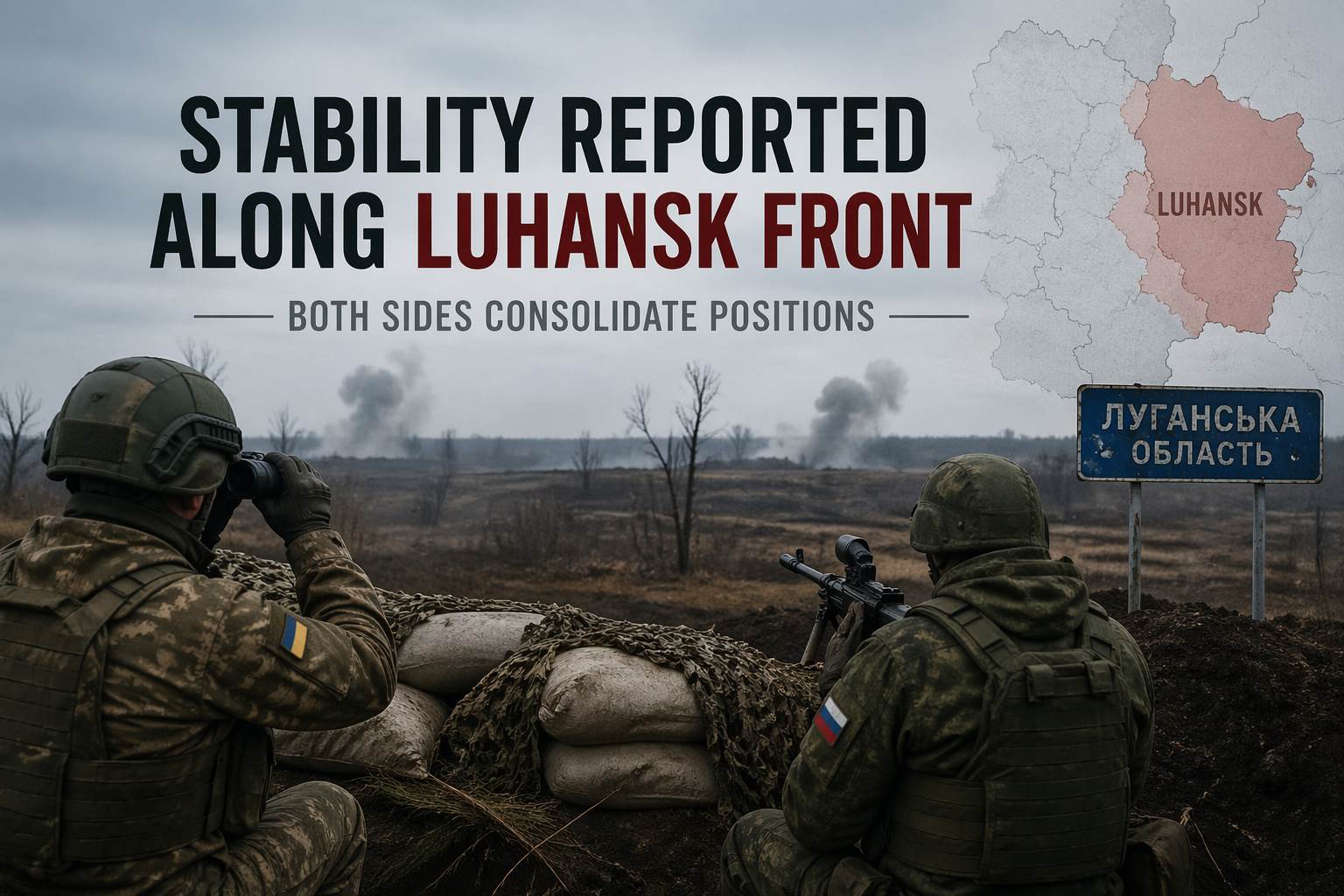
Military officials from Kyiv and Moscow indicate a slowing of territorial shifts despite continued artillery exchanges and localized skirmishes.
April 22, 2026 Last Updated: April 22, 2026
By Global War News Editorial
Recent reports from the frontline in eastern Ukraine suggest a period of relative tactical stabilization along the Luhansk sector. Both the Ukrainian and Russian defense ministries have issued statements indicating that while active combat persists, the rapid movement of the frontline has slowed in favor of defensive reinforcement.
According to official briefings from the Ukrainian General Staff, defensive lines in the vicinity of the Svatove-Kreminna axis remain under Ukrainian control despite what they described as “consistent pressure” from Russian shelling. Simultaneously, the Russian Ministry of Defence claimed in its daily update that its forces have improved their “tactical positions” in specific pockets of the region, though no major territorial breakthroughs were reported by either side.
Independent observers and analysts note that this phase likely represents a transition toward static warfare as both militaries manage logistical constraints and prepare for future operations.
Official Claims and Battlefield Status
The stabilization of the front comes after weeks of intense localized fighting. According to reporting from Reuters, which cited recent satellite imagery and official communiqués, both armies are increasingly relying on entrenched positions and drone surveillance to monitor movements rather than launching large-scale infantry assaults.
In a public statement on Wednesday, Ukrainian military officials noted that their forces successfully repelled several attempts by Russian units to advance near the settlement of Bilohorivka. Meanwhile, Russian state news agency TASS reported that their artillery units successfully targeted Ukrainian “manpower and equipment concentrations” in the same area.
These claims, while indicative of ongoing violence, suggest that neither side currently possesses the momentum required to force a significant change in the map of the Luhansk region.
The Role of Fortifications
Military analysts have suggested that the current lull in territorial change is largely due to the extensive network of fortifications built by both sides over the last year. According to a briefing from the Institute for the Study of War, these defensive lines—consisting of trenches, “dragon’s teeth” anti-tank obstacles, and dense minefields—make offensive maneuvers significantly more costly and difficult to execute.
Reports from Agence France-Presse (AFP) indicate that weather conditions in eastern Ukraine have also played a role. Recent rainfall has reportedly turned unpaved roads into mud, complicating the movement of heavy armor and supply trucks, which forces combat into a more stationary, artillery-heavy format.
Analysis: What This Stability Could Mean
The current situation along the Luhansk front raises questions about the long-term sustainability of the current attrition rates. While the lack of movement might suggest a “frozen” conflict, observers note that this is often a precursor to a renewed offensive once one side identifies a structural weakness in the other’s defense.
From an economic perspective, the stabilization of the front allows for more predictable logistical planning for the defending forces, but it also means a continued high burn rate of munitions. Data from independent research institutions suggests that the prolonged nature of this static phase is placing a significant strain on the global supply chains for 155mm and 152mm artillery shells.
Looking Ahead
It remains unclear whether this tactical pause will last through the coming months. Both Kyiv and Moscow have publicly committed to further territorial objectives, suggesting that the current stability is a temporary byproduct of current combat conditions rather than a move toward a formal ceasefire.
As reported by the BBC’s monitoring of the region, residents in nearby hubs continue to face the threat of long-range strikes even as the frontline itself remains static. The international community continues to watch the Svatove-Kreminna line as a primary indicator of where the next major shift in the conflict may occur.
Sources: This report incorporates data and statements from the Ukrainian General Staff, the Russian Ministry of Defence, Reuters, AFP, TASS, and the Institute for the Study of War.
This article is based on publicly available reporting from named international news agencies and attributed official statements. All claims about ongoing events are attributed to their original sources. Analysis sections represent the editorial interpretation of reported facts and do not constitute advocacy for any party to the described conflict. AI tools may be utilized for image generation to assist in explaining complex concepts, as well as for refining grammar, spelling, and other linguistic enhancements. However, all original content is produced, fact-checked, and revised by the editorial team. This publication does not take political positions on active military conflicts.