
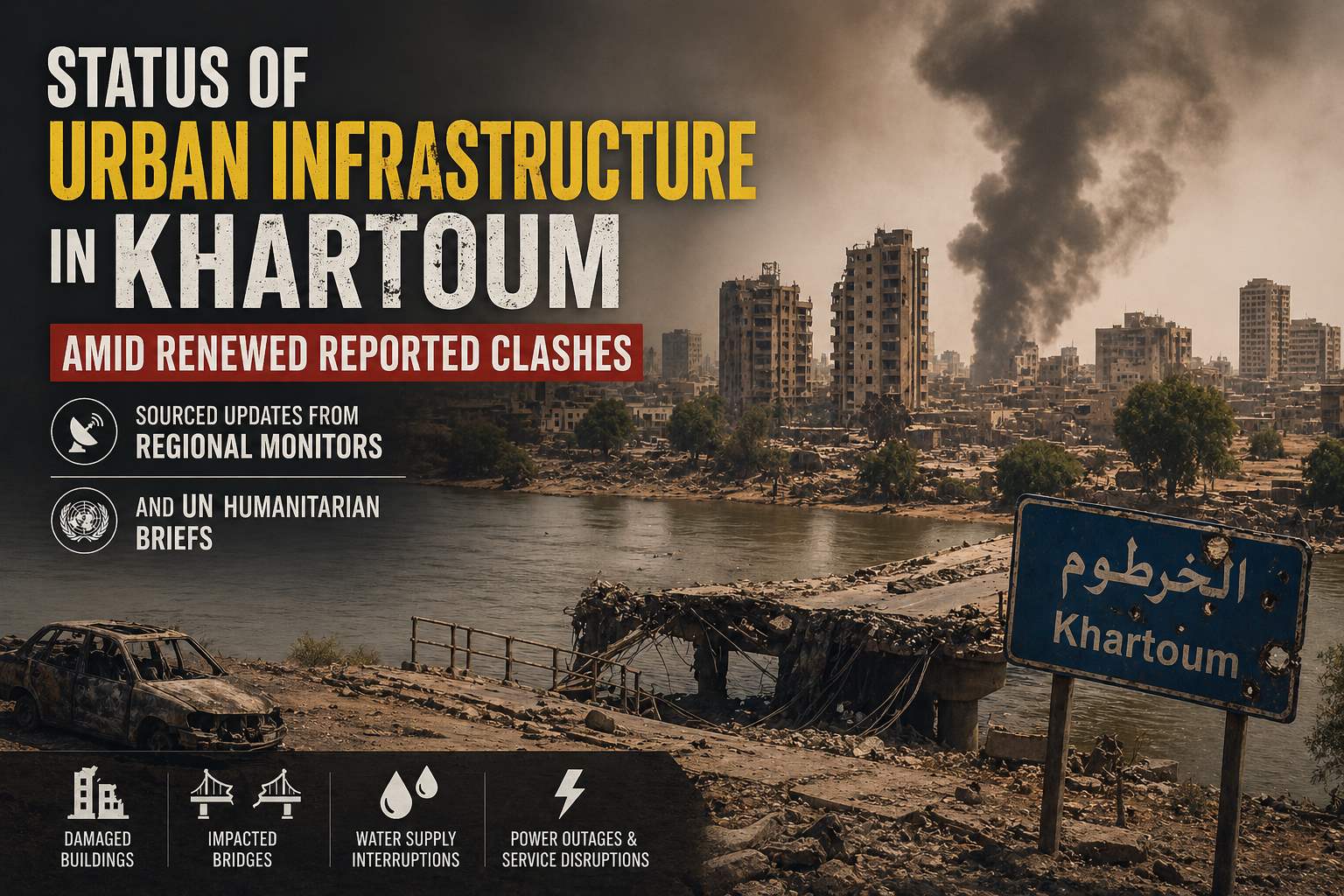
Regional monitors and UN agencies warn that three years of conflict have brought the capital’s power and water systems to the brink of permanent collapse.
April 28, 2026
Last Updated: April 28, 2026
By Global War News Editorial
Renewed reports of localized clashes in the Khartoum metropolitan area have further destabilized the city’s already fragile urban infrastructure. According to recent humanitarian briefs from the United Nations and regional monitors, the systematic destruction of utility networks has left millions without consistent access to electricity or clean water. While some residents have attempted to return to the city in early 2026, international agencies warn that the lack of essential services makes large-scale resettlement increasingly unsustainable.
The fighting, which has plagued the Sudanese capital since April 2023, continues to target or collateralize critical civilian assets. Recent assessments by the International Organization for Migration (IOM) and the World Health Organization (WHO) highlight that between 70% and 80% of health and utility infrastructure in active conflict zones is currently non-operational.
The economic cost of this degradation is staggering. Local government committees in Khartoum state estimate that the power sector alone has suffered losses exceeding $460 million. With nearly 14,000 transformers reportedly destroyed or looted, the path to recovery remains obstructed by both ongoing violence and a severe lack of international funding for reconstruction.
The Decimation of Water and Power Grids
The Drinking Water and Sanitation Authority in Khartoum has reported that all 13 of the city’s major water production stations have been affected by the war. According to Engineer Hisham Al-Amir, director general of the authority, the Bahri station—which historically produced 320,000 cubic meters of water daily—suffered severe damage early in the conflict and remains largely offline.
Reports from regional monitors suggest that even when stations are partially functional, the transmission lines required to deliver water to residential neighborhoods like Al-Sahafa and Al-Kalakla have been severed or looted. Residents in these areas reportedly rely on gasoline-powered pumps or expensive private water tankers, as the centralized grid can no longer maintain pressure.
The electricity sector faces a similar crisis. The United Nations Fact-Finding Mission for Sudan recently reported that both the Sudanese Armed Forces (SAF) and the Rapid Support Forces (RSF) have occupied or damaged power stations. Satellite imagery analysis confirms that distribution lines and transformers have been systematically dismantled across the city, leading to what observers describe as “organized sabotage” of the national grid.
Impact on Healthcare and Essential Services
The collapse of urban infrastructure has directly accelerated a public health crisis in the capital. The WHO has validated hundreds of attacks on healthcare facilities since the conflict began, with dozens of hospitals in Khartoum state sustaining partial or total damage.
According to a joint report by the Yale Humanitarian Research Lab and the Sudanese American Physicians Association (SAPA), nearly half of the city’s hospitals are currently non-functional. The lack of reliable electricity means that cold-chain storage for vaccines and life-saving medications has been severed, while surgical units are forced to operate on intermittent generator power.
Beyond healthcare, the destruction of markets and logistics hubs has paralyzed the local economy. The UN reports that communication outages and electricity blackouts have severed critical lifelines for small businesses and mutual aid groups, further driving up the cost of basic goods in a city already suffering from hyperinflation.
Analysis: The Cycle of Displacement and Return
Analysts note a troubling paradox in Khartoum’s current status. While the IOM reported in April 2026 that nearly 4 million people have attempted to return to their homes across Sudan—with a significant concentration in Khartoum—these returnees are entering a “resource vacuum.”
Observers suggest that the lack of infrastructure creates a secondary wave of displacement. When families return only to find no water, no power, and destroyed schools, they are often forced to flee a second time, compounding the humanitarian burden on neighboring regions. UN Emergency Relief Coordinator Tom Fletcher stated recently that without urgent investment to restore these basic services, the survival of the capital’s civilian population remains at extreme risk.
Closing Summary
As of late April 2026, the status of Khartoum’s infrastructure remains critical. While maintenance work is reportedly underway at select transformer stations in Khartoum East, the scale of the damage far outstrips current repair efforts. The international community continues to call for an immediate ceasefire and unrestricted humanitarian access to allow for the stabilization of these essential systems.
Sources: This report is based on humanitarian briefs from the UN (OCHA, IOM, WHO), reports from the Yale Humanitarian Research Lab, statements from the Sudanese Ministry of Irrigation and Water Resources, and coverage by Al Jazeera, AFP, and the Atar Network.
This article is based on publicly available reporting from named international news agencies and attributed official statements. All claims about ongoing events are attributed to their original sources. Analysis sections represent the editorial interpretation of reported facts and do not constitute advocacy for any party to the described conflict. AI tools may be utilized for image generation to assist in explaining complex concepts, as well as for refining grammar, spelling, and other linguistic enhancements. However, all original content is produced, fact-checked, and revised by the editorial team. This publication does not take political positions on active military conflicts.