
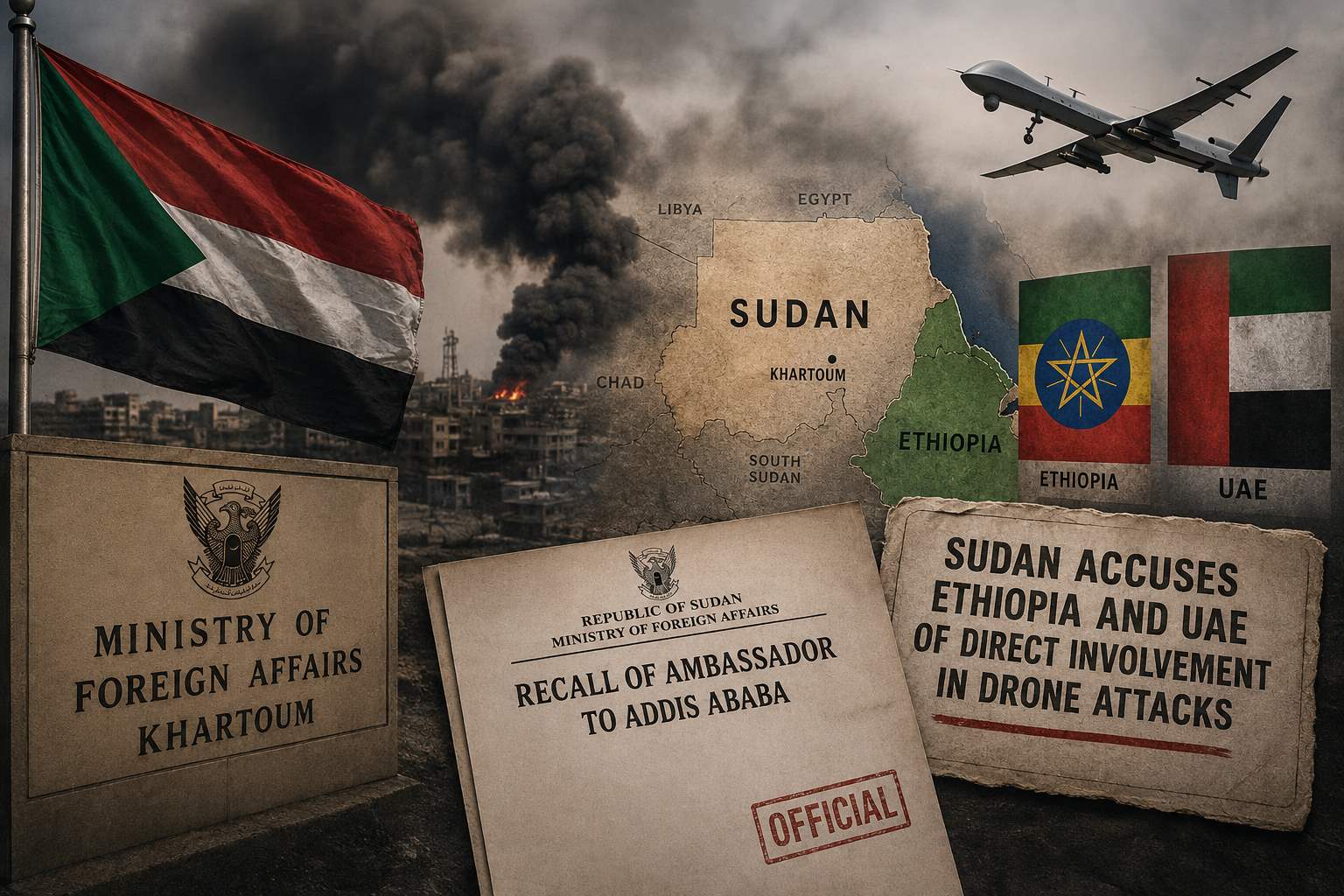
Khartoum recalls its ambassador to Addis Ababa as diplomatic tensions escalate over alleged military support for the Rapid Support Forces.
May 8, 2026
Global War News Editorial
The Sudanese government has formally accused Ethiopia and the United Arab Emirates of providing direct military assistance to the Rapid Support Forces (RSF) following a series of drone strikes in the Khartoum and Omdurman regions. In a significant diplomatic rupture, the Sudanese transitional sovereignty council announced the immediate recall of its ambassador to Addis Ababa for consultations, signaling a new low in regional relations.
General Abdel Fattah al-Burhan, the leader of the Sudanese Armed Forces (SAF), stated in a televised address on Thursday that recovered drone debris provided “irrefutable evidence” of foreign manufacturing and logistical support. While Ethiopia and the UAE have both previously denied involvement in the Sudanese internal conflict, this latest accusation specifically links foreign hardware to strikes on sovereign military installations.
Diplomatic Fallout in East Africa
The decision to recall the ambassador follows reports from the state-aligned Sudan News Agency (SUNA) alleging that Ethiopian airspace was used to facilitate the delivery of specialized munitions. According to a report by Al Jazeera, the Sudanese Foreign Ministry has also submitted a formal complaint to the United Nations Security Council, requesting an urgent session to discuss what it terms “external aggression.”
Ethiopia’s Ministry of Foreign Affairs responded on Friday morning, characterizing the accusations as “baseless and inflammatory.” A spokesperson for the Ethiopian government stated that the country remains committed to the Jeddah peace process and urged the Sudanese leadership to focus on internal dialogue rather than externalizing the causes of the conflict.
Allegations of UAE Involvement
The allegations against the United Arab Emirates center on the supply of advanced unmanned aerial vehicles (UAVs). Reuters reported that Sudanese military intelligence displayed components of tactical drones during a press briefing in Port Sudan, claiming they were channeled through regional proxies.
A statement released by the UAE Ministry of Foreign Affairs through the Emirates News Agency (WAM) reiterated the country’s neutrality. The UAE maintained that its involvement in Sudan is limited to humanitarian aid and the support of a peaceful transition to civilian rule. However, observers note that the persistence of these allegations continues to complicate diplomatic efforts led by the African Union.
Analysis: Regional Destabilization Risks
Analysts suggest that the public nature of these accusations indicates a shift in the SAF’s strategy. By naming Ethiopia and the UAE directly, Khartoum may be attempting to pressure the international community into implementing stricter monitoring of regional arms flows.
Observers from the Horn of Africa Research Group note that the tension between Khartoum and Addis Ababa is compounded by long-standing disputes over the Grand Ethiopian Renaissance Dam and the Al-Fashaga border region. The introduction of drone warfare into this mix raises the stakes for a conflict that has already displaced millions. It remains unclear whether this diplomatic freeze will lead to border skirmishes or if it serves as a precursor to a new round of mediated talks in a different regional capital.
Economic and Humanitarian Impact
The escalation has immediate consequences for the movement of aid. The UN Office for the Coordination of Humanitarian Affairs (OCHA) has expressed concern that increased kinetic activity and diplomatic friction may further restrict the “Adre corridor,” a vital route for food supplies. If Ethiopia closes its borders or restricts trade in response to the diplomatic recall, the already fragile food security situation in eastern Sudan could deteriorate.
Source Disclosure: Reporting from Reuters, Al Jazeera, the Sudan News Agency (SUNA), and the Emirates News Agency (WAM). Official statements from the Sudanese Sovereignty Council and the Ethiopian Ministry of Foreign Affairs.
This article is based on publicly available reporting from named international news agencies and attributed official statements. All claims about ongoing events are attributed to their original sources. Analysis sections represent the editorial interpretation of reported facts and do not constitute advocacy for any party to the described conflict. AI tools may be utilized for image generation to assist in explaining complex concepts, as well as for refining grammar, spelling, and other linguistic enhancements. However, all original content is produced, fact-checked, and revised by the editorial team. This publication does not take political positions on active military conflicts.