
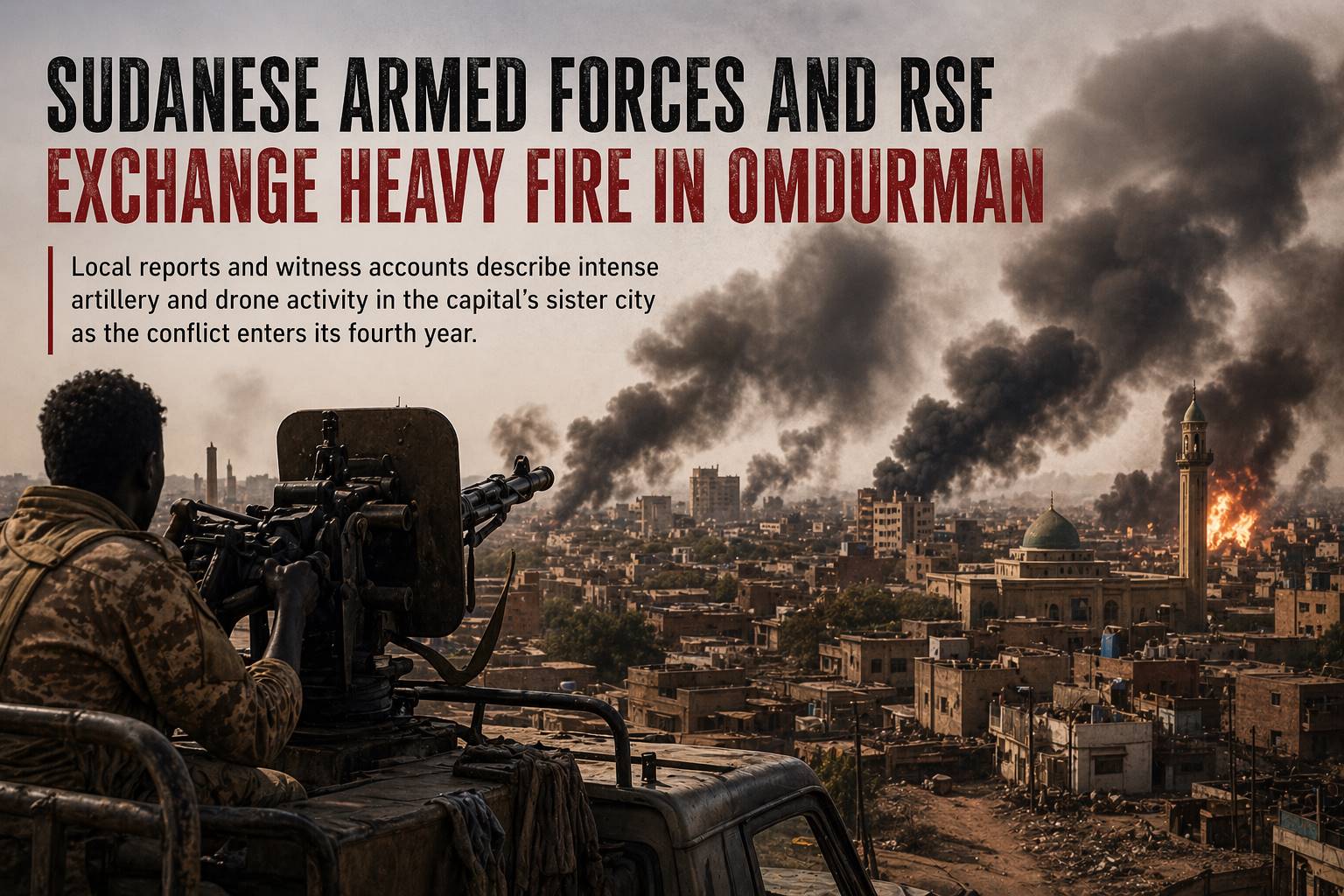
Local reports and witness accounts describe intense artillery and drone activity in the capital’s sister city as the conflict enters its fourth year.
April 21, 2026
By Staff Writer, Global War News
Clashes between the Sudanese Armed Forces (SAF) and the paramilitary Rapid Support Forces (RSF) intensified in Omdurman over the last 48 hours. According to reports from Al Jazeera and local witness accounts, the exchanges involved heavy artillery and drone strikes in several residential neighborhoods, marking a volatile escalation in the struggle for control over the tri-city capital region.
While the SAF recently regained control over large portions of central Omdurman, including the national radio and television headquarters, the RSF reportedly maintains a presence in the western and southern outskirts. The latest engagements suggest a concerted effort by the SAF to clear these remaining pockets, though the proximity of the fighting to civilian areas has raised immediate humanitarian alarms.
Escalation in Residential Sectors
Witnesses in the Al-Thawra and Ombada neighborhoods reported that the sound of heavy shelling began in the early hours of Sunday and continued intermittently through Monday evening. According to local volunteers and residents cited by Al Jazeera, several shells landed in civilian areas, causing damage to homes and local infrastructure.
The SAF has reportedly increased its use of drone surveillance and precision strikes to target RSF supply lines and temporary barracks. However, the RSF has countered with mobile anti-aircraft units and localized infantry ambushes. The SAF stated in a brief social media update that its operations are aimed at “neutralizing rebel nests,” while the RSF leadership accused the army of “indiscriminate bombardment” of civilian quarters. Neither claim could be independently verified by international observers.
Humanitarian Impact and Essential Services
The renewed fighting has further strained a healthcare system that medical professionals describe as being on the verge of collapse. According to a recent statement from Doctors Without Borders (MSF), hospitals in the Omdurman area are facing critical shortages of surgical supplies and fuel for generators.
- Displacement: Local neighborhood committees, known as “Emergency Response Rooms,” report that dozens of families have fled the southern districts of Omdurman in the last two days.
- Food Insecurity: The closure of local markets due to the shelling has hampered the distribution of aid. The World Food Programme (WFP) has previously noted that parts of Sudan are facing “unacceptable” levels of famine.
- Infrastructure Damage: Reports suggest that power stations and water treatment facilities in the region have suffered incremental damage from stray munitions, further complicating daily survival for those unable to flee.
Context: A War Entering Its Fourth Year
The conflict, which erupted in April 2023, has now crossed the three-year mark. What began as a power struggle between General Abdel Fattah al-Burhan of the SAF and Mohamed Hamdan “Hemedti” Dagalo of the RSF has evolved into a nationwide civil war.
According to data from the UN and the ACLED conflict monitoring project, the SAF has recently gained the upper hand in the Khartoum state offensive, breaking the RSF siege on several key military bases. However, the RSF continues to hold significant territory in the Darfur and Kordofan regions, leading to a solidified east-west divide that complicates any potential for a unified national ceasefire.
Analysis: The Strategic Value of Omdurman
Analysts suggest that the control of Omdurman is vital for the SAF’s goal of securing the entire capital region. By holding Omdurman, the SAF can protect its supply routes from the north and east while placing additional pressure on RSF positions across the Nile in Khartoum city.
However, the RSF’s resilience in the western suburbs suggests that they are prepared for a prolonged war of attrition. Observers note that without a breakthrough in diplomatic mediation—currently stalled as both sides seek military advantages—the residents of Omdurman remain trapped in a cycle of localized territorial shifts that offer no clear path toward stability.
Closing Summary
As of April 21, the situation in Omdurman remains fluid. While the SAF appears to be maintaining its offensive momentum, the RSF’s ability to embed within urban environments makes a decisive military conclusion unlikely in the short term. The international community continues to call for unhindered humanitarian access, yet on the ground, the sound of heavy fire remains the dominant reality for the people of the capital.
Sources: This report is based on local reporting from Al Jazeera, witness testimonies collected by regional news agencies, and official statements from the Sudanese Armed Forces. Additional humanitarian data was provided by reports from Doctors Without Borders (MSF) and UN agency briefings.
This article is based on publicly available reporting from named international news agencies and attributed official statements. All claims about ongoing events are attributed to their original sources. Analysis sections represent the editorial interpretation of reported facts and do not constitute advocacy for any party to the described conflict. AI tools may be utilized for image generation to assist in explaining complex concepts, as well as for refining grammar, spelling, and other linguistic enhancements. However, all original content is produced, fact-checked, and revised by the editorial team. This publication does not take political positions on active military conflicts.