
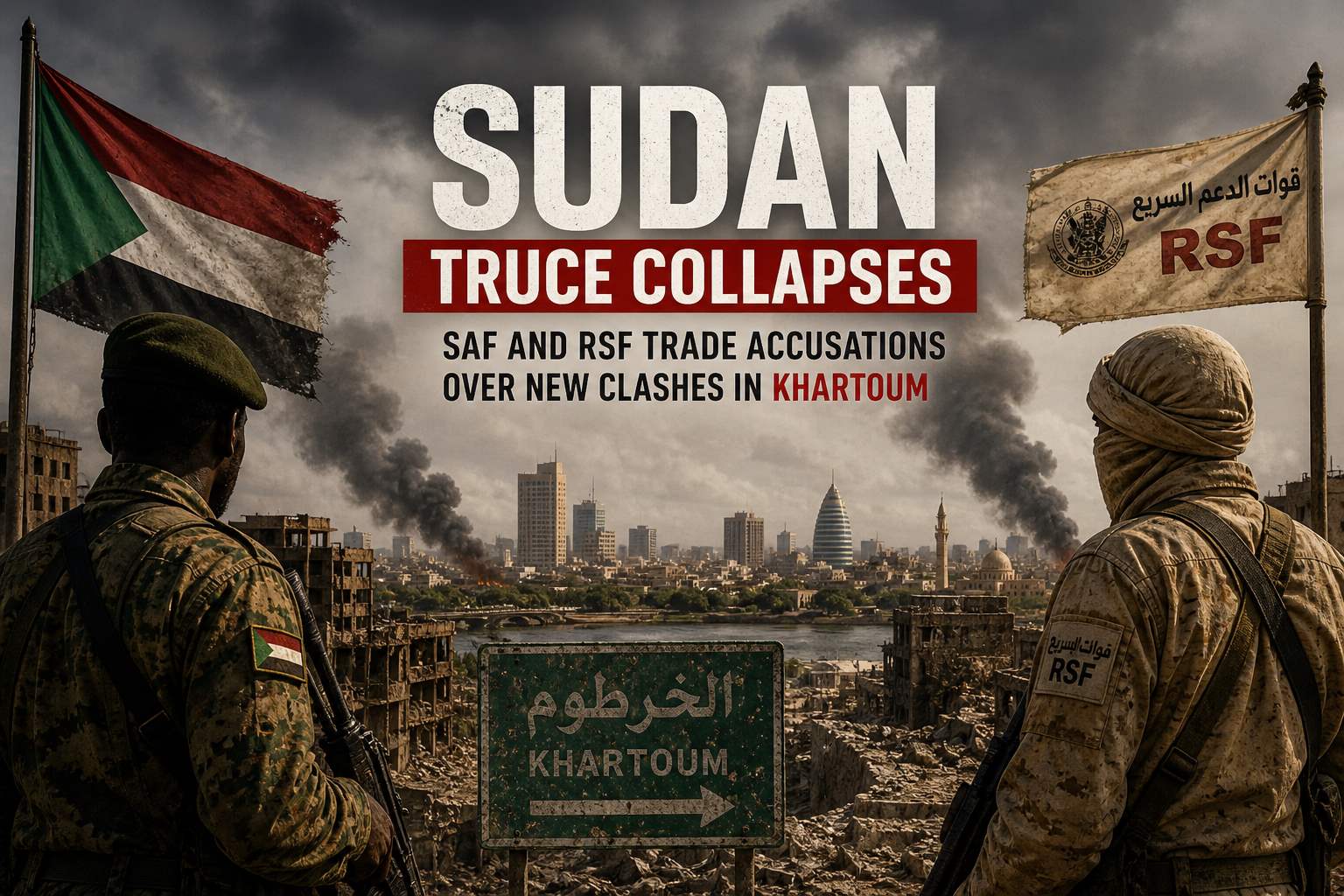
Drone strikes on the capital’s international airport shatter months of relative calm and trigger a diplomatic crisis with neighboring Ethiopia.
May 5, 2026
By Global War News Editorial
Renewed hostilities in Khartoum have led to a diplomatic rupture between the Sudanese government and Ethiopia following a series of drone strikes targeting the capital’s international airport on Monday. The Sudanese Armed Forces (SAF) and the paramilitary Rapid Support Forces (RSF) have traded accusations over the breakdown of local truces, as witnesses reported multiple explosions and smoke rising from the eastern sectors of the city.
In a press conference held in Khartoum on Tuesday, Foreign Minister Mohieddin Salem announced the recall of Sudan’s ambassador to Ethiopia for consultations. According to a statement carried by the official news agency SUNA, the Sudanese government alleges “conclusive evidence” that the drones used in the Monday attack originated from Ethiopian territory. Army spokesperson Brigadier General Asim Awad Abdelwahab further claimed that technical analysis of a downed drone linked the operation to the UAE and Ethiopian facilities, a charge that the Gulf state has repeatedly denied.
The RSF has not officially claimed responsibility for the recent barrage. However, local media and witnesses in the twin city of Omdurman reported that RSF-linked drones targeted several areas over the weekend, including a strike on a civilian vehicle on Saturday that reportedly killed five passengers.
Context and Background
Khartoum has experienced a period of relative stability since the SAF regained substantial control of the city in March 2025. This period allowed for the return of several government ministries and the resumption of limited international flights just last week. The recent strikes represent a significant escalation in what had become a hardened frontline along the city’s outskirts.
The conflict, which began in April 2023, has evolved into a fragmented war of attrition. While the SAF maintains control of the central and eastern regions from its administrative bases in Khartoum and Port Sudan, the RSF remains entrenched in the Darfur region and parts of Kordofan. The use of drone warfare has become increasingly prevalent as both sides seek to bypass ground fortifications, often leading to significant civilian casualties in densely populated urban zones.
Analysis: A Shift Toward Regionalization
The decision to recall the ambassador to Ethiopia marks a sharp escalation in the regional dimension of the Sudanese conflict. Analysts have suggested that the SAF’s public naming of Ethiopia and the UAE as direct participants in the drone campaign reflects a shift in strategy. By internationalizing the blame, the Sudanese government may be seeking to pressure the UN Security Council for more stringent monitoring of regional airspace.
The breakdown of local truces in Khartoum also raises questions about the stability of internal military alliances. Observers note that the recent defection of senior RSF commander al-Nour al-Guba to the SAF late last month may have triggered a retaliatory phase of strikes. It remains unclear whether these drone attacks are intended to seize territory or are merely punitive measures designed to disrupt the normalization of life in the capital. The “patchwork” nature of territorial control means that even small shifts in tactical pressure can have outsized effects on the already fragile humanitarian corridors.
Current Status and Outlook
As of May 5, airport operations in Khartoum have reportedly resumed following security sweeps. However, the atmosphere in the capital remains tense. International mediators from the African Union and the Arab League have called for an immediate return to the negotiation table, though the Sudanese government has stated it reserves the right to respond to what it terms “direct aggression.” Residents are advised to monitor official channels as the risk of sporadic strikes remains high in the city’s northern and eastern districts.
Source Disclosure: This report is based on official statements from the Sudanese Foreign Ministry and the Sudanese Armed Forces, reporting from Reuters and Agence France-Presse (AFP), and data provided by the rights group Emergency Lawyers and the Armed Conflict Location & Event Data Project (ACLED).
This article is based on publicly available reporting from named international news agencies and attributed official statements. All claims about ongoing events are attributed to their original sources. Analysis sections represent the editorial interpretation of reported facts and do not constitute advocacy for any party to the described conflict. AI tools may be utilized for image generation to assist in explaining complex concepts, as well as for refining grammar, spelling, and other linguistic enhancements. However, all original content is produced, fact-checked, and revised by the editorial team. This publication does not take political positions on active military conflicts.