
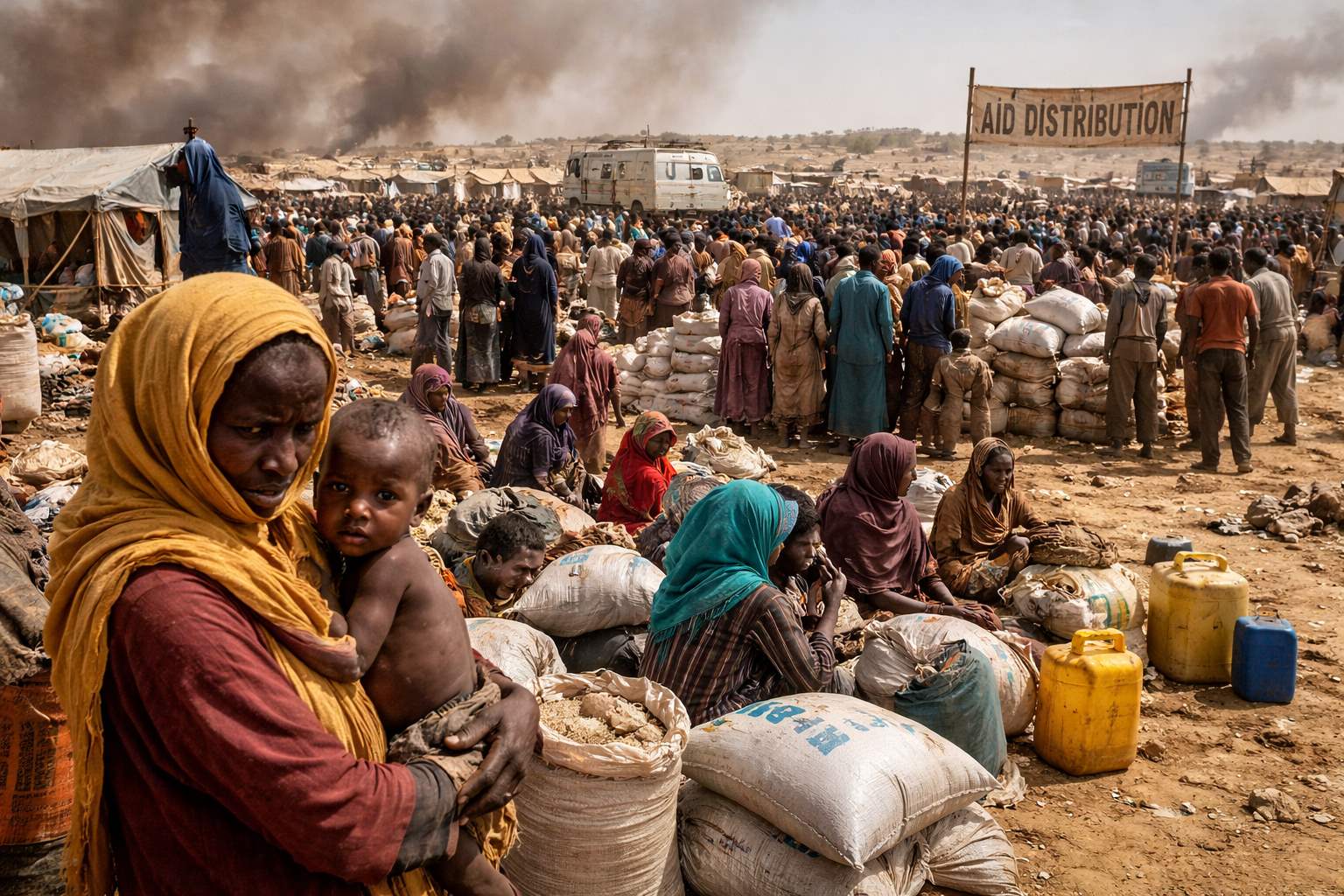
A deepening stalemate between military factions has left 33 million people in need of assistance while funding and access reach a breaking point.
April 29, 2026
By Global War News Editorial
The conflict in Sudan has officially entered its third year, marked by a rigid territorial partition and what international observers describe as the world’s most severe humanitarian crisis. As of late April 2026, the nation remains fractured between the Sudanese Armed Forces (SAF) in the east and the Rapid Support Forces (RSF) in the west, with neither side appearing capable of a decisive military victory.
The United Nations Office for the Coordination of Humanitarian Affairs (OCHA) released its 2026 Humanitarian Needs and Response Plan this month, revealing that approximately 33.7 million people, more than half the population, now require urgent assistance. Despite the scale of the emergency, aid agencies report that funding remains at less than 15% of the required levels, forcing a “humanitarian reset” that prioritizes only the most extreme cases of starvation.
A Nation Divided: The Current Frontlines
Military analysts from the International Crisis Group (ICG) report that the conflict has settled into a “protracted stalemate.” The SAF maintains control over central areas around the Nile, the north, and the strategic Red Sea hub of Port Sudan. Conversely, the RSF has consolidated its hold over nearly the entire Darfur region following the fall of El Fasher in late 2025.
Fighting has recently intensified in the Kordofan region, a critical agricultural and oil-producing belt that has become the new primary battleground. According to reports from the International Organization for Migration (IOM), this “unstable partition” has created a climate of constant displacement. While some 2.2 million people reportedly returned to parts of Khartoum earlier this year following a slight subsiding of urban combat, these movements are often reversed by fresh drone strikes and artillery shelling.
The Humanitarian Funding Gap
The gap between humanitarian needs and available resources has reached what the IOM Director General described as a “breaking point measured in human lives.” International aid organizations are currently appealing for $2.9 billion to sustain basic survival packages, yet global attention remains fragmented by competing crises.
The impact of this shortfall is visible in the burgeoning famine. According to the Integrated Food Security Phase Classification (IPC) data cited by the UN, more than 20 areas across Sudan are either in or at immediate risk of famine. Local responders, including “Emergency Response Rooms” run by Sudanese volunteers, have become the primary lifeline for millions, yet these groups face systemic risks, including targeted detention and the looting of supplies by armed actors.
Economic Paralysis and Supply Chain Collapse
Sudan’s war economy has led to a near-total collapse of domestic production. The Sudanese pound has lost significant value, and liquidity shortages have made it nearly impossible for civilians to purchase the few goods available in local markets.
- Trade Disruptions: Regional supply chains have been severed by the bifurcation of the country. Goods entering through Port Sudan often cannot reach RSF-controlled areas in the west without passing through multiple dangerous frontlines.
- Agricultural Decline: The Kordofan and Darfur regions, once the breadbasket of the country, are littered with landmines and explosive remnants of war (ERW), preventing farmers from planting essential crops.
- Infrastructure: Scores of attacks on healthcare facilities have been recorded over the last year, with the UN reporting the deaths of over 1,600 health workers and patients since the conflict began.
Analysis: The Risks of Permanent Partition
Analysts have suggested that the current stalemate is morphing into a durable, yet violent, partition. The establishment of competing administrative structures, the SAF-aligned government in Port Sudan and an RSF-led council in Nyala, indicates that both factions are digging in for long-term governance of their respective territories.
However, observers note that neither “government” has achieved international recognition or the ability to provide basic services. This raises questions about the viability of Sudan as a unified state. Without a decisive diplomatic intervention, the country risks becoming a permanent cluster of failed-state zones, providing a vacuum that could destabilize neighboring Chad, South Sudan, and Egypt. The current trajectory suggests that the “Sudan situation” is no longer a temporary war but a structural collapse of the state.
What to Watch
The upcoming rainy season in May and June is expected to worsen the humanitarian outlook, with seasonal flooding likely to trigger outbreaks of cholera and malaria in displacement camps. Furthermore, the international community’s response to the UN’s $2.9 billion appeal will determine whether aid agencies can maintain even a minimal presence in the most affected regions of Darfur and Kordofan.
Source Disclosure: This report is based on the Sudan Humanitarian Needs and Response Plan 2026 issued by UN OCHA, and situation updates from the International Organization for Migration (IOM) and UNHCR. Military and political analysis was sourced from the International Crisis Group and regional reporting by Al Jazeera and Reuters.
This article is based on publicly available reporting from named international news agencies and attributed official statements. All claims about ongoing events are attributed to their original sources. Analysis sections represent the editorial interpretation of reported facts and do not constitute advocacy for any party to the described conflict. AI tools may be utilized for image generation to assist in explaining complex concepts, as well as for refining grammar, spelling, and other linguistic enhancements. However, all original content is produced, fact-checked, and revised by the editorial team. This publication does not take political positions on active military conflicts.