
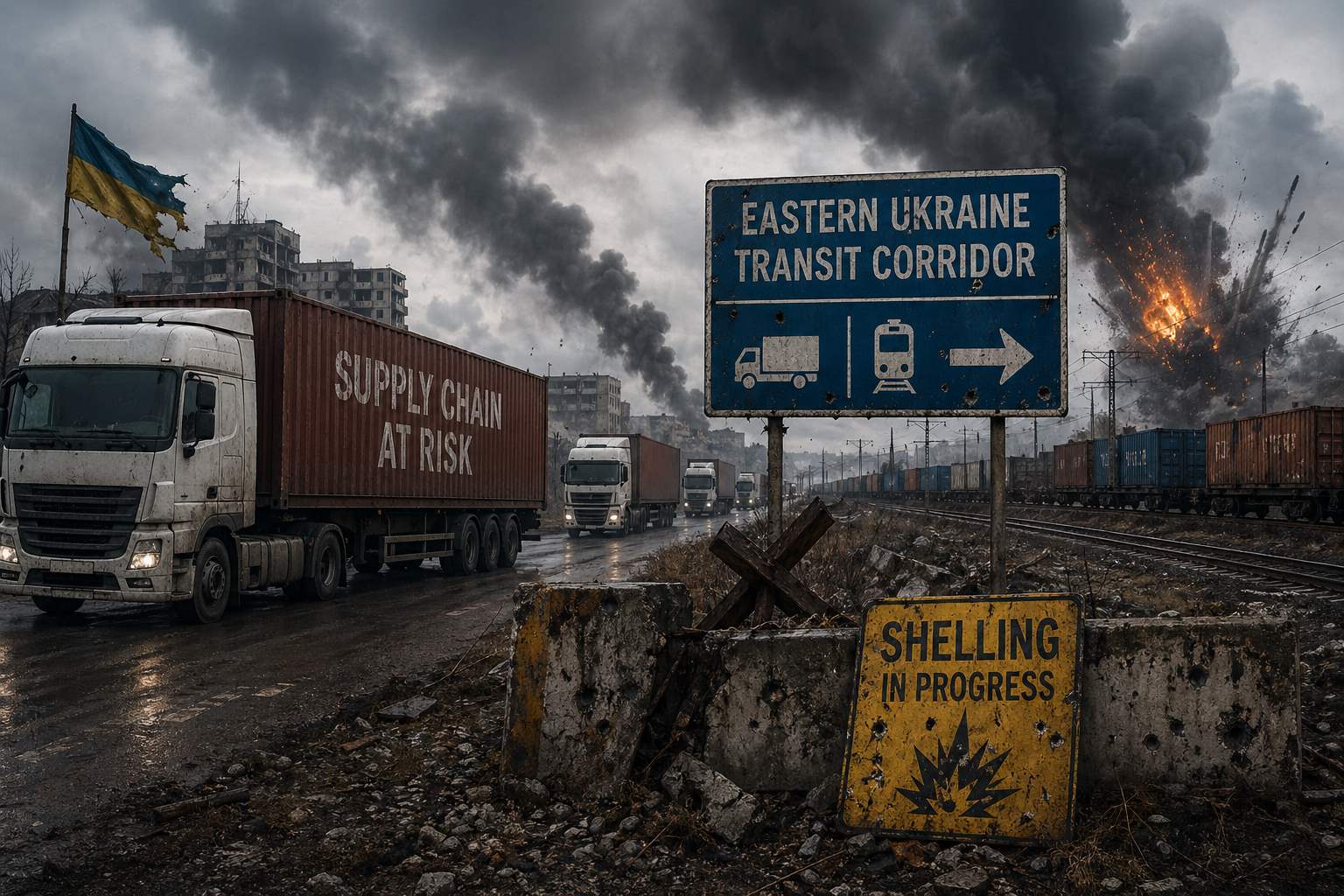
Rising instability in renovated transport hubs threatens local agricultural exports and regional price stability.
April 27, 2026
Last updated: April 27, 2026
By Global War News Editorial
Recent reports indicate a significant increase in artillery activity and shelling near critical supply corridors in Eastern Ukraine. These routes, which underwent extensive renovation over the past year to facilitate the movement of essential goods, are now facing renewed operational disruptions. The escalation threatens to stall the recovery of regional trade and increase logistics costs for local producers.
The intensified military activity has centered on transport hubs that serve as primary veins for both humanitarian aid and commercial exports. According to local administrative updates and reporting from Reuters, the shelling has damaged sections of newly laid road infrastructure and rail signaling systems. While no permanent closures have been announced, logistics firms have reportedly begun rerouting shipments, leading to immediate delays in the delivery of seasonal agricultural supplies.
Background: The Push for Renovated Corridors
Following the heavy damage sustained in previous years, an international consortium assisted in the renovation of Eastern Ukraine’s transit network throughout 2025. These corridors were designed to bypass the most volatile frontlines, providing a stabilized path for grain, sunflower oil, and industrial machinery to reach western markets.
Before the current escalation, the World Bank noted that the restored efficiency of these routes had contributed to a 12% increase in regional export volume during the first quarter of 2026. However, the proximity of these corridors to shifting contact lines has remained a persistent risk for insurers and transport operators alike.
Economic Impact: Infrastructure and Logistics
The immediate economic consequence of the shelling is the rising cost of transport insurance. According to industry analysts cited by the Associated Press, maritime and land-based insurance premiums for cargo moving through the region have seen a sharp uptick over the last 48 hours.
Local businesses are also facing a “wait-and-see” dilemma. For small-scale farmers in the Donbas periphery, the disruption to these corridors means a potential inability to move produce before spoilage occurs. Furthermore, the IMF has previously suggested that any prolonged disruption to Ukraine’s internal supply lines could exert renewed upward pressure on global food price indices, which had only recently begun to stabilize.
Analysis: Strategic Targets or Collateral Damage?
The targeting of areas near supply corridors raises questions about whether the infrastructure itself has become a strategic focus. While official military statements from the involved parties have not confirmed a deliberate policy of infrastructure destruction, the result remains the same: a narrowing of the economic “breathing room” for the region.
Observers note that by creating a persistent state of insecurity around these transit hubs, the economic viability of the renovated corridors is undermined without requiring their total physical destruction. This “gray zone” of risk effectively acts as an informal blockade, deterring foreign investment and slowing the pace of regional reconstruction.
Current Status and Outlook
As of late Monday, repair crews have reportedly been unable to reach several damaged sites due to the ongoing threat of secondary strikes. The situation remains fluid, and much depends on whether the current intensity of shelling represents a temporary spike or a shift in the broader operational landscape.
Traders and humanitarian organizations are currently monitoring the safety of these routes on an hourly basis. The primary indicator for the coming week will be whether major logistics providers continue to utilize these corridors or if they pivot to more expensive, longer routes through the southern districts.
Sources:
- Official statements from regional administrative authorities.
- Reporting from Reuters and Associated Press (April 26-27, 2026).
- Economic data on export volumes from the World Bank and IMF (Q1 2026 reports).
- Industry analysis from logistics and insurance risk consultants.
This article is based on publicly available reporting from named international news agencies and attributed official statements. All claims about ongoing events are attributed to their original sources. Analysis sections represent the editorial interpretation of reported facts and do not constitute advocacy for any party to the described conflict. AI tools may be utilized for image generation to assist in explaining complex concepts, as well as for refining grammar, spelling, and other linguistic enhancements. However, all original content is produced, fact-checked, and revised by the editorial team. This publication does not take political positions on active military conflicts.