
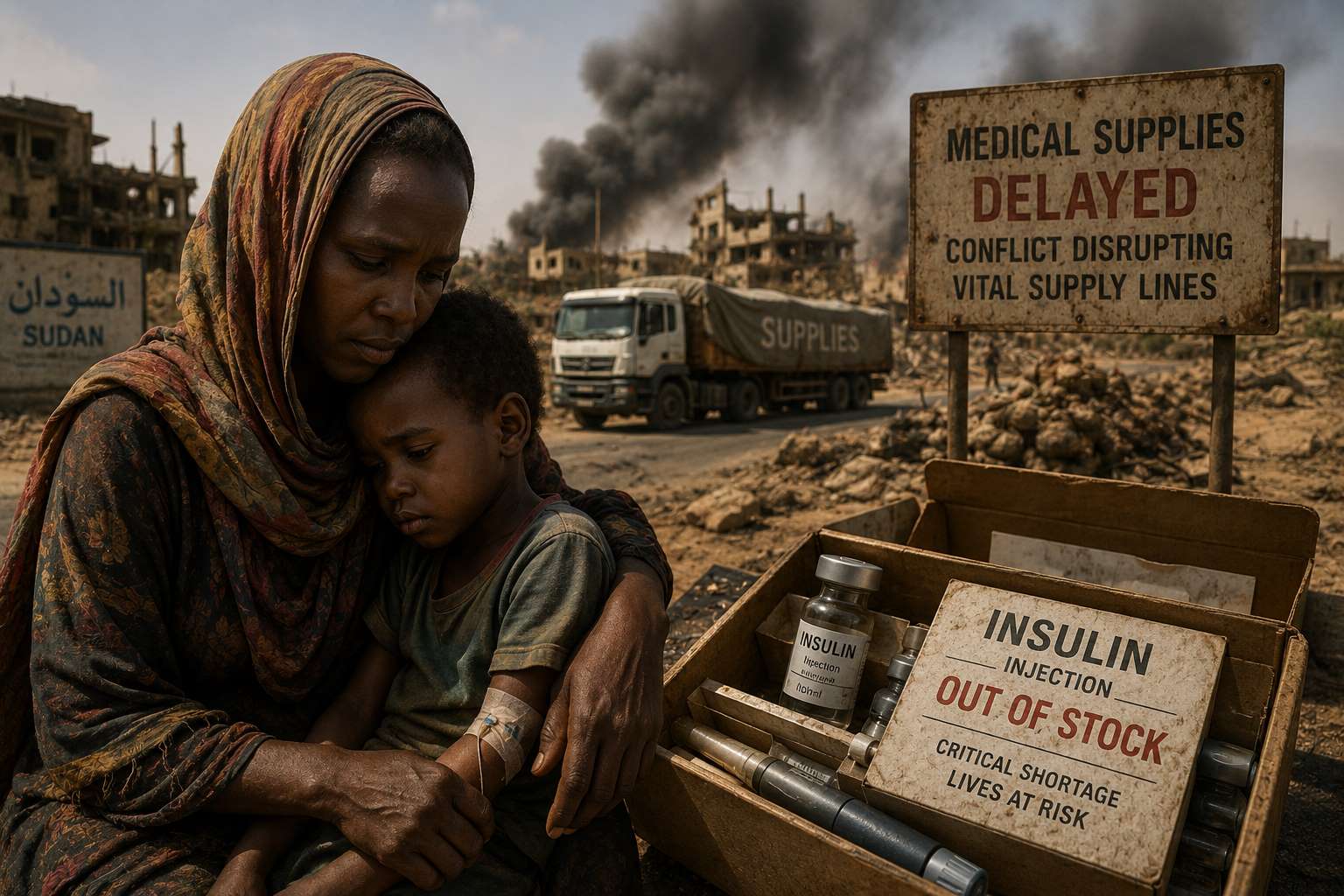
The intersection of an active internal war and maritime blockades in the Middle East drives shipping insurance up by 120%, leaving essential temperature-sensitive medical supplies stranded at regional transit hubs.
Publication Date: June 2, 2026
Last Updated: June 2, 2026
Byline: Global War News Editorial
PORT SUDAN: The convergence of Sudan’s prolonged civil conflict and the widening maritime disruptions in the Middle East has created an acute medical logistics emergency, cutting off the primary supply lines for vital pharmaceuticals, including insulin. Shipments of cold-chain dependent medicines destined for humanitarian programs have become stranded at regional transport hubs due to the closure of critical waterways and subsequent re-routing delays.
According to a formal report released by Save the Children, vital shipments of medical supplies intended for families in Sudan are currently held in Dubai due to security closures affecting the Strait of Hormuz. The international aid agency warned that these specific logistical backlogs put more than 90 primary healthcare facilities across Sudan at immediate risk of completely exhausting their remaining inventories of essential medicines.
Compounding these external logistics failures, Sudan’s domestic infrastructure is heavily degraded. Official data published by the Sudanese Ministry of Health indicates that approximately 85% of the nation’s domestic industrial sector has suffered severe physical damage since the outbreak of internal hostilities in 2023. This destruction includes the wholesale loss of pharmaceutical manufacturing plants in Khartoum that previously formulated over 80 distinct varieties of essential medications, leaving the country almost entirely reliant on vulnerable international import corridors.
The Logistical Bottleneck and Cost Escalations
The transport of insulin requires rigid temperature controls, known as a cold chain, from the point of manufacture to delivery. The current security environment in the Red Sea and the wider Gulf region has altered standard maritime shipping parameters, introducing severe friction into these sensitive pipelines:
- Skyrocketing Transit and Insurance Fees: Walid Mohamed Ahmed, head of the medicine importers’ division in Sudan, stated publicly that specialized maritime insurance and transport costs for pharmaceutical containers have jumped by up to 120%. While older orders processed before the late winter escalation continue to filter slowly into Port Sudan, new procurement contracts face indefinite delays.
- Alternative Route Constraints: In response to the regional closures, aid organizations have attempted to establish alternative paths. Save the Children confirmed it is exploring an emergency overland route across Jeddah, Saudi Arabia, to bypass blocked waters, subsequently utilizing localized sea freight to reach Port Sudan. However, this adjustment adds an estimated $1,000 to $2,000 in operational costs per shipping container.
- The Infeasibility of Air Freight: For highly sensitive cargo, air logistics costs have become prohibitive. In one documented instance, nutrition and medical supplies originally routed via land and sea channels had to be converted to emergency air transport, resulting in a single-freight cost exceeding $240,000. Sudanese economic analyst Haitham Mohamed Fathi noted that concurrent spikes in international oil prices are driving the baseline production and delivery costs of all incoming medical products beyond the reach of local authorities.
Domestic Collapse of the Sudanese Healthcare Network
The suspension of international pharmaceutical shipments arrives at a time when Sudan’s internal health infrastructure is facing systematic collapse. The World Health Organization (WHO) published an updated assessment reporting that Sudan represents the world’s largest ongoing humanitarian health crisis, with 34 million people requiring immediate assistance and 21 million individuals entirely detached from basic health services.
Across the country’s 18 states, the WHO confirmed that 37% of all established health facilities are completely non-functional. Ongoing fighting, structural shelling, and direct attacks on medical staff have severely hollowed out the remaining network. In late spring, an aerial attack on the El Daein Teaching Hospital in East Darfur rendered the facility entirely non-functional and resulted in at least 64 deaths, including healthcare workers and patients.
With formal urban medical hubs out of service, individuals living with chronic conditions such as Type 1 diabetes face severe risks. The International Diabetes Federation (IDF) issued an alert confirming that strategic reserves of essential chronic care medications within Sudan had dropped below 20% of pre-war averages, meaning local dispensaries are operating on less than a month’s worth of localized insulin supply.
ANALYSIS: The Combined Impact of Interlocking Conflicts
The structural starvation of Sudan’s insulin supply provides a stark case study in how localized conflicts are amplified by secondary regional wars. Sudan’s domestic health system was already severely compromised by its internal power struggle, yet it maintained a fragile survival mechanism by importing raw materials and finished medical goods through international aid organizations operating out of Gulf logistics hubs.
When the broader conflict directly impacted shipping through the Strait of Hormuz, it exposed the extreme vulnerability of this single-point supply line. For temperature-sensitive items like insulin, a delay of two to three weeks at a maritime port is not merely a bureaucratic or financial issue; it is a physical failure of the product itself, as cold-chain storage systems at grid-compromised transit centers fail.
The strategy currently pursued by the Sudanese National Medical Supplies Fund, attempting to source alternative contract manufacturing from non-Gulf nations like Egypt or Turkey, faces deep challenges. Both of those nations rely heavily on chemical precursors and raw inputs that originate in India and China, meaning their own domestic outputs remain vulnerable to the exact same shipping blockades and transport premium increases. Without dedicated, internationally protected humanitarian corridors that exempt medical cargo from the broader geopolitical containment protocols in the Middle East, the chronic disease mortality rate within Sudan is projected to surpass direct battlefield casualties before the end of the quarter.
What to Watch Next
As the pharmaceutical shortfall worsens, several operational developments will dictate the survival capacity of Sudan’s chronic care infrastructure:
- Exemptions for Global Waterways: Whether international mediators can successfully negotiate binding humanitarian carveouts to allow medical supplies to clear the transit blocks currently choking the ports of Dubai.
- Implementation of Regional Procurement: The progress of the WHO-backed proposal to move pharmaceutical procurement entirely to localized hubs within safer, secondary provinces in eastern and central Sudan.
- Last-Mile Distribution Capabilities: Whether domestic groups can successfully transport incoming shipments from Port Sudan across active frontlines to reaching vulnerable clinics in Khartoum and Darfur without interception or spoilage.
Source Disclosure Note: This report incorporates verified data and public updates from the World Health Organization (WHO), field intelligence logs from Save the Children, supply chain cost data from the Sudanese National Medicines and Poisons Board, and chronic care infrastructure tracking from the International Diabetes Federation (IDF). Additional context regarding local manufacturing damage was obtained via the Sudanese Ministry of Health and independent tracking briefs published by the Sudan Tribune.
This article is based on publicly available reporting from named international news agencies and attributed official statements. All claims about ongoing events are attributed to their original sources. Analysis sections represent the editorial interpretation of reported facts and do not constitute advocacy for any party to the described conflict. AI tools may be utilized for image generation to assist in explaining complex concepts, as well as for refining grammar, spelling, and other linguistic enhancements. However, all original content is produced, fact-checked, and revised by the editorial team. This publication does not take political positions on active military conflicts.