
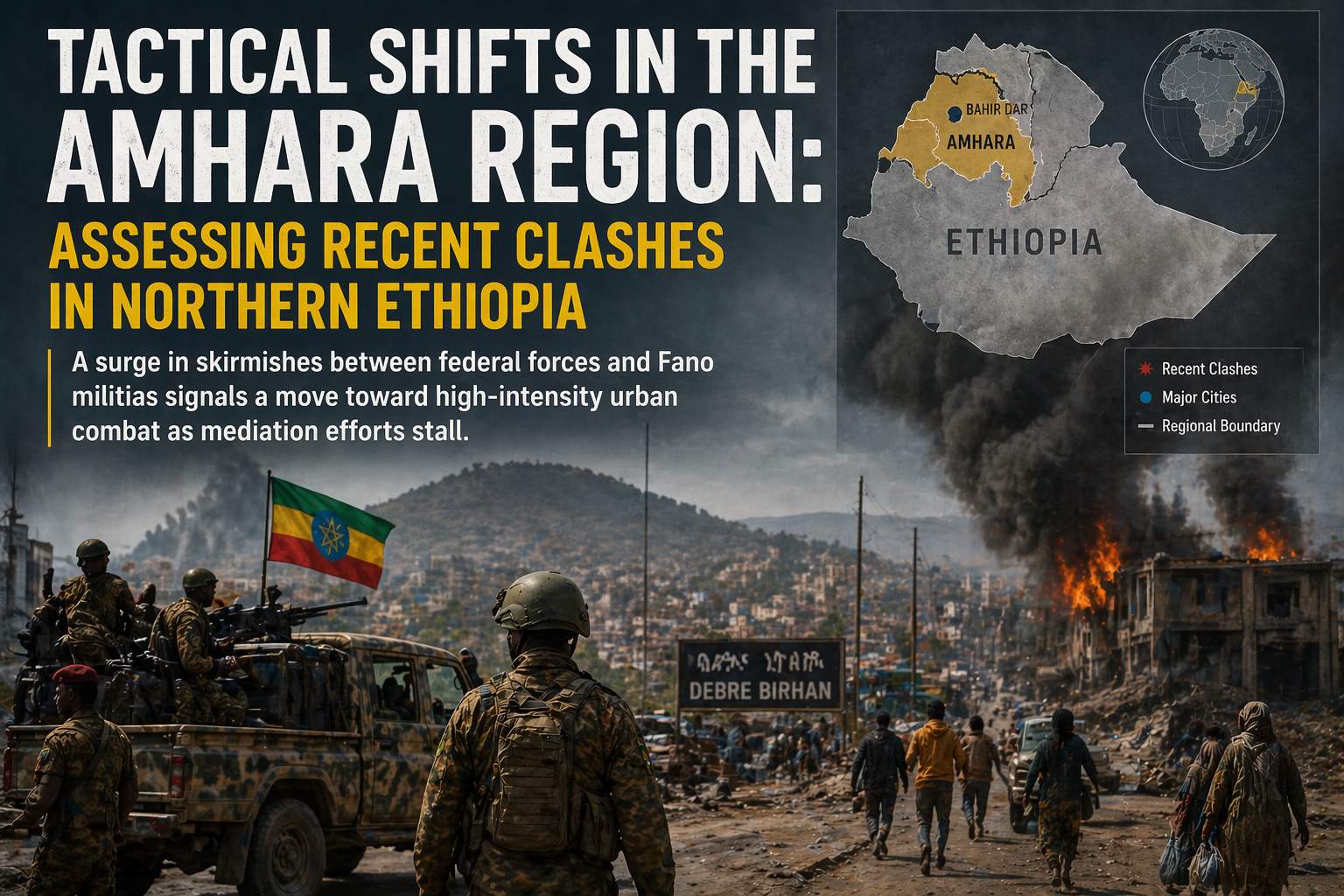
A surge in skirmishes between federal forces and Fano militias signals a move toward high-intensity urban combat as mediation efforts stall.
April 23, 2026
Last Updated: 17:50 GMT
By Global War News Editorial
The security landscape in Ethiopia’s Amhara region has undergone a significant tactical shift over the past week. Independent reporting and localized security alerts indicate an escalation in direct engagements between the Ethiopian National Defense Force (ENDF) and the regional Fano militias. What was previously characterized by hit-and-run tactics in rural highlands has increasingly moved toward strategic urban centers, specifically targeting administrative hubs in the North Gondar and Gojjam zones.
Reports of Urban Engagements
According to reports from the Associated Press and local sources cited by the Ethiopian Human Rights Council (EHRCO), heavy gunfire was reported in the city of Gondar and the town of Debre Markos throughout Tuesday and Wednesday. The ENDF reportedly utilized heavy artillery and armored units to secure government installations, while Fano fighters utilized their knowledge of urban terrain to launch coordinated ambushes on military convoys.
Federal government spokespersons have stated that the military is conducting “stabilization operations” to disarm “illegal armed groups” and restore constitutional order. However, the Fano leadership has countered this in digital statements, asserting that they are defending regional autonomy and resisting what they describe as “federal encroachment” on Amhara interests. As of Thursday morning, neither side has been able to claim undisputed control over the outskirts of the affected cities.
Civilian Displacement and Communication Blackouts
The intensification of fighting has led to a deteriorating humanitarian situation. According to the United Nations Office for the Coordination of Humanitarian Affairs (OCHA), fresh displacement has been reported in the North Wollo zone, with thousands of civilians fleeing toward the neighboring Afar region.
A persistent challenge to verifying the scope of the conflict remains the sporadic communication blackouts. According to reports from NetBlocks and local journalists, internet and cellular services have been restricted in parts of the Amhara region since the escalation began. This lack of transparency has hindered the documentation of civilian casualties and complicates the delivery of essential medical supplies to local hospitals, which are reportedly operating at maximum capacity.
Analysis: The Evolution of Militia Strategy
Military analysts observing the Horn of Africa note that the Fano militias have transitioned from a loosely organized volunteer force into a more structured insurgent movement. The ability to coordinate simultaneous attacks across multiple zones suggests an improvement in their command-and-control capabilities.
Observers suggest that the ENDF’s reliance on air power and heavy weaponry in populated areas may be a response to the difficulty of engaging the militia in close-quarters urban combat. It remains unclear whether the federal government intends to pursue a total military victory or if these operations are designed to force the Fano leadership into a disadvantaged position ahead of potential, though currently unconfirmed, peace talks.
Economic Impact: The Blockade of the Northern Corridor
The instability in the Amhara region has severe implications for Ethiopia’s broader economy. The region is a vital agricultural hub and sits across the primary transport corridor connecting the capital, Addis Ababa, to the northern borders. According to data from the National Bank of Ethiopia and regional trade monitors, the price of grain and pulses has surged by approximately 18% this month due to the frequent closure of the main highways by both military checkpoints and militia roadblocks.
Furthermore, the disruption of the “Northern Corridor” has affected the transit of fuel and commercial goods, adding to the inflationary pressures already facing the country. International logistics firms have reportedly suspended non-essential transport through the region until a stable security corridor can be guaranteed.
What to Watch
The international community is monitoring for signs of a wider regional contagion. Specifically, observers are watching the movements along the borders of the Tigray and Oromia regions to see if the Amhara conflict triggers shifts in the delicate post-2022 peace balance. The African Union (AU) has called for a cessation of hostilities, but without a formal mechanism for dialogue between the federal government and the decentralized Fano commands, the prospect of a near-term truce remains low.
Sources: This report is based on reporting from the Associated Press, Reuters, and the Ethiopian Human Rights Council (EHRCO). Humanitarian updates were sourced from UN OCHA, and digital connectivity data was provided by NetBlocks. Economic assessments were informed by the National Bank of Ethiopia and regional market monitors.
This article is based on publicly available reporting from named international news agencies and attributed official statements. All claims about ongoing events are attributed to their original sources. Analysis sections represent the editorial interpretation of reported facts and do not constitute advocacy for any party to the described conflict. AI tools may be utilized for image generation to assist in explaining complex concepts, as well as for refining grammar, spelling, and other linguistic enhancements. However, all original content is produced, fact-checked, and revised by the editorial team. This publication does not take political positions on active military conflicts.