
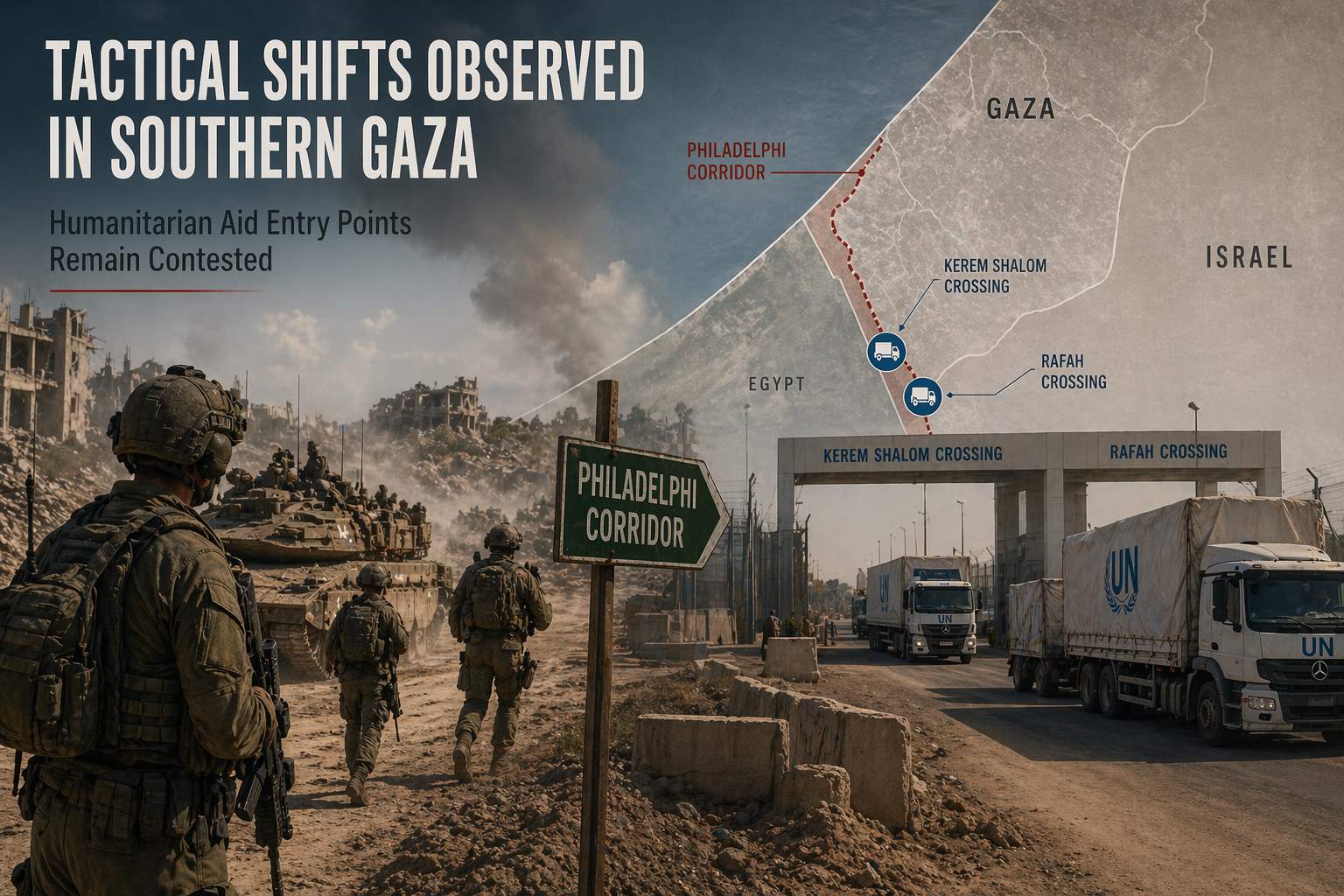
Military movements near the Philadelphi Corridor coincide with ongoing disputes over the security and management of the Kerem Shalom and Rafah crossings.
April 22, 2026
Last Updated: April 22, 2026
By Global War News Editorial
Recent military movements in southern Gaza indicate a significant tactical shift as the Israel Defense Forces (IDF) reportedly consolidate control over strategic buffer zones. According to satellite imagery and reports from the Associated Press, there has been a notable increase in the construction of semi-permanent military outposts along the Philadelphi Corridor, a 14-kilometer strip of land separating Gaza from Egypt.
While military activity has transitioned toward what analysts describe as “targeted raids” rather than large-scale troop maneuvers, the situation surrounding humanitarian entry points remains volatile. Negotiations over the reopening of the Rafah crossing have reached a standstill, with the United Nations reporting that aid flow into the southern districts has dropped by approximately 40% over the last thirty days due to security concerns and logistical bottlenecks.
Consolidation Along the Buffer Zone
According to a statement from the IDF spokesperson’s office, operations in the southern sector are currently focused on “neutralizing underground infrastructure” and preventing the smuggling of munitions across the border. These operations have led to the establishment of a reinforced security perimeter that now restricts movement in several formerly residential neighborhoods of Rafah.
Local sources, as reported by Al Jazeera, state that these tactical shifts have created a “no-man’s land” that complicates the movement of local civilian administrators. The Syrian-based Monitoring Group for Human Rights noted that the expansion of this buffer zone has resulted in the further displacement of several thousand families who had recently returned to the area following earlier withdrawals.
The Contested Status of Aid Gateways
The management of the Kerem Shalom and Rafah crossings remains the primary point of international diplomatic friction. According to a briefing from the UN Office for the Coordination of Humanitarian Affairs (OCHA), the Kerem Shalom crossing is currently the only high-capacity artery for supplies, but its operations are frequently interrupted by protests and ongoing combat nearby.
Reports from Reuters indicate that the Egyptian government has maintained its position that the Rafah crossing must be managed by Palestinian entities to resume full operations. Conversely, Israeli officials have stated publicly that they will not allow any group linked to the previous administration in Gaza to oversee the transit of goods. This administrative deadlock has left hundreds of trucks loaded with perishable food and medical supplies idling in the Sinai Peninsula.
Analysis: The Strategy of “Controlled Access”
Military analysts have suggested that the current tactical posture in southern Gaza represents a move toward a “long-term security envelope.” By controlling the primary entry and exit points, the IDF can regulate the flow of both people and goods without maintaining a large-scale presence inside high-density civilian areas.
However, observers note that this strategy carries significant humanitarian risks. “The decoupling of military control from administrative responsibility creates a vacuum,” says a senior analyst at a regional policy center. “When the entry points for life-saving aid become contested military objectives, the civilian population faces a secondary crisis of scarcity that is often more lethal than the direct combat.”
From an economic perspective, the near-total reliance on a single crossing (Kerem Shalom) has created a monopoly on trade routes, leading to a surge in black-market prices for basic commodities inside the Gaza Strip. According to data from the World Food Programme (WFP), the price of flour and clean water in southern Gaza has increased by more than 200% since the start of the year.
Future Outlook and Regional Stability
The international community, led by the “Quartet” mediators, continues to push for a neutral third-party entity to manage the border crossings. According to reports from the BBC, several European nations have offered to provide monitors to oversee the Rafah crossing, but a formal agreement remains elusive.
What to watch for in the coming weeks is whether the current military consolidation along the Philadelphi Corridor becomes a permanent fixture. Any moves toward long-term fortification may prompt a formal diplomatic response from Cairo, which has previously stated that a permanent Israeli military presence on its border would violate existing security protocols.
Sources: This article is based on reporting from the Associated Press, Reuters, Al Jazeera, the BBC, and official statements from the IDF, UN OCHA, and the World Food Programme.
This article is based on publicly available reporting from named international news agencies and attributed official statements. All claims about ongoing events are attributed to their original sources. Analysis sections represent the editorial interpretation of reported facts and do not constitute advocacy for any party to the described conflict. AI tools may be utilized for image generation to assist in explaining complex concepts, as well as for refining grammar, spelling, and other linguistic enhancements. However, all original content is produced, fact-checked, and revised by the editorial team. This publication does not take political positions on active military conflicts.