
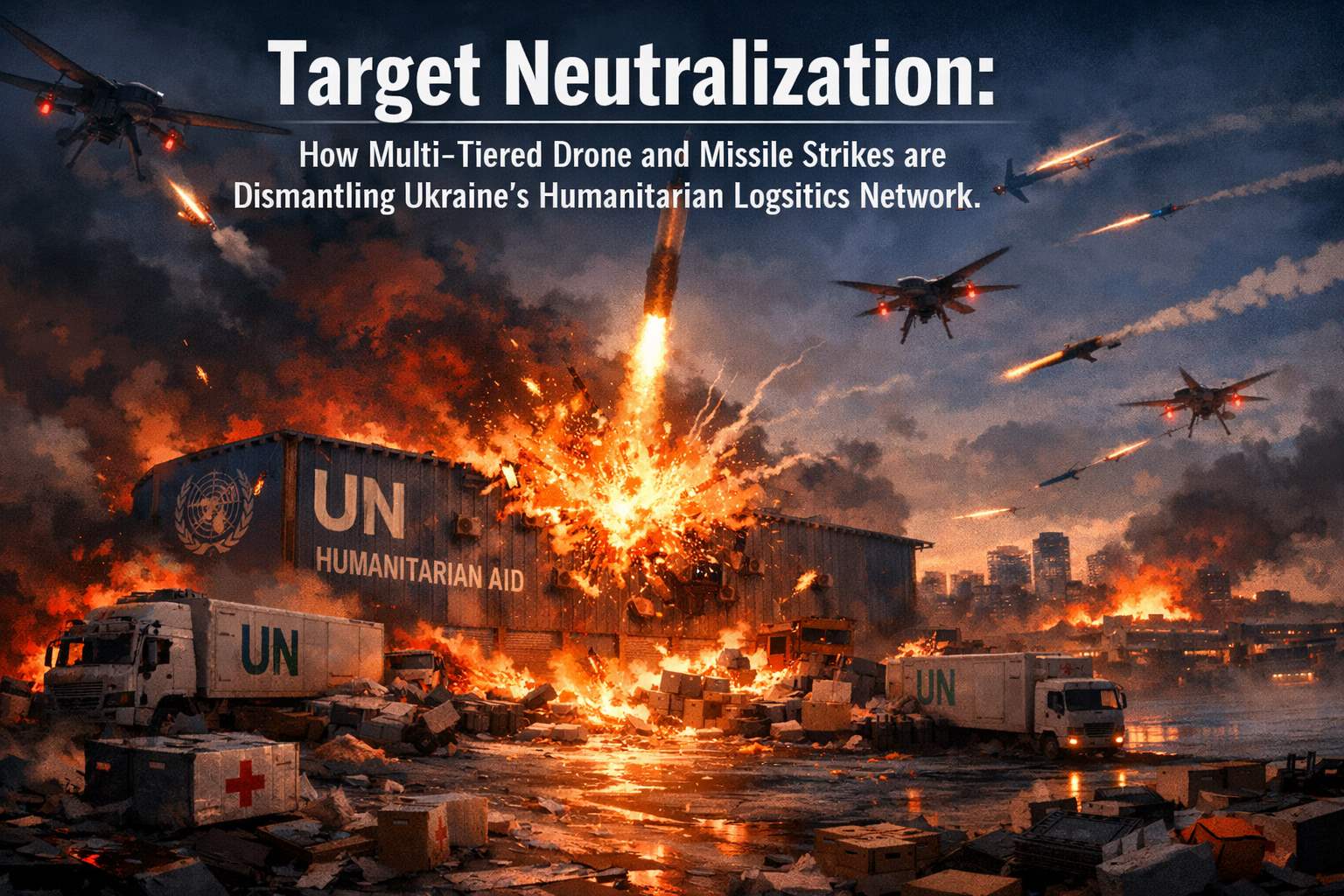
Following a high-altitude ballistic strike on a major UN supply hub in Dnipro, international monitoring groups warn of systemic supply grid collapse as escalating operations directly target protected humanitarian storage.
Publication Date: May 21, 2026
Last Updated: May 21, 2026
By Global War News Editorial
The infrastructure sustaining millions of displaced civilians across Ukraine faces an unprecedented operational crisis. Following a severe escalation in long-range aerial bombardments during the first half of May 2026, international monitoring groups and United Nations entities have warned that the logistical backbone of the humanitarian response is being systematically dismantled.
The crisis reached a critical inflection point on the night of May 19, 2026, when a Russian ballistic missile strike directly hit a major logistics terminal in Dnipro contracted by the UN Refugee Agency (UNHCR). The attack killed two facility workers, ignited a massive industrial fire, and obliterated over one million dollars worth of critical emergency relief items. This development follows a documented wave of heavy bombardments hitting energy hubs, railway corridors, and healthcare facilities across western and central Ukraine, signaling a shift in the conflict’s geographic and operational footprint.
For international observers, the precision targeting of logistics nodes signals a highly volatile phase of the war. As supply corridors collapse under persistent long-range strikes, international aid agencies face severe delivery blockades, soaring operational insurance costs, and a rapidly expanding vacuum in emergency support for millions of front-line civilians.
The Destruction of the Dnipro Hub
According to an official statement issued on May 20, 2026, by Bernadette Castel-Hollingsworth, the UN Refugee Agency Representative in Ukraine, the targeted facility in Dnipro was heavily compromised by a high-velocity ballistic missile. Preliminary damage assessments conducted by emergency response teams indicated that the resulting fire destroyed approximately 900 pallets of essential humanitarian cargo.
The inventory of the destroyed stock reflects the immediate human cost of the logistical disruption. The lost supplies included specialized shelter materials designed for rapid structural reinforcement following missile attacks, alongside heavy thermal blankets, sleeping mats, and family hygiene kits. These assets were staged for immediate deployment to civilian evacuation transit sites throughout the Dnipropetrovsk oblast and adjacent front-line territories, where local displacement figures have spiked amid renewed ground hostilities.
The loss of a consolidated regional distribution node leaves local partner organizations without immediate access to emergency reserves. Maritime and overland supply lines originating from central European staging areas must now absorb prolonged transit delays, as distribution networks are forced to decentralize to avoid localized tracking and subsequent strikes.
A Broadening Patterns of Critical Strikes
The destruction in Dnipro is part of a larger, systemic expansion of aerial operations. According to briefings provided to the UN Security Council on May 19, 2026, by Ukraine’s Permanent Representative, Andrii Melnyk, the first four months of 2026 have emerged as one of the deadliest and most destructive periods for non-combatant infrastructure since the escalation of the conflict.
Data compiled by the UN Human Rights Monitoring Mission in Ukraine (HRMMU) indicates that a steep increase in the deployment of long-range precision weaponry has driven an estimated 31% rise in infrastructure damage and civilian casualties compared to the same period in 2025. This expanding offensive capability was demonstrated on May 13, 2026, when Russian forces deployed a coordinated fleet of approximately 800 long-range drones, executing a 24-hour continuous strike wave targeting railway intersections and high-voltage energy grids in Ukraine’s western border regions, including Rivne, Volyn, and Ivano-Frankivsk.
Furthermore, international organizations have documented the frequent utilization of “double-tap” strike tactics. In these operations, an initial missile strike is followed by a secondary precision bombardment targeting the exact same coordinates minutes later, explicitly threatening arriving emergency personnel, search-and-rescue teams, and localized supply trucks.
The Structural Degradation of Essential Systems
Beyond dedicated aid storage facilities, the broader operational environment for humanitarian actors has eroded due to direct degradation of social safety infrastructure. On May 8, 2026, the World Health Organization (WHO) published a verified audit revealing that the Ukrainian healthcare system has sustained more than 3,000 distinct attacks since February 2022.
Dr. Jarno Habicht, the WHO Representative in Ukraine, noted that during the opening months of 2026 alone, 186 verified attacks targeted outpatient clinics, maternity units, and pharmaceutical storage depots. The immediate consequence is a profound contraction of localized healthcare access:
- Casualty Surges: Fatalities resulting directly from medical infrastructure strikes have increased nearly fourfold compared to early 2025 data.
- Service Reductions: Roughly 80% of documented healthcare strikes completely compromised operational capability, removing local trauma centers from active service.
- Expanding Needs: An estimated 12.7 million individuals within Ukraine currently require immediate humanitarian assistance, with approximately 9.2 million requiring direct medical supply support.
Speaking from Geneva, UN High Commissioner for Human Rights Volker Türk formally deplored the expanded employment of long-range weapons systems in densely populated zones, emphasizing that the destruction of critical utility systems and medical support nodes constitutes a direct violation of international humanitarian law.
Legal Repercussions and Diplomatic Standoffs
The direct targeting of UN-contracted facilities has escalated tensions within international legal forums. Under Article 8 of the Rome Statute of the International Criminal Court, intentionally directing attacks against buildings, material, medical units, and transport vehicles involved in a humanitarian assistance mission constitutes a war crime, provided they are entitled to the protection given to civilians under the international law of armed conflict.
During an emergency session of the UN Security Council in New York, the Ukrainian delegation utilized the destruction of the Dnipro warehouse to pressure member states to explore structural political mechanisms to alter Russia’s diplomatic status. Legal analysts note, however, that because Russia maintains permanent member status and holds an absolute veto on the Security Council, direct legal accountability or binding resolutions through the UN framework remain structurally deadlocked.
Conversely, Russian state media and external military analysts maintain that aerial operations are restricted to objects meeting the criteria of military objectives, including dual-use transport facilities, radar nodes, and suspected covert ammunition depots located within commercial zones. The consistent lack of transparent, independent access to tactical strike data continues to obscure full tracking of target selection criteria on both sides of the frontline.
What to Watch
As the mid-year campaign intensifies, three distinct variables will dictate the survival of Ukraine’s remaining civilian support networks:
The first is the implementation of emergency decentralization strategies by major international agencies. To avoid catastrophic multi-million dollar losses like the Dnipro strike, entities such as UNHCR and the World Food Programme will likely pivot toward a “micro-hubting” model, distributing smaller stockpiles across hundreds of anonymized private facilities despite significantly higher administrative overhead.
The second factor is the introduction of advanced air defense elements dedicated explicitly to protecting non-military logistics. Western donors are facing mounting requests from Kyiv to deploy tactical air defense systems around key rail junctions in western Ukraine and civil storage depots in central regions, a move that would require diverting high-demand batteries away from active combat fronts.
Finally, the escalating financial strain on international aid funds warrants close monitoring. With global war-risk insurance premiums adjusting upward to match the threat to civilian assets, the cost of delivering a single ton of aid to front-line regions is projected to hit record highs, forcing hard budgetary trade-offs that could leave millions without basic winterization and medical support later this year.
Source Disclosure Note: This report relies on official press statements issued directly by the United Nations Refugee Agency (UNHCR) in Ukraine; verified health infrastructure data from the World Health Organization (WHO); open-source briefings from the United Nations Security Council open debates; casualty tracking metrics provided by the UN Human Rights Monitoring Mission in Ukraine (HRMMU); and regional strike field dispatches reported by international agencies including Reuters and Interfax-Ukraine.
This article is based on publicly available reporting from named international news agencies and attributed official statements. All claims about ongoing events are attributed to their original sources. Analysis sections represent the editorial interpretation of reported facts and do not constitute advocacy for any party to the described conflict. AI tools may be utilized for image generation to assist in explaining complex concepts, as well as for refining grammar, spelling, and other linguistic enhancements. However, all original content is produced, fact-checked, and revised by the editorial team. This publication does not take political positions on active military conflicts.