
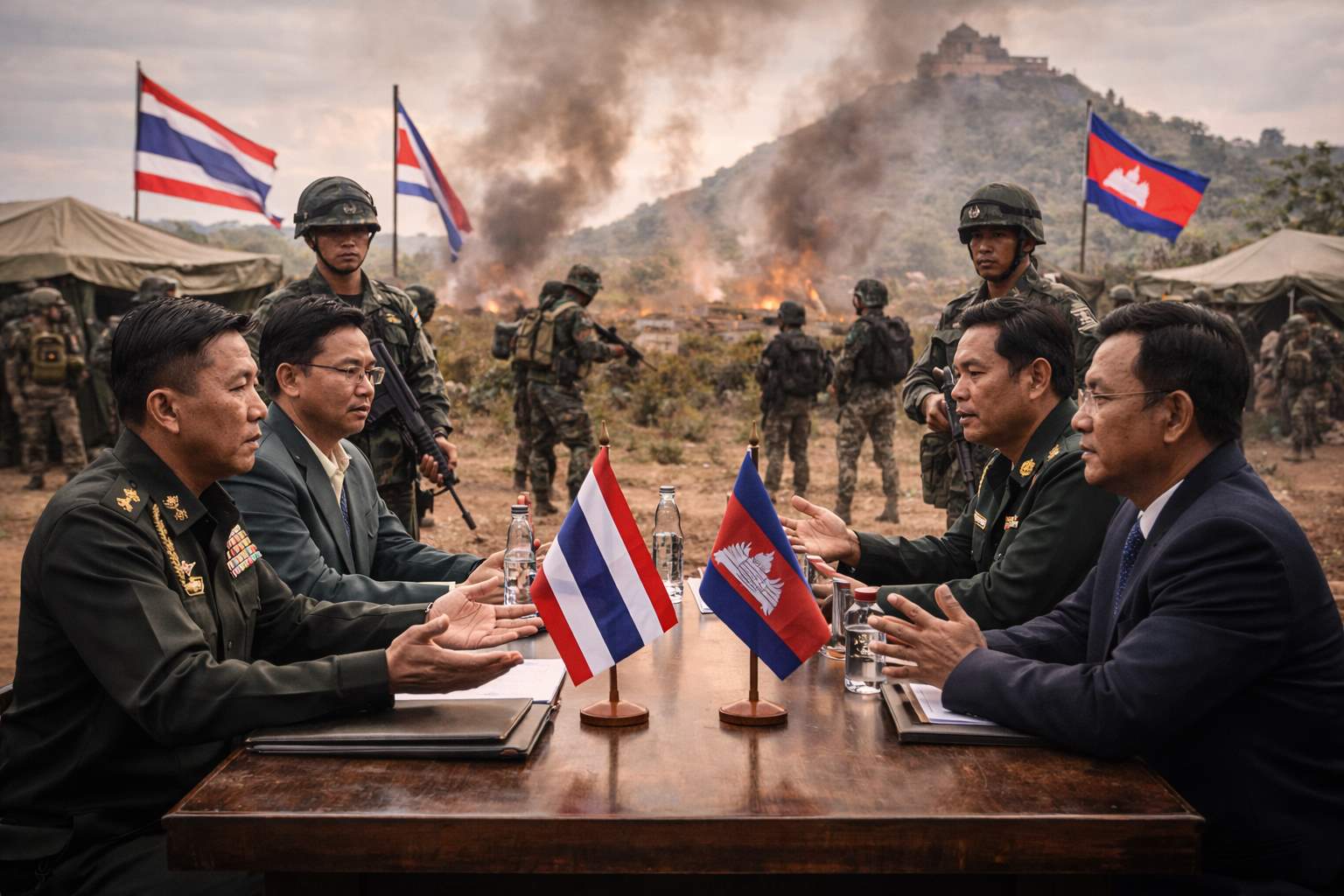
Diplomatic efforts intensify to prevent local skirmishes from escalating into a broader regional confrontation as trust remains fragile.
April 30, 2026
By Global War News Editorial
Thailand has called for an immediate “halt to verbal warfare” with Cambodia, urging Phnom Penh to curb inflammatory statements on the international stage that threaten a fragile border ceasefire. The request for a “verbal ceasefire” was delivered by Thai Foreign Minister Sihasak Phuangketkeow during high-level talks with his Cambodian counterpart, Prak Sokhonn, on the sidelines of the ASEAN-EU Ministerial Meeting in Brunei this week.
The diplomatic push comes at a critical juncture for the two neighbors, who are struggling to maintain a truce signed on December 27, 2025. That agreement followed two rounds of deadly armed clashes in July and December 2025 that displaced more than a million people and left dozens dead. While the guns are largely silent, the atmosphere remains charged with accusations of airspace violations, illegal dredging, and provocative troop movements near disputed temple sites.
According to the Thai Ministry of Foreign Affairs, the “verbal ceasefire” is seen as a necessary precursor to resuming formal meetings of the Joint Boundary Commission (JBC). Minister Sihasak emphasized that without a positive public atmosphere, it will be impossible to rebuild the trust required to resolve the underlying demarcation disputes that have plagued the 817-kilometer frontier for decades.
A Legacy of “Lost Territories” and Modern Skirmishes
The Thai-Cambodian border dispute is rooted in a century-old disagreement over maps drawn during the French colonial era. For Thailand, the issue is deeply tied to a historical sense of “lost territories,” particularly regarding the 1904–1907 Franco-Siamese Treaties.
In recent months, the tension has expanded beyond traditional military posturing:
- Canal Dredging: The Burapha Task Force was placed on high alert this week after reports of Cambodian dredging activity in a border canal.
- Infrastructure Disputes: Tensions have flared over temple restoration projects and the placement of barbed-wire fences near positions guarded by both armies.
- Maritime Claims: Thailand recently moved to revoke “MoU 44,” a key agreement on overlapping maritime claims, signaling a toughening stance on sovereign resources.
Humanitarian Impact and Economic Paralysis
The continued closure of major border crossings has had a devastating effect on local economies and civilian safety. On Thursday morning, more than 600 Thai nationals remained stranded at the Cambodian side of the Khlong Luek-Poipet crossing after Cambodian officials reportedly failed to honor a reopening agreement.
According to data from regional administrative agencies, trade at the Sa Kaeo border—the busiest land link between the two nations—has plummeted since Thailand tightened controls in June 2025. Security concerns have led to restricted operating hours and the closure of multiple checkpoints to all but humanitarian cases.
Humanitarian organizations, including the UN Refugee Agency (UNHCR), have warned that the cycle of displacement and border closures is creating a “permanent state of uncertainty” for residents of border provinces like Pursat and Aranyaprathet.
Analysis: The Instrumentalisation of Nationalism
The Thai demand for a “verbal ceasefire” highlights a core obstacle to peace: the use of border conflict for domestic political gain. In Thailand, Prime Minister Anutin Charnvirakul’s administration has faced significant domestic pressure from nationalist factions who view any compromise on border demarcation as a betrayal of sovereignty.
Observers note that by calling for a halt to “verbal warfare,” Thailand is attempting to decouple the border technicalities from the emotional weight of public sentiment. However, Cambodia’s leadership, under Prime Minister Hun Manet, has utilized a “peace discourse” to appeal to international audiences while simultaneously accusing Thailand of unilateral violations. This duality makes the path to a sustainable settlement extremely narrow. Without a formal mechanism to monitor both troop movements and public rhetoric, the mid-May diplomatic window may close without a breakthrough.
What to Watch For
- JBC Meeting Dates: Whether the two nations can agree on a mutually acceptable timeline for the Joint Boundary Commission to address land demarcation.
- MoU 44 Negotiations: The fallout from Thailand’s move to revoke the maritime agreement and how it affects joint energy exploration talks.
- ASEAN Observer Teams: The role of regional monitors in verifying reports of troop movements close to the border fence.
Source Disclosure: This report is based on official statements from the Thai Ministry of Foreign Affairs, the Cambodian Ministry of Foreign Affairs and International Cooperation, and reporting from The Nation Thailand, Khmer Times, and Channel News Asia (CNA). Analytical context on nationalism was provided by the Fulcrum research institute.
This article is based on publicly available reporting from named international news agencies and attributed official statements. All claims about ongoing events are attributed to their original sources. Analysis sections represent the editorial interpretation of reported facts and do not constitute advocacy for any party to the described conflict. AI tools may be utilized for image generation to assist in explaining complex concepts, as well as for refining grammar, spelling, and other linguistic enhancements. However, all original content is produced, fact-checked, and revised by the editorial team. This publication does not take political positions on active military conflicts.