
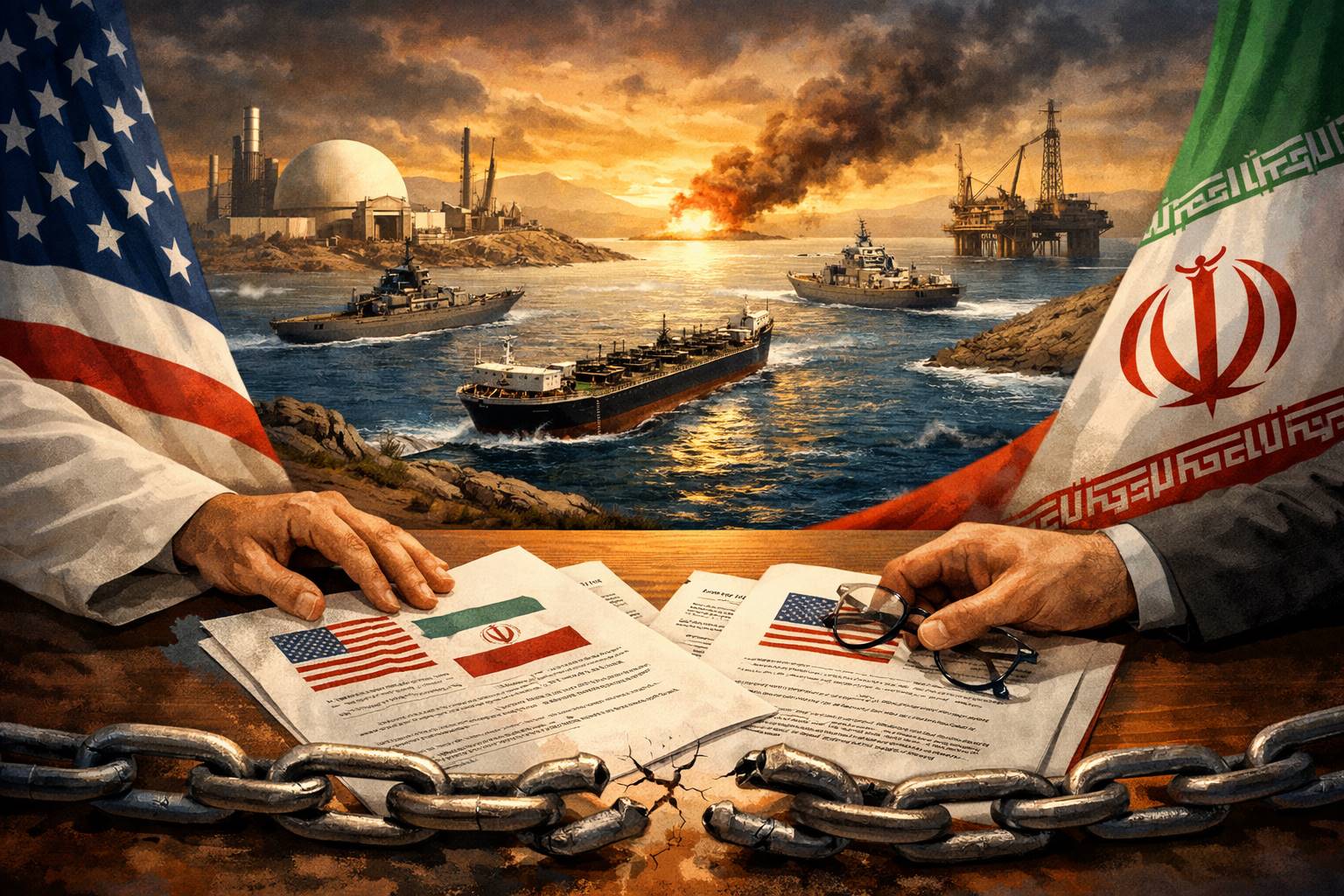
A fragile framework brokered by regional partners offers a temporary window to reopen the Strait of Hormuz, but fundamental disputes over nuclear stockpiles and maritime sovereignty threaten a return to hostilities.
Published: May 25, 2026
Last Updated: May 25, 2026
Byline: Global War News Editorial
A flurry of mediated diplomatic exchanges between Washington and Tehran has brought the 2026 Iran War to its most critical decision point since hostilities intensified earlier this year. According to reporting by international news agencies and statements from regional mediators, the United States and Iran are actively reviewing a revised draft framework for a 60-day memorandum of understanding (MOU) aimed at halting active military strikes and stabilizing global energy corridors.
The diplomatic push, spearheaded primarily by Pakistan and supported by Qatar, comes amid explicit warnings of renewed military escalation. While political leaders express public optimism regarding a “largely negotiated” truce, state media outlets and security sources in both capitals indicate that deep friction remains over nuclear enrichment terms and the ultimate management of global shipping lanes.
The 60-Day Framework: What Is on the Table
According to details of the draft proposal published by Axios and confirmed through regional diplomatic sources, the interim agreement hinges on a “relief-for-performance” model designed to provide immediate economic and military breathing room without finalizing a permanent peace treaty.
The core components of the active text include:
- A 60-Day Truce Extension: An immediate, formalized halt to direct hostilities between the US, its regional allies, and Iranian state forces.
- Reopening the Strait of Hormuz: Iran would commit to clearing naval mines deployed in the waterway and restoring unrestricted commercial shipping traffic.
- Sanctions Waivers and Port Access: In return, the US would lift its maritime blockade on Iranian ports, which has been rigidly enforced since mid-April, and issue targeted sanctions waivers allowing Iran to resume restricted oil exports.
- Asset Unfreezing: The framework reportedly contains provisions to unfreeze a specified portion of Iranian financial assets currently held in foreign banking institutions.
The primary objective of the 60-day window is to establish a secure environment to negotiate highly contentious long-term issues, including the permanent status of Iran’s nuclear program and regional maritime security architectures.
Conflict and Contradiction: The Sovereignty Dispute
Despite public declarations from Washington suggesting that a deal is nearing finalization, significant gaps in the text have triggered pushback from hardline factions within the Iranian state apparatus.
A primary point of contention centers on the long-term governance of the Strait of Hormuz. US officials, including Secretary of State Marco Rubio, stated that successful negotiations would achieve a completely open transit corridor free of tolls or unilateral restrictions. However, Iran’s state-affiliated Fars News Agency rejected this characterization, citing internal negotiating texts to assert that the strait must remain under explicit Iranian management.
Furthermore, high-level statements indicate a sharp divergence regarding the scope of concurrent nuclear talks. The New York Times, citing US officials, previously reported that Tehran had signaled a willingness to negotiate the surrender or removal of its highly enriched uranium (HEU) stockpile. Conversely, a senior Iranian diplomatic source told Reuters that Tehran has explicitly refused to hand over its HEU material, maintaining that the country’s core nuclear infrastructure remains outside the boundaries of this preliminary interim agreement.
Context and Background: The Path to the May Standstill
The current diplomatic impasse follows a cycle of intense economic pressure and kinetic military engagements that characterized the opening months of 2026.
The enforcement of a total US naval blockade on April 13 severely restricted Iran’s ability to export crude oil, compounding domestic economic strain and rolling electricity blackouts across major Iranian cities. In response, Tehran utilized asymmetrical naval tactics, deploying sea mines and restricting commercial transit through the Strait of Hormuz—a chokepoint responsible for approximately 20% of the world’s petroleum consumption.
A brief, temporary two-week ceasefire was brokered by Pakistan on April 8, but frequent tactical violations by both sides left the region on the brink of wider escalation. Diplomatic momentum shifted on May 22, when Pakistani Army Chief Field Marshal Asim Munir and Qatari officials conducted late-night sessions in Tehran with Iranian President Masoud Pezeshkian and Foreign Minister Abbas Araghchi to synthesize a multi-point counter-proposal to deliver to Washington.
Analysis: The Strategic Calculations Behind the Drafts
Observers note that the sudden willingness of both administrations to engage with the Pakistani-brokered draft reflects immediate domestic and economic pressures rather than a fundamental shift in geopolitical alignment.
For Washington, the prolonged closure of the Strait of Hormuz has pushed global oil markets into a volatile threshold, impacting international supply chains and generating significant inflationary pressure. The temporary framework allows the administration to stabilize energy transport lanes and maintain regional troop deployments without committing to an open-ended, ground-level conflict.
For Tehran, the motivation is heavily tied to economic survival. The combination of intense infrastructure strikes and secondary sanctions has severely depleted domestic reserves. Securing immediate waivers to sell crude oil and regaining access to frozen foreign currency assets provides the Iranian government with critical domestic relief.
However, analysts caution that the structural design of the MOU contains inherent risks. By deferring the most explosive issues—such as the verified destruction of uranium enriched to 60% and the dismantling of advanced centrifuges—to a later date, the framework remains highly vulnerable. Iranian hardliners have already publicly criticized the diplomacy as a tactical retreat, while US national security officials have signaled that fresh military options remain active if the 60-day talks stall.
What to Watch For
The immediate viability of the draft depends on whether regional mediators can harmonize the conflicting language regarding maritime tolling and nuclear verification before the current informal understanding degrades.
Key indicators of progress in the coming days will include:
- Whether the International Atomic Energy Agency (IAEA) is granted specific, expanded monitoring access to tracking facilities within Iran as a confidence-building measure.
- The formal announcement of a venue, likely Islamabad, for the commencement of the structured Phase 2 negotiations.
- Any unilateral movement of commercial tankers toward the mouth of the Persian Gulf, signaling private sector confidence in the security guarantees outlined in the text.
Source Disclosure Note: This analysis relies on verified reporting from Reuters, the Associated Press, Axios, The Financial Times, The New York Times, and official state updates from IRNA and Fars News Agency.
This article is based on publicly available reporting from named international news agencies and attributed official statements. All claims about ongoing events are attributed to their original sources. Analysis sections represent the editorial interpretation of reported facts and do not constitute advocacy for any party to the described conflict. AI tools may be utilized for image generation to assist in explaining complex concepts, as well as for refining grammar, spelling, and other linguistic enhancements. However, all original content is produced, fact-checked, and revised by the editorial team. This publication does not take political positions on active military conflicts.