
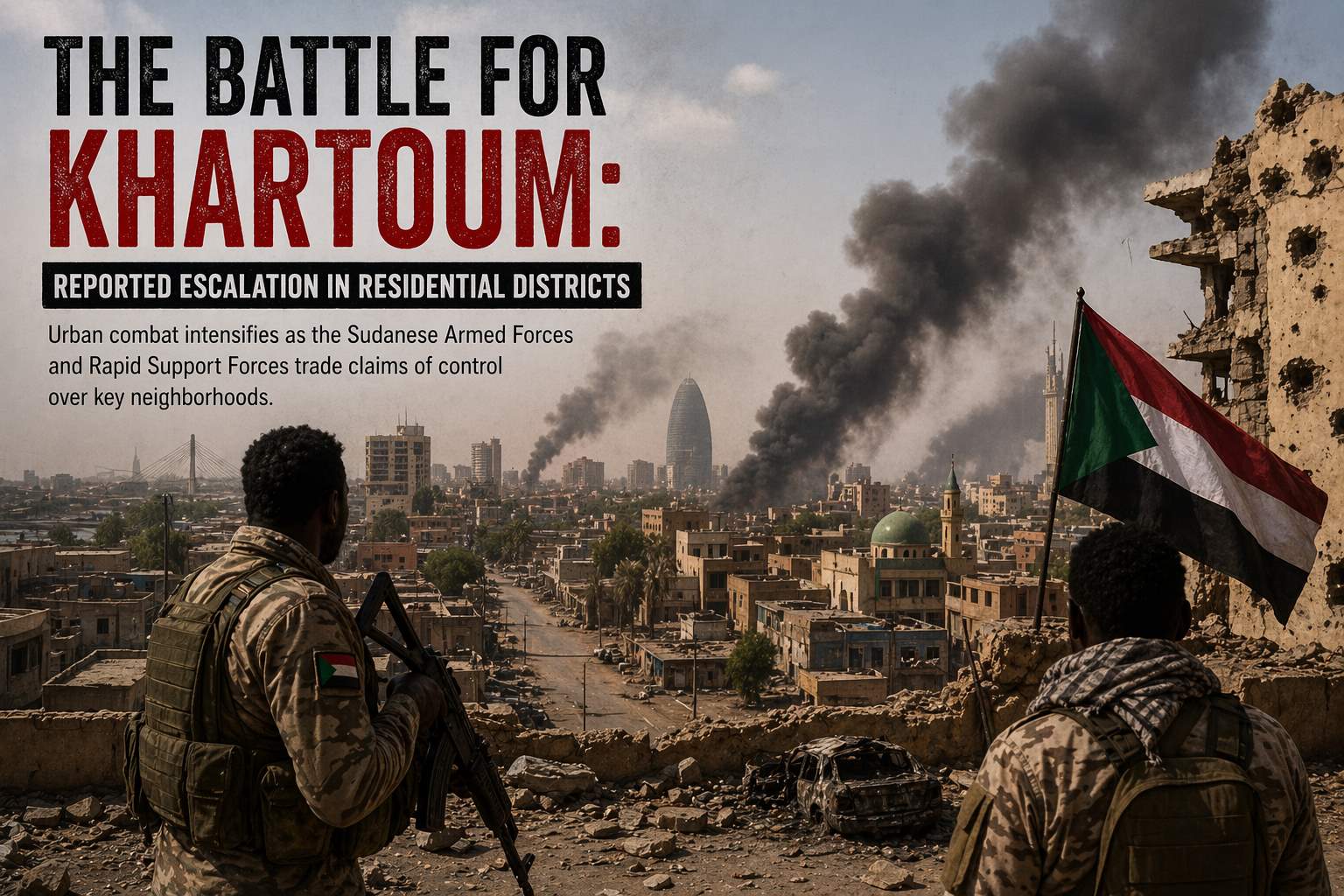
Urban combat intensifies as the Sudanese Armed Forces and Rapid Support Forces trade claims of control over key neighborhoods.
April 23, 2026
Last Updated: 10:15 GMT
By Global War News Editorial
Heavy fighting has reportedly surged within the residential heart of Khartoum over the past 48 hours. Both the Sudanese Armed Forces (SAF) and the paramilitary Rapid Support Forces (RSF) have issued conflicting statements regarding territorial control, with local residents reporting a significant increase in the use of heavy artillery and drone strikes in densely populated urban zones.
Conflicting Operational Reports
According to a statement released by the SAF General Command on Wednesday, regular army units have conducted “surgical operations” aimed at neutralizing RSF positions in the Al-Nahda and Al-Manshiya districts. The SAF claims to have successfully dislodged paramilitary fighters from several government buildings, though these claims have not been independently verified.
Conversely, the RSF’s media wing published a series of video clips on social media purportedly showing their fighters patrolling deep within residential areas they claim to have “liberated” from army control. The RSF stated that its forces have repelled several SAF attempts to advance from the north of the city. As noted by Reuters, the authenticity and timing of these video recordings remain subject to verification.
Impacts on Civilian Infrastructure
The intensification of combat in these districts has placed a severe strain on the city’s remaining essential services. According to reports from the World Health Organization (WHO), at least three additional clinics in the greater Khartoum area were forced to suspend operations this week due to proximity to the fighting.
Local “Emergency Response Rooms”, volunteer-led community groups, have reported that the use of explosive weaponry in residential streets has led to significant damage to water and power grids. According to these local monitors, many residents remain trapped in their homes as sniper activity and street-level skirmishes make evacuation increasingly hazardous.
Analysis: The Strategy of Urban Attrition
Military observers note that the current phase of the battle appears to be one of attrition rather than rapid maneuver. Analysts suggest that the SAF is utilizing its superior air power to strike RSF supply lines, while the RSF continues to leverage its mobility and presence within civilian housing to offset that aerial advantage.
The move into deeper residential pockets suggests a shift away from the earlier focus on strategic military bases toward a struggle for control over the city’s administrative and logistical core. It remains unclear if either side possesses the necessary manpower to fully clear and hold these neighborhoods in the long term without a significant change in the current military balance.
Regional Economic Implications
The ongoing instability in the Sudanese capital continues to disrupt trade routes toward the Red Sea. According to data from the International Monetary Fund (IMF), the protracted conflict has led to a near-total collapse of the formal banking sector in Khartoum, forcing the local economy to rely almost entirely on informal markets and barter systems. This economic paralysis has contributed to rising food prices that are affecting the wider East African region.
What to Watch
The international community is currently monitoring reports of potential mediation efforts in Jeddah, though no formal ceasefire has been established. Observers are also watching for any signs of a major offensive toward the southern districts of the city, which have so far seen less intensive combat than the northern and central hubs.
Source: This report is based on official statements from the Sudanese Armed Forces (SAF) and the Rapid Support Forces (RSF). Supplemental reporting on civilian impact was sourced from the World Health Organization (WHO) and Reuters. Economic data was provided by the International Monetary Fund (IMF).
This article is based on publicly available reporting from named international news agencies and attributed official statements. All claims about ongoing events are attributed to their original sources. Analysis sections represent the editorial interpretation of reported facts and do not constitute advocacy for any party to the described conflict. AI tools may be utilized for image generation to assist in explaining complex concepts, as well as for refining grammar, spelling, and other linguistic enhancements. However, all original content is produced, fact-checked, and revised by the editorial team. This publication does not take political positions on active military conflicts.