
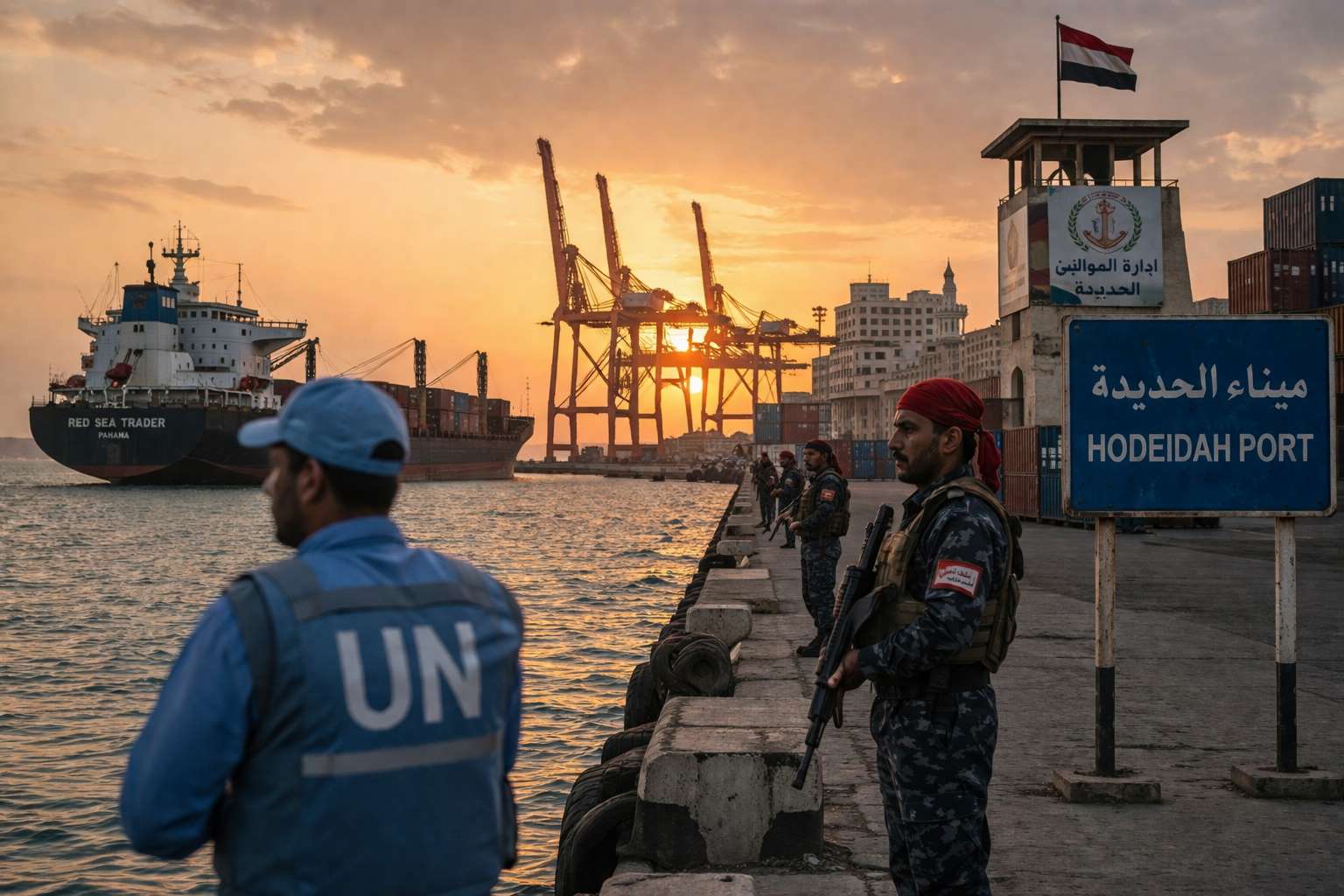
As international monitors withdraw, maritime security firms track a consolidation of Houthi administrative control over vital port infrastructure.
April 16, 2026
Last Updated: 02:45 PM
By Global War News Editorial
Control over Yemen’s critical Red Sea port infrastructure has entered a new and uncertain phase following the formal termination of the United Nations Mission to Support the Hodeidah Agreement (UNMHA). According to official UN documents and reports from maritime security firms, the mission concluded its mandate on March 31, 2026, entering a liquidation phase that leaves the ports of Hodeidah, Salif, and Ras Issa without direct international oversight for the first time in seven years.
The withdrawal comes amidst a period of relative tactical calm on the water, linked to the October 2025 Gaza ceasefire. However, maritime risk assessments indicate that the de facto Houthi authorities in northern Yemen have utilized this transition to consolidate their administrative and security hold on the coastline. While the ports remain the primary entry points for humanitarian aid and commercial goods, their dual-use nature continues to be a central point of contention in regional security briefings.
The Impact of UNMHA’s Liquidation
UNMHA was established in 2019 to monitor the redeployment of forces and maintain the civilian nature of the Red Sea ports. According to a Security Council report from early April, the mission’s closure was prompted by what some member states described as “persistent obstruction” by Houthi forces, which limited the effectiveness of the monitoring teams.
Diplomats from Russia and China, however, have expressed concerns that the “hasty withdrawal” risks a security vacuum. According to a statement from the Russian Deputy Ambassador to the UN, the mission played a vital stabilizing role in preventing the ports from being fully remilitarized. Without these monitors, the burden of verification now shifts to remote sensing and the Office of the Special Envoy for Yemen (OSESGY).
Maritime Security Reports and Infrastructure Status
Recent data from maritime risk firms, including Ambrey and the U.S. Maritime Administration (MARAD), suggest that the ports of Hodeidah and Salif have seen a significant increase in cargo throughput since late 2025. According to MARAD’s April 2026 advisory, while there have been no recorded missile attacks on commercial shipping since the October truce, “entities claiming to be Yemeni authorities” continue to attempt the diversion of vessels.
Reports from local port authorities in Hodeidah suggest that the Houthi administration has begun a series of “rehabilitation projects” on damaged loading docks. However, independent analysts note that these infrastructure improvements are often accompanied by the installation of sophisticated radar and sensor arrays. According to a March 2026 report by The Century Foundation, the Houthi movement has evolved its supply chain capabilities, transforming Hodeidah into a hub for both legitimate trade and the importation of dual-use materials and manufacturing equipment.
Analysis: From Monitoring to De Facto Governance
The transition in Hodeidah reflects a broader trend in the Yemeni conflict: the gradual normalization of Houthi de facto governance in the north. Analysts suggest that the closure of the UN mission is a recognition of the current reality on the ground—that the Houthi movement holds firm control over the Red Sea coast and is unlikely to concede military authority under the current ceasefire framework.
According to the International Crisis Group, the risk in Hodeidah is no longer an immediate military offensive, but rather the ports’ role in a “wider regional confrontation.” The Houthis’ willingness to support regional allies means that the ports could quickly pivot back to being launch sites for anti-shipping operations if regional tensions flare. Furthermore, the absence of international monitors makes it significantly harder for the global community to distinguish between a civilian cargo vessel and a dhow carrying sensitive military components.
The Humanitarian Context
Despite the improved flow of goods through the ports, the humanitarian situation in Yemen remains dire. The 2026 Yemen Humanitarian Needs and Response Plan (HNRP) indicates that over 22 million people—roughly half the population—require assistance.
The World Food Programme (WFP) recently noted that operating in Houthi-controlled northern Yemen remains exceptionally difficult due to “mounting restrictions.” The closure of the UN mission may further complicate these logistics, as aid agencies can no longer rely on UNMHA’s localized security assessments to clear convoys from the port to the hinterland.
Sources: This article is based on Security Council Resolution 2813 (2026), UNMHA press releases, reports from the U.S. Maritime Administration (MARAD), maritime security briefings from Ambrey, and analysis from the Century Foundation and the International Crisis Group.
This article is based on publicly available reporting from named international news agencies and attributed official statements. All claims about ongoing events are attributed to their original sources. Analysis sections represent the editorial interpretation of reported facts and do not constitute advocacy for any party to the described conflict. AI tools may be utilized for image generation to assist in explaining complex concepts, as well as for refining grammar, spelling, and other linguistic enhancements. However, all original content is produced, fact-checked, and revised by the editorial team. This publication does not take political positions on active military conflicts.