
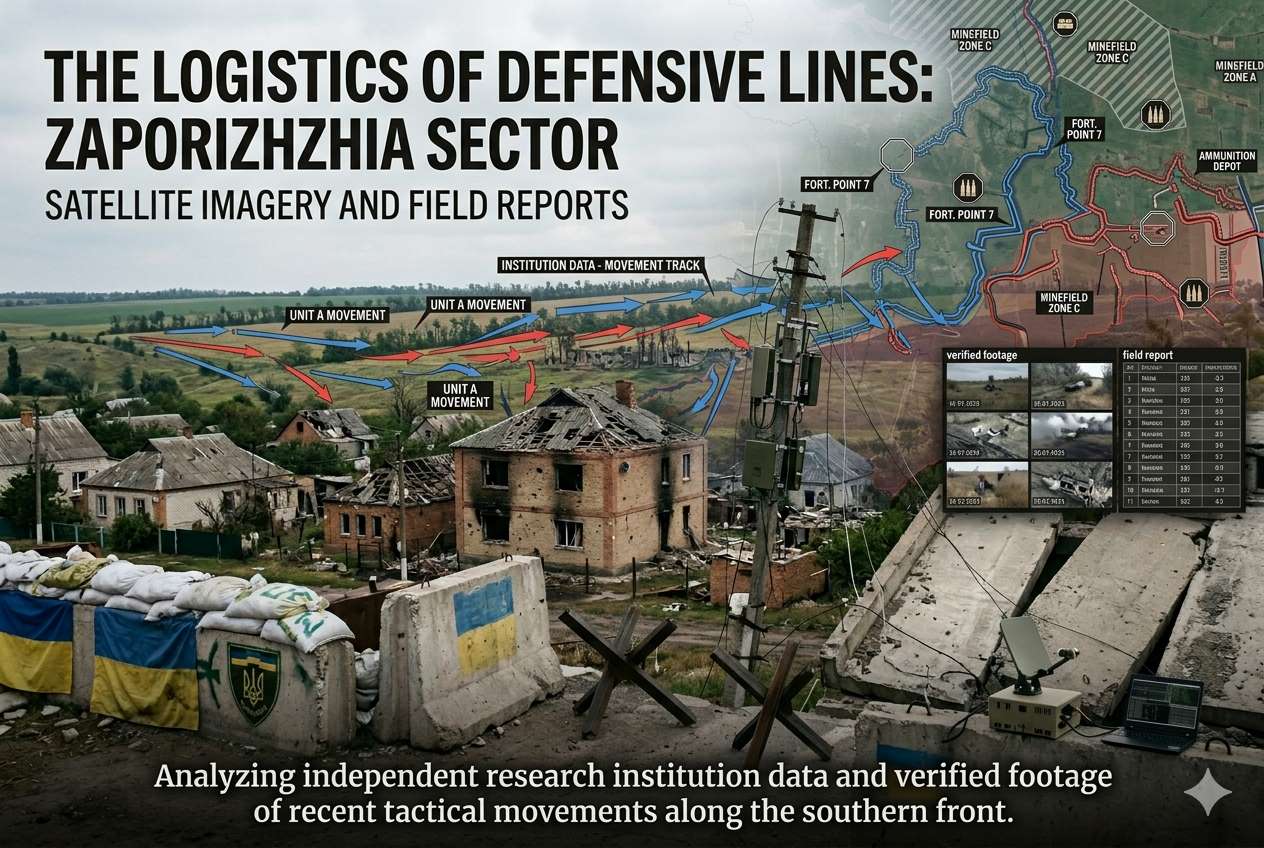
Analyzing independent research institution data and verified footage of recent tactical movements along the southern front.
Publication date: April 17, 2026
Last updated: April 17, 2026
Byline: Staff Writer, Global War News
The Zaporizhzhia sector has emerged as a focal point for military engineering and logistical adaptation, as both Ukrainian and Russian forces consolidate deep defensive networks. Recent satellite imagery and field reports from independent research institutions indicate a shift from high-mobility maneuvers to a prolonged war of positions. The focus has turned to the structural integrity of “multi-layered” defense lines—complex systems of trenches, anti-tank ditches, and fortified strongpoints designed to withstand sustained artillery and drone strikes.
According to data released by the Institute for the Study of War (ISW) and verified by commercial satellite providers, the density of these defensive structures has increased significantly over the last 48 hours. This build-up is particularly evident around the critical logistics hubs of Tokmak and Melitopol, which remain essential for maintaining the southern land bridge.
Structural Composition of Modern Defense Lines
Independent analysis of geolocated footage suggests that the current defensive doctrine relies on a “defense-in-depth” strategy. Rather than a single frontline, both sides have constructed a series of staggered obstacles.
As reported by military analysts at the Center for Strategic and International Peace (CSIP), these lines typically consist of three distinct zones:
- The Disruption Zone: A forward area heavily saturated with minefields and remote sensors intended to slow an advancing force and force it into “kill zones.”
- The Main Defense Line: A series of interconnected trench systems and “dragon’s teeth” anti-tank obstacles, supported by subterranean bunkers for personnel protection.
- The Reserve Zone: Rear-positioned artillery and electronic warfare units designed to disrupt drone communication and provide fire support to the forward lines.
Verified Tactical Movements and Logistical Adaptation
Field reports from the ground, corroborated by drone footage verified by Reuters, show that logistics are being forced underground. To mitigate the threat of First-Person View (FPV) drones, which have made surface movement within 10 kilometers of the front nearly impossible, both forces are reportedly utilizing tunnel networks for ammunition transport and troop rotation.
The British Ministry of Defence (MoD) noted in a recent intelligence update that “logistical attrition” has become the primary metric of success in this sector. The goal of recent tactical strikes has not been the capture of territory, but the destruction of the specific engineering equipment—such as mine-clearing vehicles and bridge-layers—required to breach these lines.
Analysis: The “Static Front” and Economic Sustainability
Observers note that the sheer scale of the fortifications in Zaporizhzhia raises questions about the long-term sustainability of the conflict. The construction of these lines requires massive amounts of concrete, steel, and timber, placing a heavy burden on domestic industrial bases.
Analysts from the Royal United Services Institute (RUSI) suggest that the front has become “technologically static.” While both sides possess the technology to identify targets, neither currently possesses the logistical mass to bypass these fortified zones without incurring unsustainable losses. This suggests that the Zaporizhzhia sector may remain a theater of attrition for the foreseeable future, where “victory” is measured in the depletion of the opponent’s engineering reserves rather than the movement of the frontline.
From an economic perspective, the sterilization of vast tracts of agricultural land in the Zaporizhzhia oblast—once a primary region for grain production—has long-term implications for global food security. The presence of millions of unexploded ordnances and anti-tank mines ensures that even if a ceasefire were reached tomorrow, the land would remain unusable for commercial farming for a decade or more.
Context and Background: The Legacy of the 2023 Counteroffensive
The current complexity of the defensive lines is a direct evolution of the lessons learned during the 2023 counteroffensive. At that time, initial breakthroughs were halted by dense minefields that had not been fully mapped by satellite reconnaissance.
Since then, the “Surovikin Line” and subsequent Ukrainian counter-fortifications have set a new global standard for modern trench warfare. The integration of electronic warfare (EW) “bubbles” around these defenses has added a digital layer to the physical obstacles, making the Zaporizhzhia sector one of the most contested and difficult environments for military operations in modern history.
Looking Ahead
As satellite imagery continues to show the expansion of these networks, international monitors are looking for signs of a “maneuver breakthrough.” However, without a significant shift in air superiority or a breakthrough in de-mining technology, the logistical reality of the Zaporizhzhia sector points toward a stalemate. The international community remains focused on the potential for localized escalations around the Zaporizhzhia Nuclear Power Plant (ZNPP), where the proximity of these fortified lines to sensitive nuclear infrastructure creates a persistent risk of accidental or intentional damage.
Sources: This report utilizes data and official statements from the Institute for the Study of War (ISW), the Center for Strategic and International Peace (CSIP), the Royal United Services Institute (RUSI), the British Ministry of Defence, and verified satellite imagery from Maxar Technologies.
This article is based on publicly available reporting from named international news agencies and attributed official statements. All claims about ongoing events are attributed to their original sources. Analysis sections represent the editorial interpretation of reported facts and do not constitute advocacy for any party to the described conflict. AI tools may be utilized for image generation to assist in explaining complex concepts, as well as for refining grammar, spelling, and other linguistic enhancements. However, all original content is produced, fact-checked, and revised by the editorial team. This publication does not take political positions on active military conflicts.