
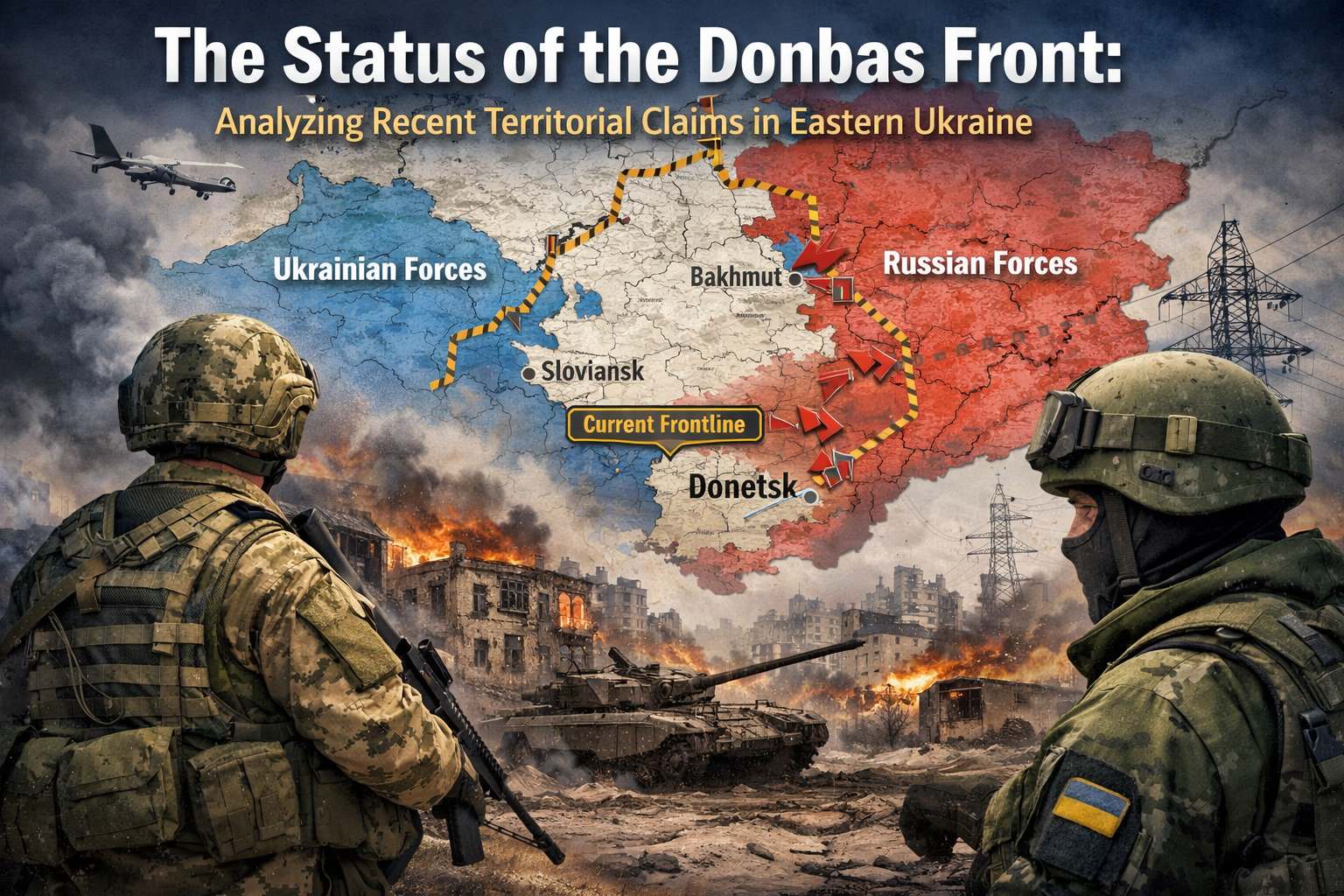
Verified updates from international monitors on shifting control lines and the impact on local infrastructure.
Publication date: April 17, 2026
Last updated: April 17, 2026
Byline: Staff Writer, Global War News
The frontline in the Donbas region of eastern Ukraine remains the site of intense kinetic activity, with both Ukrainian and Russian forces reporting incremental shifts in territorial control over the last 72 hours. While official statements from both capitals suggest significant localized gains, independent international monitors describe a more fluid and contested environment where control over specific settlements often changes within a single day.
According to recent briefings from the Institute for the Study of War (ISW) and verified satellite imagery provided by European monitoring services, the most significant pressure remains centered on the logistics hubs in the Donetsk region. These areas serve as critical junctions for both military supply lines and what remains of the civilian energy grid.
The humanitarian cost of these renewed maneuvers is increasingly visible. International observers from the United Nations have noted that the remaining civilian infrastructure in the path of the current escalation is facing “severe degradation,” particularly regarding water and power distribution.
Verified Shifts in Control Lines
The Russian Ministry of Defense claimed earlier this week that its forces had secured “favorable positions” on the outskirts of several key settlements in the Bakhmut-Avdiivka corridor. However, the Ukrainian General Staff reported that their defensive lines remain largely intact, stating that they have repelled numerous assaults in these sectors.
Independent analysis by Reuters, citing military bloggers on both sides and geolocated footage, suggests that while Russian forces have made marginal territorial advances, these have come at a significant cost to equipment and personnel. Conversely, Ukrainian forces appear to be employing a strategy of “elastic defense,” trading small amounts of territory to preserve combat effectiveness and strike at advancing supply columns.
As reported by the Associated Press, the frontlines are currently characterized by heavy artillery exchanges and the widespread use of First-Person View (FPV) drones, which has made large-scale troop movements difficult for either side to execute without immediate detection.
Impact on Local Infrastructure
The escalation has had a direct effect on the regional economy and civilian survival. According to data from the World Bank’s latest regional update, the destruction of power sub-stations in the Donbas has led to rolling blackouts that affect not only the immediate conflict zone but also neighboring provinces.
Repair crews reportedly face extreme danger. A spokesperson for the International Committee of the Red Cross (ICRC) stated that the “constant threat of shelling” has prevented technicians from accessing critical water filtration plants. This has left approximately 150,000 residents with limited access to clean drinking water, according to UN humanitarian assessments.
Context and Background: The Strategic Value of the Donbas
To understand the current intensity of the fighting, it is necessary to look at the industrial history of the region. The Donbas, comprised of the Donetsk and Luhansk oblasts, was historically the industrial heartland of Ukraine, rich in coal reserves and metallurgical plants.
Since the initial conflict began in 2014, the region has been physically divided. The current phase of the war, which escalated in February 2022, has seen these industrial centers turned into fortified positions. Controlling these areas is not merely a matter of symbolic victory; it is about controlling the rail networks that allow for the movement of heavy industry products and military hardware across the vast plains of eastern Ukraine.
Analysis: What the Current Stalemate Signals
Observers note that the current “seesaw” nature of the frontline suggests a period of mutual attrition. Analysts from the International Institute for Strategic Studies (IISS) have suggested that neither side currently possesses the decisive “breakthrough” capability required to collapse the other’s front entirely.
This raises questions about the long-term sustainability of such high-intensity warfare. If neither side can achieve a strategic victory in the Donbas, the conflict may continue to revolve around small, localized gains that result in the total destruction of the infrastructure being fought over. From an economic perspective, the “scorched earth” reality on the ground means that even if territorial control is established, the cost of reconstruction will likely exceed the immediate economic value of the captured land for years to come.
Looking Ahead
As the spring thaw concludes and the ground hardens, military analysts expect an increase in armored maneuvers. The international community is currently watching for signs of a larger-scale offensive from either side. However, until such a move is verified by independent monitors, the Donbas front remains a grueling battle of inches with a rising toll on the region’s remaining infrastructure.
Sources: This report utilizes data and statements from the Ukrainian General Staff, the Russian Ministry of Defense, the United Nations (OCHA), the World Bank, the Institute for the Study of War (ISW), Reuters, and the Associated Press.
This article is based on publicly available reporting from named international news agencies and attributed official statements. All claims about ongoing events are attributed to their original sources. Analysis sections represent the editorial interpretation of reported facts and do not constitute advocacy for any party to the described conflict. AI tools may be utilized for image generation to assist in explaining complex concepts, as well as for refining grammar, spelling, and other linguistic enhancements. However, all original content is produced, fact-checked, and revised by the editorial team. This publication does not take political positions on active military conflicts.