
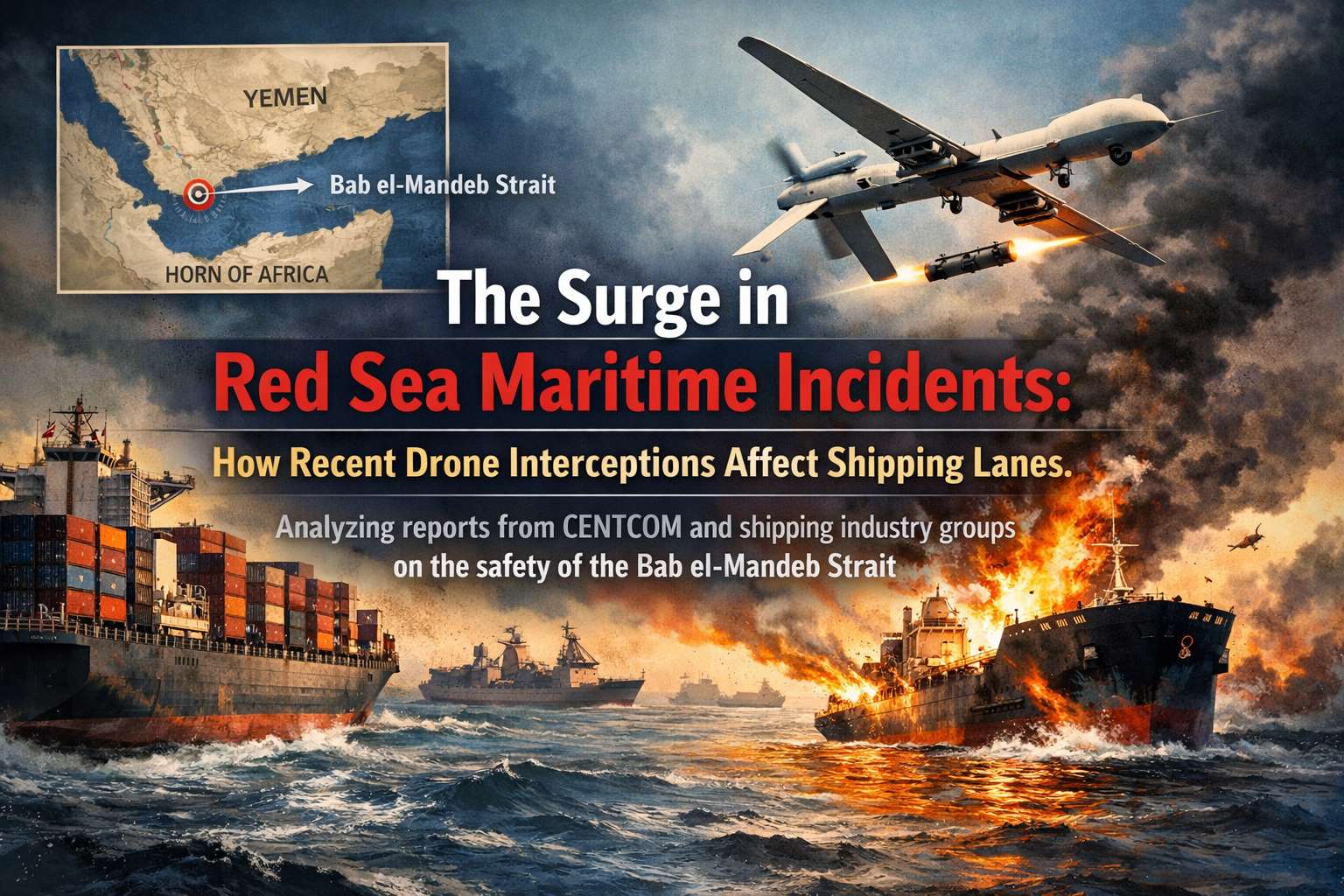
Analyzing reports from CENTCOM and shipping industry groups on the safety of the Bab el-Mandeb Strait as geopolitical tensions rise.
Publication date: April 17, 2026
Last updated: April 17, 2026
Byline: Global War News Editorial
The Bab el-Mandeb Strait, a narrow maritime artery connecting the Red Sea to the Gulf of Aden, is experiencing a sharp rise in security incidents that threaten to further destabilize global trade. According to recent reports from U.S. Central Command (CENTCOM), international naval forces have intercepted multiple “one-way attack drones” and anti-ship missiles over the last 48 hours, highlighting a renewed threat to commercial shipping.
While a broad regional ceasefire had largely held in early 2026, industry groups warn that shipping lanes are becoming increasingly precarious as the conflict between the United States and Iran enters a new phase of maritime enforcement. The current escalation centers on the “regardless of location” blockade doctrine, which has expanded the geographic scope of potential naval confrontations.
Surge in Drone and Missile Interceptions
According to a series of statements released by CENTCOM via official channels, U.S. and allied destroyers operating under Operation Epic Fury successfully neutralized at least six uncrewed aerial vehicles (UAVs) launched from Houthi-controlled areas in Yemen. CENTCOM officials stated that these drones were “heading toward the direction of commercial tankers” transiting the Bab el-Mandeb.
The uptick in activity coincides with reports from the Wall Street Journal and the Institute for the Study of War (ISW) suggesting that Iran is pressuring regional proxies to “close” the strait in response to the ongoing U.S. naval blockade of Iranian ports. While Houthi leaders had largely refrained from attacking non-Israel-linked vessels following the 2025 ceasefire, the most recent interceptions suggest a pivot toward broader targets, including those suspected of aiding the blockade efforts.
Shipping Industry Response and Rerouting
The shipping industry has reacted with immediate caution. According to maritime intelligence firm Windward, more than 1,100 vessels in the region have reported significant GPS and AIS (Automatic Identification System) interference, a tactic often used to obscure vessel movements or confuse targeting systems.
Major shipping groups, including French and Danish carriers, have reportedly begun reassessing the safety of the Red Sea route. Key developments include:
- Diverted Traffic: Industry data shows a 15% increase in vessels opting for the longer route around the Cape of Good Hope this week, a detour that adds approximately 10 to 14 days to transit times between Asia and Europe.
- War Risk Premiums: Maritime insurers have reportedly increased “war risk” premiums for the southern Red Sea by nearly 25% since the start of April, citing the unpredictability of drone technology.
- Spoofing Concerns: Shipping groups have expressed alarm over “AIS spoofing,” where vessels appear in incorrect locations on digital tracking systems. CENTCOM reported turning back several tankers leaving the Gulf of Oman due to manipulated tracking data.
Analysis: The Strategic Value of the “Yanbu Lifeline”
Analysts note that the current tension puts Saudi Arabia’s “Yanbu Lifeline” at significant risk. As the Strait of Hormuz remains heavily contested, Saudi Arabia has relied on its Red Sea port of Yanbu to export up to 5 million barrels of crude oil per day.
Observers suggest that if the Bab el-Mandeb becomes impassable due to persistent drone threats, the world’s ability to bypass the Hormuz bottleneck would effectively vanish. This raises questions about the long-term viability of Red Sea energy corridors. If the RSF and Houthi proxies continue to challenge the U.S. “regardless of location” seizure doctrine, the Bab el-Mandeb may transition from a shipping lane into a permanent combat zone.
From an economic perspective, the cost of forced substitution—moving from short-haul Middle Eastern routes to longer African or Russian alternatives—is already impacting Asian consumers. Countries like Japan and South Korea, which rely on these lanes for over 60% of their energy imports, are particularly exposed to the resulting price volatility.
Context and Background: A Legacy of Chokehold Tactics
The Bab el-Mandeb has long been a focal point for asymmetric warfare. Historically, the Houthi movement has utilized low-cost drone technology and uncrewed surface vehicles (USVs) to challenge high-cost naval assets. The current surge is a continuation of this doctrine, but with a critical difference: the integration of “dark fleet” dynamics.
As the U.S. enforces its blockade, many tankers are operating in legal gray zones, switching flags or names to avoid interdiction. This “shadow” behavior makes the task of distinguishing between neutral commercial trade and sanctioned cargo nearly impossible for naval forces, increasing the risk of collateral damage or mistaken engagement in the strait.
Looking Ahead
Shipping industry leaders are calling for a 45-day extension of existing regional ceasefires to allow for a diplomatic resolution. However, with the U.S. Defense Department framing the stakes in binary terms—warning of “bombs dropping on infrastructure” if the blockade is tested—the likelihood of a de-escalation in the Red Sea remains low.
For the remainder of April, the global economy remains tethered to the stability of the Bab el-Mandeb. Any successful strike on a major tanker could trigger a total suspension of Red Sea transit, a scenario that would fundamentally reshape global supply chains for the foreseeable future.
Sources: This report utilizes data and official statements from U.S. Central Command (CENTCOM), the U.S. Maritime Administration (MARAD), the World Bank, Windward Maritime AI, the Institute for the Study of War (ISW), and Reuters.
This article is based on publicly available reporting from named international news agencies and attributed official statements. All claims about ongoing events are attributed to their original sources. Analysis sections represent the editorial interpretation of reported facts and do not constitute advocacy for any party to the described conflict. AI tools may be utilized for image generation to assist in explaining complex concepts, as well as for refining grammar, spelling, and other linguistic enhancements. However, all original content is produced, fact-checked, and revised by the editorial team. This publication does not take political positions on active military conflicts.