
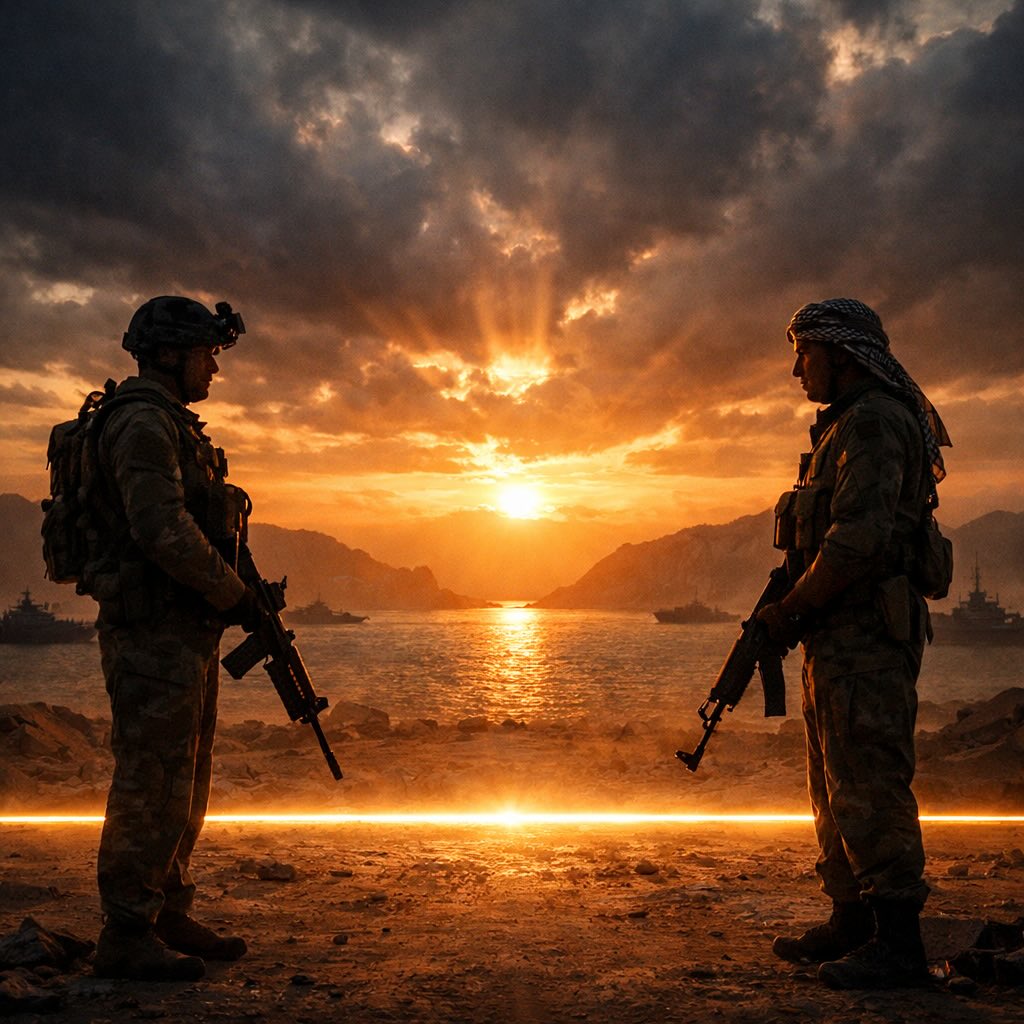
Oil prices fell sharply on the announcement. Markets rallied. But with Strait of Hormuz passage still conditional, a trust deficit on both sides, and talks only just beginning, the hard questions remain unanswered.
Published: 8 April 2026 Last Updated: 8 April 2026
Global War News Editorial.
The guns have not fallen fully silent. But for now, a deal is in place. The United States and Iran agreed late Tuesday to a two-week ceasefire, brokered by Pakistan, ending more than five weeks of US-Israeli strikes on Iran and Iranian retaliatory attacks on Israel, US military bases, and Gulf states. The agreement also requires Iran to allow shipping through the Strait of Hormuz, the narrow waterway through which roughly 20 percent of the world’s oil supply normally passes and which Iran had effectively shut since early March.
Markets responded immediately. Brent crude dropped nearly 17 percent to around $91 a barrel CNN, and the S&P 500 gained 2.56 percent while the Nasdaq surged 3.46 percent. CNN In Sri Lanka, where fuel rationing has been in place for weeks and prices have climbed sharply, the news will be watched closely.
But relief, if it comes, will not arrive overnight. The ceasefire is conditional, fragile, and surrounded by unresolved disputes that begin with the very question of what it covers.
How the Ceasefire Came About
Pakistan provided the diplomatic opening. Pakistani Prime Minister Shehbaz Sharif and Field Marshal Asim Munir contacted President Trump hours before his stated deadline to launch what he described as a massive strike on Iran. Axios Sharif asked Trump to delay, and simultaneously pressed Tehran to reopen the strait as a gesture of good faith.
Trump announced the agreement on Truth Social, describing it as a “double-sided ceasefire” and saying the US had “met and exceeded all military objectives.” Axios He confirmed the US had received a ten-point proposal from Iran and described it as “a workable basis on which to negotiate.”
Iranian Foreign Minister Abbas Araghchi confirmed Tehran’s acceptance. Iran said it would allow “safe passage” of the Strait of Hormuz during the two weeks, coordinated with Iran’s armed forces. Axios
Pakistani Prime Minister Sharif announced the cessation of hostilities and invited both delegations to Islamabad on Friday, 10 April 2026, “to further negotiate for a conclusive agreement to settle all disputes.” Al Jazeera
What the Ceasefire Does and Does Not Cover
The terms are not as clean as either side’s public statements suggest.
Israeli Prime Minister Benjamin Netanyahu said the ceasefire would not extend to Israel’s fighting with Hezbollah or its invasion of southern Lebanon, appearing to contradict Pakistani Prime Minister Sharif’s claim that the ceasefire included a halt to Israel’s attacks on Lebanon. Al Jazeera On Wednesday morning, Israeli strikes in Lebanon continued.
Iran also stated publicly that the ceasefire was only temporary: “This is not the end of the war but all military branches should follow the Supreme Leader order and cease their fire,” according to a statement read on state-run broadcaster IRIB. CNN
The Strait question carries its own complication. Iran’s Secretariat of the Supreme National Security Council said Iran’s military would regulate passage through the Strait of Hormuz, granting the country “unique economic and geopolitical standing.” CNN Tehran has in recent weeks charged some shipping companies reported fees of up to $2 million per vessel to guarantee safe passage. According to Neil Shearing, group chief economist at Capital Economics, these transit fees would add roughly $1 per barrel to the cost of oil transported through the Strait, amounting to what he called a “de facto partial nationalisation of the shipping route.” CNN
Why Oil Prices Are Still Well Above Pre-War Levels
Analysis
The market reaction tells only part of the story. Yes, Brent crude fell sharply on Wednesday. But it fell from heights that themselves reflected weeks of disruption. Brent crude stood at around $95 per barrel on Wednesday morning, still up almost 30 percent since the war began in late February, and well below the recent peaks above $110 per barrel. Euronews
The ceasefire is conditional on the immediate reopening of the Strait of Hormuz. Even with a truce in place, the effects of the crisis will be felt for months. Renewable Matter
The Ras Laffan industrial complex in Qatar, which accounts for around 20 percent of global liquefied natural gas production, suffered damage that has reduced its export capacity by 17 percent, according to estimates by Rystad Energy. Total costs of rebuilding energy infrastructure in the region could exceed $25 billion, Rystad estimates. Renewable Matter
As of Tuesday, 187 tankers laden with 172 million barrels of seaborne crude and refined oil products remained stranded inside the Gulf, according to trade intelligence firm Kpler. CNN That backlog will not clear within days.
Energy and commodity markets are likely to remain on a structurally higher floor regardless of the ceasefire outcome, according to BCA Research economist Gertken, as governments hoard and restock in anticipation of renewed conflict. CNBC
The Trust Problem at the Centre of the Talks
Analysis
The ceasefire announcement is not a peace agreement. It is a two-week window for negotiations that both sides have publicly described as unfinished.
Iran expert Mehran Kamrava, professor of government at Georgetown University of Qatar, said there is “tremendous willpower” from both Washington and Tehran to end the conflict. “But,” he added, “it is a very fragile arrangement.” CNBC
The core sticking points from before the war remain. From Washington’s perspective, longstanding concerns over Iran’s nuclear programme are unresolved. From Tehran’s side, there is deep scepticism about US intentions, given past withdrawals from agreements and continued military pressure. CNBC According to Al Jazeera’s reporting, Iran’s ten-point terms include a request that Washington accept its uranium enrichment programme and lift all sanctions, while Israel has urged the US to press for the surrender of enriched uranium stockpiles.
Iran expert Trita Parsi said the potential talks in Islamabad could fail, “but the terrain has shifted.” He suggested that Trump’s use of military force had not produced the decisive outcome Trump had sought, which changes the negotiating dynamic. Al Jazeera
Neil Roberts, head of the Lloyd’s Market Association, said it was highly unlikely that trade into the Gulf would simply resume. “The region remains at heightened risk with none of the underlying tensions resolved,” he stated. NBC News
Where Things Stand
As of Wednesday, 8 April, the ceasefire is in effect between the US and Iran. Negotiations are scheduled to begin in Islamabad on Friday. Israel has agreed to the ceasefire in Iran but is continuing military operations in Lebanon. Shipping through the Strait of Hormuz is conditionally reopening, subject to Iranian oversight and coordination. Oil prices have fallen sharply from their peak but remain well above pre-war levels.
Whether the two-week window produces a durable agreement depends on whether the parties can bridge disputes that have been unresolved for decades: Iran’s nuclear programme, the status of US sanctions, and the role of Iranian-backed forces across the wider region. None of those questions will be settled in Islamabad on Friday.
What the ceasefire has achieved, for now, is time. Whether the parties use it well is the only question that matters from here.
Sources used in this article: Al Jazeera (ceasefire terms, Lebanon contradiction, Parsi quote, Kamrava quote), Axios (Trump announcement, ceasefire timeline), CNN Business (market data, Iran statement, Kpler tanker data, Shearing quote, Lloyd’s Market Association quote), CNBC (oil price movements, BCA Research quote), Euronews (market summary), NBC News (De Haan quote), Rystad Energy via Renewable Matter (infrastructure damage estimates, LNG capacity), Capital Economics via CNN (transit fee analysis), Wikipedia / 2026 Strait of Hormuz crisis article (IEA emergency reserve release, oil price history), Wikipedia / Economic impact of the 2026 Iran war (IEA characterisation, Sri Lanka fuel context).
This article is based on publicly available reporting from named international news agencies and attributed official statements. All claims about ongoing events are attributed to their original sources. Analysis sections represent the editorial interpretation of reported facts and do not constitute advocacy for any party to the described conflict. This publication does not take political positions on active military conflicts.