
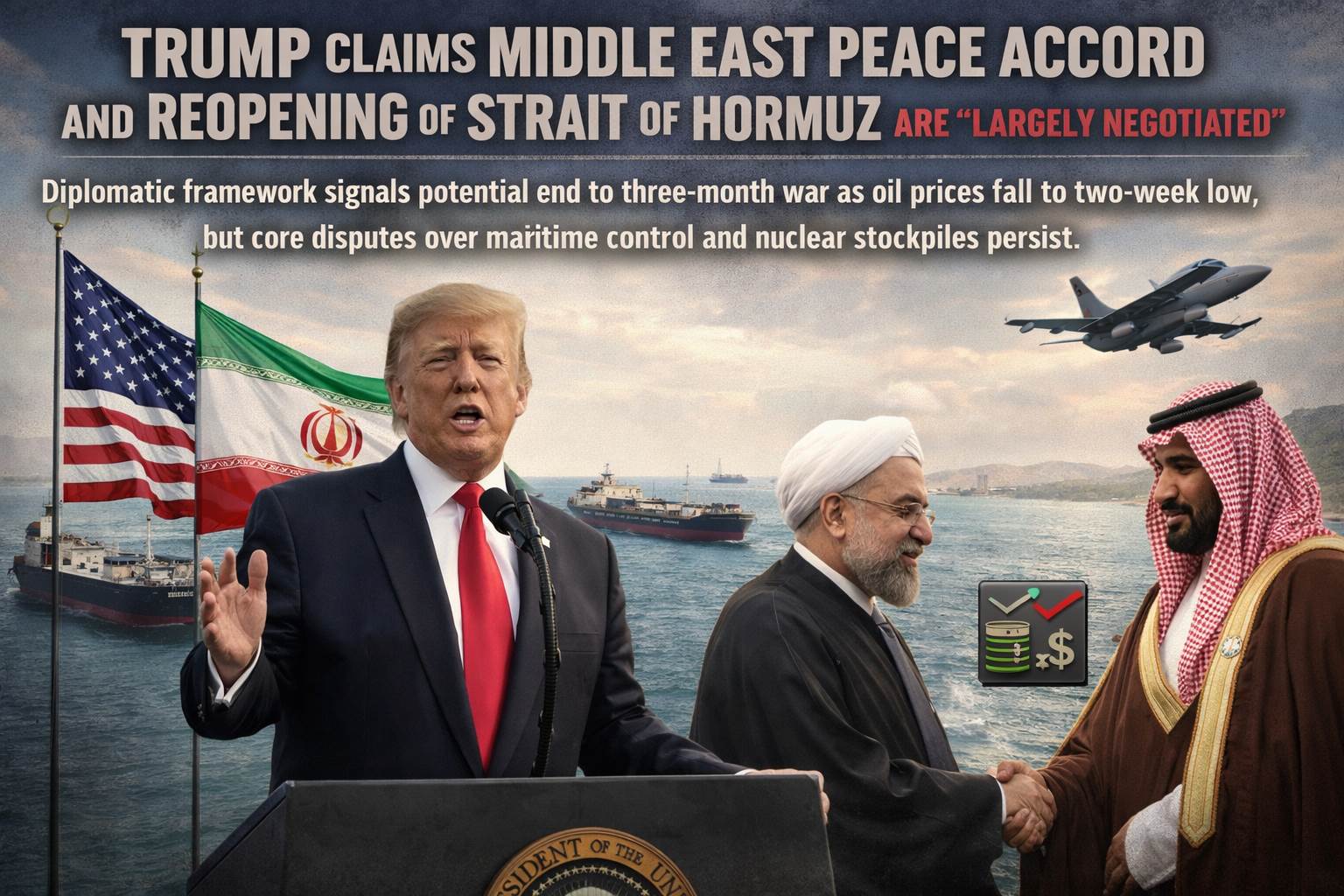
Diplomatic framework signals potential end to three-month war as oil prices fall to two-week low, but core disputes over maritime control and nuclear stockpiles persist.
Publication Date: May 25, 2026
Byline: Global War News Editorial
US President Donald Trump announced that an agreement to permanently end the war with Iran and reopen the blockaded Strait of Hormuz has been “largely negotiated” following a series of high-level telephone discussions with regional leaders and international mediators. In a statement published on his social media platform, Trump indicated that a “Memorandum of Understanding pertaining to PEACE” is undergoing final adjustments and will be formally announced shortly.
The diplomatic breakthrough, brokered primarily through Pakistani mediation, has immediately reverberated across international financial markets. Brent crude futures fell 4.5% to $98.83 a barrel on Monday, hitting a two-week low as energy traders reacted to the prospect of restoring maritime traffic through the world’s most critical oil transit chokepoint. US Secretary of State Marco Rubio, speaking during a diplomatic visit to India, supported the president’s remarks, stating that a definitive agreement could materialise as early as today.
Despite the optimistic tone from Washington, significant discrepancies remain between the negotiating parties regarding the exact terms of the draft accord. While US officials describe a framework that includes the total removal of trade blockades and strict limits on Iranian nuclear assets, state-affiliated media channels in Tehran have disputed the finality of the deal, indicating that core structural terms are still highly contested.
The Proposed Framework and Technical Terms
According to regional diplomatic sources cited by the Associated Press and Reuters, the draft memorandum outlines a phased, two-stage de-escalation process designed to transition the current fragile ceasefire into a permanent cessation of hostilities.
- Ceasefire Extension: The temporary truce, which has officially held since April 8 following the outbreak of direct military conflict in late February, would be extended by 60 days to allow for comprehensive diplomatic talks.
- Maritime Reopening: Iran would clear naval mines from the Strait of Hormuz and permit the unrestricted transit of commercial vessels without the imposition of tolls or transit fees.
- Lifting of Blockades: The United States would systematically dismantle its naval blockade of Iranian ports, which has been strictly enforced since April 13.
- Asset Liquidation and Sanctions Relief: The agreement reportedly incorporates a phased protocol for unfreezing approximately $25 billion in Iranian assets currently held in foreign banking institutions, alongside conditional waivers on the sale of Iranian petroleum and petrochemical products.
Conflicting Perspectives on Control and Weapons
While the overarching structure of the diplomatic track is established, official statements from the respective capitals reveal deep divisions regarding state sovereignty and national security guarantees.
An Israeli government official stated on Sunday that Trump had conducted a telephone conference with Prime Minister Benjamin Netanyahu, during which the US president reportedly pledged to stand firm on demands for the complete removal of highly enriched uranium from Iranian territory. The official emphasized that Israel intends to preserve its internal freedom of action to counter security threats across all regional arenas, including ongoing operations in Lebanon.
Conversely, the Iranian government has rejected assertions that its primary strategic defense programs are on the negotiating table at this stage. Iranian Foreign Ministry spokesperson Esmail Baghaei stated to the official IRNA news agency that nuclear parameters do not form part of the preliminary framework. Baghaei stated that Tehran’s primary focus is the absolute termination of the war on all operational fronts and the explicit, unconditional lifting of economic sanctions.
Furthermore, domestic rhetoric within Iran directly challenges the US narrative regarding maritime authority. Iran’s semi-official Fars news agency reported via its official networks that the administration, route mapping, and permitting systems of the Strait of Hormuz will remain under the absolute, non-negotiable monopoly of the Islamic Republic of Iran, calling the US characterization of an imminent, comprehensive settlement inconsistent with reality.
Global Economic and Energy Implications
The economic stakes surrounding the current diplomatic track remain exceptionally high for both energy-importing nations and global logistics networks. The closure of the Strait of Hormuz by Iranian forces during the height of the three-month war effectively halted a significant portion of the daily global supply of liquefied natural gas and crude oil, triggering sharp inflationary pressures throughout European and Asian consumer markets.
Financial data from early Monday trading indicates that the mere prospect of a diplomatic resolution has eased market anxieties. The decline of Brent crude below the $100 threshold represents the sharpest single-day contraction in energy futures since the enforcement of the US naval blockade in April. Market analysts note that a verified reopening of the waterway would likely restore standard commercial shipping volumes within 30 days, substantially stabilizing maritime insurance premiums and global supply lines.
Analysis: The Hurdles to a Final Settlement
The current diplomatic scenario represents the most significant de-escalation effort since the onset of US-led strikes in February, yet observers note that the framework faces intense domestic political opposition within the United States and the broader Middle East.
The divergence between Washington’s insistence on comprehensive nuclear disarmament and Tehran’s focus on sovereignty suggests that the upcoming 60-day negotiation window will be highly volatile. For Donald Trump, the draft agreement offers a rapid mechanism to resolve a disruptive international conflict and claim a major foreign policy victory. However, domestic critics, including senior legislative figures in Washington, have already expressed deep concern that any deal providing sanctions relief without the verified dismantling of Iran’s nuclear infrastructure constitutes a strategic error.
The central friction point rests on the physical management of the Strait of Hormuz. If Iran maintains its stated policy of absolute administrative control and vessel vetting, the United States and its maritime allies may find the arrangement incompatible with their stated demands for a completely free, open, and unmonitored international waterway. Until these conflicting legal and operational interpretations are reconciled, the sustainability of the current truce remains uncertain.
Source Disclosure:
This report incorporates verified data and official public statements from the following entities:
- Official social media statements from US President Donald Trump.
- Public press briefings from US Secretary of State Marco Rubio during his official visit to India.
- Official statements from Iranian Foreign Ministry Spokesperson Esmail Baghaei via the IRNA news agency.
- Independent journalistic reporting from Reuters, the Associated Press, the Financial Times, and The Guardian.
- Regional operational dispatches from the semi-official Tasnim and Fars news agencies.
This article is based on publicly available reporting from named international news agencies and attributed official statements. All claims about ongoing events are attributed to their original sources. Analysis sections represent the editorial interpretation of reported facts and do not constitute advocacy for any party to the described conflict. AI tools may be utilized for image generation to assist in explaining complex concepts, as well as for refining grammar, spelling, and other linguistic enhancements. However, all original content is produced, fact-checked, and revised by the editorial team. This publication does not take political positions on active military conflicts.