
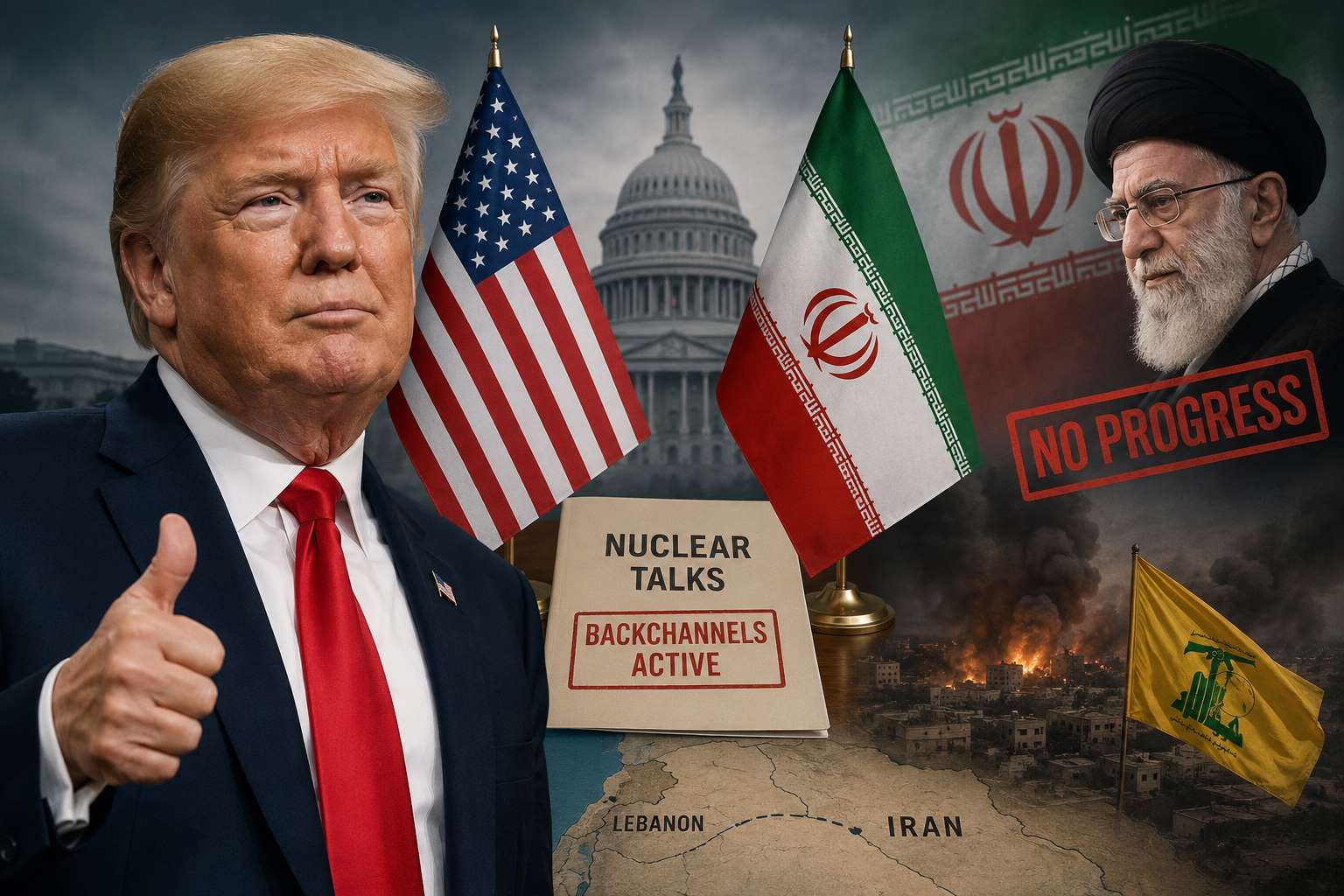
Direct backchannels remain active in Washington as the White House attempts to uncouple broader nuclear talks from expanding hostilities in Lebanon.
Publication Date: June 4, 2026
Last Updated: June 4, 2026
Byline: Global War News Editorial
WASHINGTON; United States President Donald Trump announced that direct high-level negotiations with Iran are proceeding constructively and could yield a structural breakthrough as early as this upcoming weekend. The executive assessment comes at a highly critical juncture, as international observers attempt to gauge whether a comprehensive agreement can survive a parallel cycle of maritime enforcement actions and retaliatory drone salvos across the Gulf region.
Speaking to reporters at the White House on Wednesday, President Trump indicated that diplomatic team structures are actively engaged in reviewing text options. “I hear the negotiation itself is going very well actually,” Trump stated in the Oval Office, adding that while a finalized text framework might not materialize immediately, “it could happen over the weekend.”
The optimistic White House appraisal stands in stark contrast to the formal diplomatic rhetoric emerging from Tehran. In an interview broadcast by Lebanon’s Al Mayadeen television network, Iranian Foreign Minister Abbas Araghchi confirmed that indirect message exchanges through intermediary backchannels have not been cut off. However, Araghchi explicitly countered the American characterization, stating that “no tangible progress has been made in the negotiation process” due to ongoing Western military pressure and unresolved territorial disputes.
The Nuclear Impasse and Delinking Strategy
The primary tactical friction point within the Washington negotiations remains the future status of Iran’s highly enriched uranium reserves. President Trump emphasized that under any proposed peace agreement, the United States would insist on the physical removal of Tehran’s near-weapons-grade uranium stockpile, repeating his administration’s core objective to prevent the Islamic Republic from attaining full military nuclear capability.
While Iran continues to deny seeking nuclear weaponry, it has amassed quantities of highly enriched material that international monitors note have no viable domestic civilian application. Throughout the current round of talks, Iranian negotiators have resisted total removal, insisting instead on a sovereign right to maintain closely monitored enrichment activities for domestic energy purposes.
A secondary structural hurdle involves an effort by the White House to isolate the bilateral US-Iran conflict from parallel regional frontlines. President Trump confirmed on Wednesday that he is actively seeking to uncouple the primary nuclear talks from the active cross-border hostilities occurring between Israel and Hezbollah in southern Lebanon. “I’d like to separate it, I’d like to have a separate thing because it is separate,” Trump told reporters.
Tehran, however, has consistently rejected this delinking strategy. Foreign Minister Araghchi reiterated that the regional theater remains operationally linked, declaring that returning to a formal negotiating table is entirely conditional on securing the economic rights of the Iranian people, ensuring a verified cessation of Israeli forward incursions into Lebanon, and stopping broader Western aggression over regional capitals.
Domestic Legislative Friction and Gulf Volatility
The administration’s diplomatic push is unfolding against a backdrop of intensifying political opposition within Washington. Hours after the president’s Oval Office remarks, the United States House of Representatives passed a war powers resolution directing the withdrawal of American military personnel from direct combat operations associated with the conflict, which opened in February.
The legislative measure passed in a narrow 215–208 vote, drawing support from a unified Democratic caucus alongside four defecting members of the president’s Republican Party. While the resolution serves as a notable public rebuke of the administration’s regional strategy, it remains largely symbolic, as the executive branch holds sufficient veto authority to block the measure should it achieve parallel passage within the Senate.
The diplomatic maneuvers are further complicated by immediate security incidents in the northern Gulf that have tested local air shields:
- Maritime Blockade Enforcement: On Tuesday, US Central Command (CENTCOM) confirmed that naval assets intercepted and disabled the engine room of a Botswana-flagged commercial tanker, the M/T Lexie, as it transited toward Iran’s Kharg Island terminal in defiance of an active maritime embargo.
- Civilian Infrastructure Impacts: Following the tanker interdiction, Iranian uncrewed aerial platforms launched a series of retaliatory strikes across neighboring state logistics hubs. Kuwaiti civil aviation authorities confirmed that an uncrewed platform struck Terminal 1 at Kuwait International Airport, causing significant structural damage, wounding 63 people, and resulting in one civilian fatality.
- Divergent Explanations: In a public message, Foreign Minister Araghchi defended the military response as an act of legitimate self-defense against logistics bases used to enforce the trade blockade. Conversely, Iranian media networks suggested that the airport destruction was caused by a malfunctioning Western interceptor missile rather than a directed drone impact.
President Trump sought to minimize the long-term impact of the airport strike on the peace talks, remarking to reporters that “in that part of the world ceasefire is when you’re shooting in a more moderate manner,” and asserting that US forces “nipped it in the bud very quickly.”
Analysis: Interceptor Consumption and Strategic Deadlines
Military analysts note that the administration’s eagerness for a rapid weekend breakthrough reflects real logistical anxieties regarding long-term air defense parameters. Months of multi-directional drone interceptions and ballistic missile suppression campaigns have led to significant consumption rates across global stockpiles of high-altitude interceptor missiles, including Western Patriot and Arrow networks. With production lines facing competing demands from separate international conflicts, maintaining a permanent high-intensity defensive envelope over multiple allied Gulf states places real material constraints on Western naval deployment capacity.
From an economic perspective, the persistent gap between optimistic White House projections and Tehran’s rigid diplomatic posture maintains high volatility across international commodity channels. Following news of the House war powers vote and the temporary suspension of commercial flights in Kuwait, Brent crude futures advanced moderately, holding firm above 93 US dollars a barrel. Financial institutions indicate that while the continuation of backchannel text exchanges prevents a full-scale panic, market operators are unlikely to reduce the maritime insurance premiums currently affecting shipping routes through the Strait of Hormuz until a verified nuclear framework is formally signed by both sovereign entities.
What to Watch
In the immediate term, diplomatic monitors are watching for whether the White House will dispatch Secretary of State Marco Rubio to a neutral regional venue, such as Muscat or Geneva, to iron out specific technical language regarding the uranium transfer before Sunday. Attention is also focused on whether the newly implemented, conditional Israel-Lebanon ceasefire agreement can hold over the next 48 hours, as any renewed bombardment inside Beirut would, according to Tehran’s explicit warnings, prompt a total suspension of the Washington backchannel and a full-scale resumption of coordinated regional missile operations.
Source Disclosure Note: This report is compiled from verified public statements and press briefings issued by the White House, the Iranian Ministry of Foreign Affairs, and the US House of Representatives. Additional contextual updates regarding regional tactical developments were sourced from official transcripts published by the Tasnim News Agency, the Kuwait State News Agency, and field dispatches from Reuters, the Associated Press (AP), and Agence France-Presse (AFP).
This article is based on publicly available reporting from named international news agencies and attributed official statements. All claims about ongoing events are attributed to their original sources. Analysis sections represent the editorial interpretation of reported facts and do not constitute advocacy for any party to the described conflict. AI tools may be utilized for image generation to assist in explaining complex concepts, as well as for refining grammar, spelling, and other linguistic enhancements. However, all original content is produced, fact-checked, and revised by the editorial team. This publication does not take political positions on active military conflicts.