
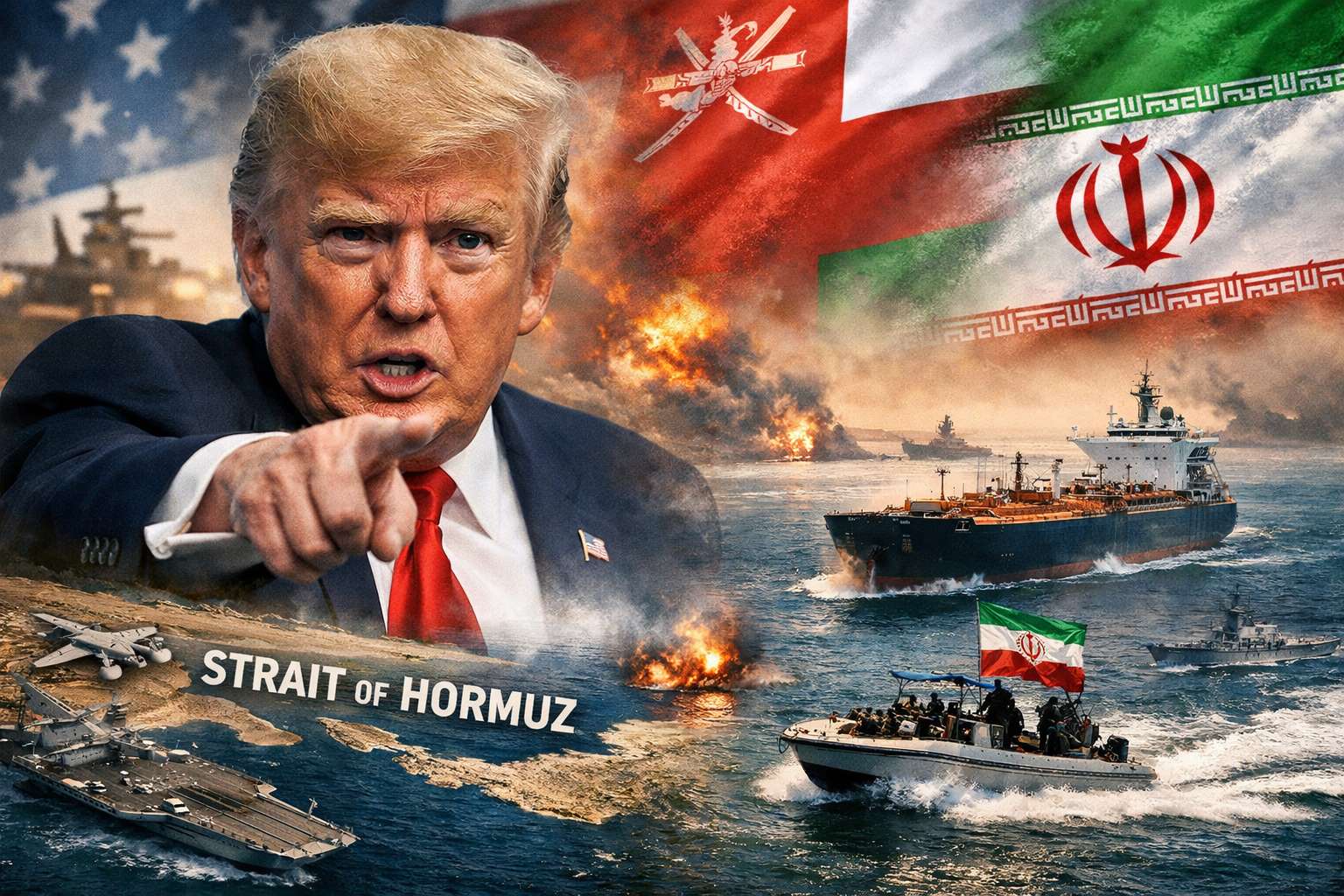
Washington threatens sanctions and military action over proposed maritime toll framework with Iran, upending regional diplomacy and global shipping projections.
Published: May 29, 2026
Byline: Staff Writer, Global War News
WASHINGTON: US President Donald Trump has issued a direct warning to Oman regarding the strategic control of the Strait of Hormuz. Speaking to reporters during a cabinet meeting at the White House on May 27, 2026, President Trump explicitly rejected any proposal that would grant Iran and Oman joint authority over commercial traffic passing through the narrow waterway.
The statement followed reports broadcast by Iranian state television claiming that a draft memorandum of understanding had been drawn up between Tehran and Muscat. According to those unverified regional reports, the proposed framework aimed to restore merchant shipping to pre-war levels by establishing a joint transit management system. The arrangement reportedly included the collection of regulatory fees or transit tolls by a newly established Iranian entity, the Persian Gulf Strait Authority.
When asked whether the United States would accept a short-term arrangement allowing Oman and Iran to oversee trade through the passage, President Trump stated that the strait must remain open to all nations. He warned that Oman must conform to international norms or face severe military repercussions, stating that the Gulf nation must “behave just like everybody else, or we’ll have to blow them up.”
The diplomatic friction has injected fresh volatility into global energy and shipping markets. The Strait of Hormuz, which separates Oman and Iran, typically handles more than 20 percent of global petroleum shipments and a significant portion of liquefied natural gas liquefied natural gas (LNG). The transit route has seen a sharp decline in commercial traffic since the outbreak of hostilities between the United States, Israel, and Iran on February 28, 2026.
Escalation of Financial Pressures
Following the president’s verbal warning, the US Department of the Treasury moved rapidly to institutionalize Washington’s position through targeted economic penalties. On May 28, 2026, US Treasury Secretary Scott Bessent announced that the United States government had officially placed sanctions on Iran’s Persian Gulf Strait Authority. Washington has accused the regulatory body of working in direct coordination with the Islamic Revolutionary Guard Corps Navy to extort commercial vessels and channel revenue to a designated foreign terrorist organization.
Secretary Bessent extended the warning explicitly to Muscat via a statement published on social media. He declared that the United States would not tolerate the implementation of an artificial tolling or fee collection system within international waters. He stated that the US Treasury would aggressively target any regional actors or financial institutions involved directly or indirectly in facilitating collection mechanisms for the strait.
The diplomatic standoff was partially deactivated late on May 28, when Secretary Bessent informed a White House press briefing that he had spoken directly with the Omani ambassador to the United States. Following the conversation, the Treasury Department reported that Muscat had officially assured Washington it has no intentions of participating in or implementing a maritime tolling system within the waterway.
Context and Background: Oman’s Fragile Neutrality
The public rift represents a rare and significant strain in relations between Washington and Muscat. For decades, Oman has maintained a foreign policy focused on strict regional neutrality and diplomatic mediation. It has historically served as a critical backchannel intermediary between Western governments and Tehran, frequently hosting sensitive, unpublicized negotiations.
The current conflict has placed immense pressure on this traditional balancing act. While other member states of the Gulf Cooperation Council (GCC) have sought to distance themselves from Iranian maritime initiatives, Oman maintained active diplomatic contact with Tehran. According to reporting from the Arab Center Washington DC, Iranian Foreign Minister Abbas Araghchi visited Muscat in late April 2026 to propose cooperative maritime management protocols.
The economic incentives for Oman are distinct from its neighbors. Because Oman’s primary commercial ports, such as Sohar and Salalah, lie outside the Persian Gulf on the Arabian Sea, its domestic exports are not physically trapped by a closure of the Strait of Hormuz. Regional economic data published in May 2026 indicates that Omani ports have experienced a 117 percent increase in transit cargo volume originating from other GCC nations since the regional war began in late February. This logistics boom has made Muscat a vital alternative conduit for regional trade, even as it complicates its security relationship with the West.
Analysis: What This Could Mean for Global Energy and Trade
The swift US response underscores a rigid stance regarding international maritime law and freedom of navigation. Independent legal scholars have noted that the imposition of arbitrary financial tolls or unilateral entry blockades within an international strait directly violates the 1982 United Nations Convention on the Law of the Sea. By threatening both military action and comprehensive secondary sanctions, Washington has signaled that it views any concession on Hormuz transit management as a strategic victory for Iran.
For global shipping firms, insurers, and commodity traders, the immediate outlook remains highly uncertain. Maritime security analysts note that commercial traffic through the strait is unlikely to recover toward pre-conflict averages based on diplomatic assurances alone. Shipowners face a dual-layered risk matrix: potential physical threats from naval minefields and missile strikes, alongside severe compliance penalties from the US Office of Foreign Assets Control if any transit fees are inadvertently paid to entities tied to the Persian Gulf Strait Authority.
Consequently, supply chain logistics are shifting toward long-term adaptations. Energy analysts project that crude oil and LNG prices will maintain a high risk premium as long as the legal and physical safety of the strait remains unguaranteed. Nations dependent on Gulf energy supplies are being forced to expand their reliance on alternative overland pipelines or lengthy maritime detours around the African continent, driving up baseline freight costs globally.
What to Watch
Moving forward, observers should monitor whether Oman can successfully maintain its role as an independent regional mediator while adhering to Washington’s strict sanctions regime. A key indicators will be the progress of ongoing, fragile bilateral discussions aimed at re-establishing maritime security protocols without the implementation of contested transit fees. Furthermore, the operational activity of the sanctioned Persian Gulf Strait Authority will demonstrate whether Tehran intends to enforce its regulatory framework unilaterally despite the withdrawal of Omani diplomatic backing.
Source Disclosure Note: This report relies upon official press transcripts from the White House, public statements issued by US Treasury Secretary Scott Bessent, regional diplomatic dispatches via the Arab Center Washington DC, and independent journalism published by Reuters, AFP, Al Jazeera, and gCaptain.
This article is based on publicly available reporting from named international news agencies and attributed official statements. All claims about ongoing events are attributed to their original sources. Analysis sections represent the editorial interpretation of reported facts and do not constitute advocacy for any party to the described conflict. AI tools may be utilized for image generation to assist in explaining complex concepts, as well as for refining grammar, spelling, and other linguistic enhancements. However, all original content is produced, fact-checked, and revised by the editorial team. This publication does not take political positions on active military conflicts.