
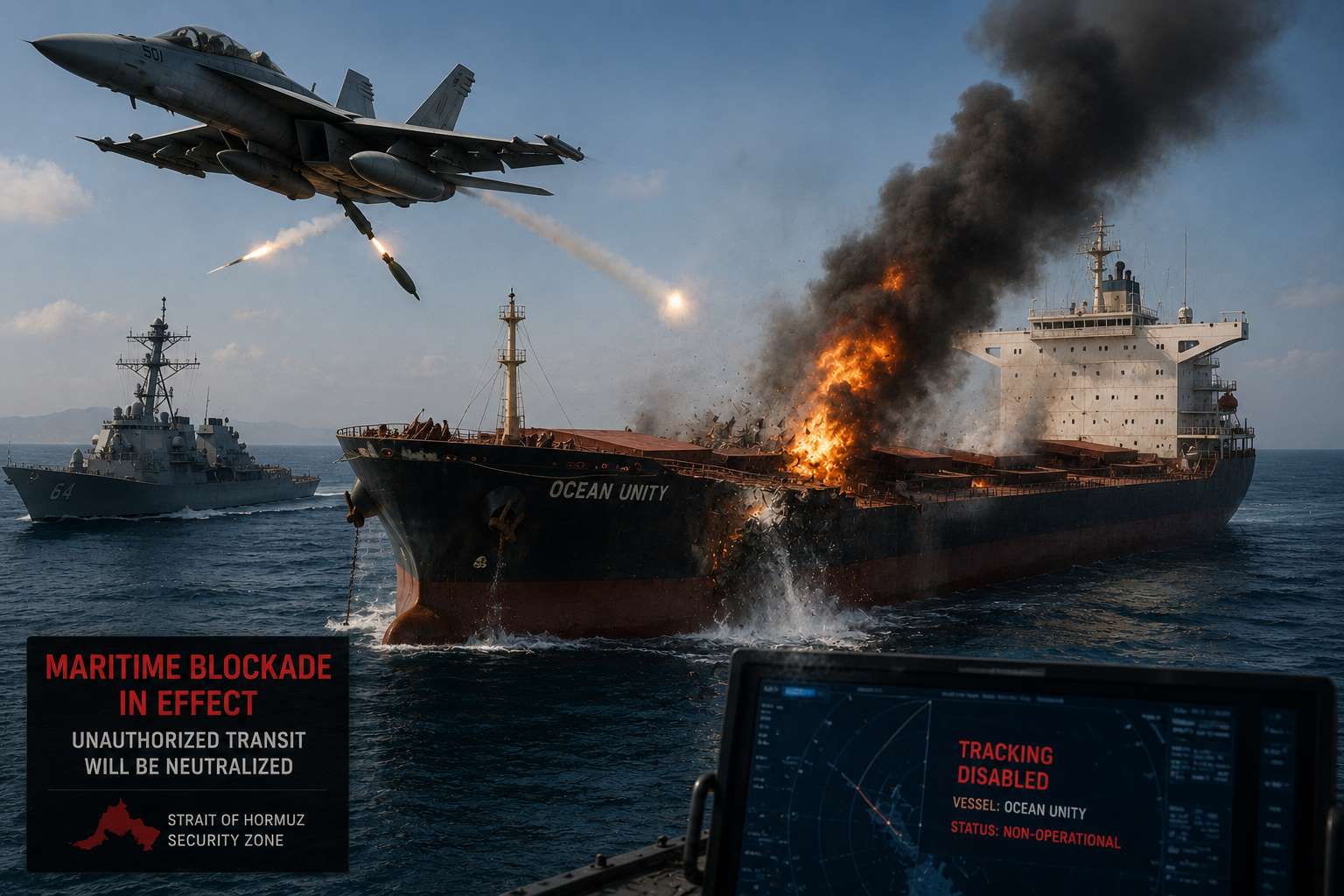
A Gambia-flagged merchant ship bound for an Iranian port becomes the fifth commercial vessel disabled by American forces as Washington maintains a strict naval embargo despite ongoing truce negotiations.
Publication Date: June 2, 2026
Last Updated: June 2, 2026
Byline: Global War News Editorial
WASHINGTON: United States military aircraft intercepted and disabled a commercial bulk carrier in the Gulf of Oman after the vessel repeatedly ignored orders to halt its journey toward an Iranian port. The operation represents a sharp kinetic enforcement of Washington’s maritime embargo, occurring at a highly sensitive moment as both nations review a tentative 60-day ceasefire outline.
According to an official statement released by U.S. Central Command (CENTCOM), forces observed the Gambia-flagged cargo vessel, identified as the M/V Lian Star, transiting international waters toward the Iranian coast. CENTCOM reported that American forces issued more than 20 distinct warnings via maritime radio channels, informing the crew that their trajectory violated the ongoing U.S. naval blockade.
When the bulk carrier failed to comply and maintained its course, a U.S. military aircraft fired a Hellfire missile directly into the vessel’s engine room. The strike successfully disabled the ship’s propulsion, leaving the vessel adrift in the Gulf of Oman. U.S. officials, speaking on condition of anonymity to discuss active operations, confirmed to the Associated Press that American forces have not boarded the strike target and that no immediate details regarding crew casualties or the specific nature of the cargo have been released.
Escalating Enforcement Measures in the Choke Point
The disabled merchant ship brings the total number of vessels halted by the U.S. military to six since the implementation of the embargo, with five being permanently disabled and one redirected. The incident highlights the strict rules of engagement currently enforced by U.S. Naval Forces Central Command in the outer approaches to the Persian Gulf:
- Expanded Interdiction Data: In its latest operational summary, CENTCOM announced that U.S. forces have redirected 116 commercial vessels away from Iranian ports since the maritime enforcement campaign began. The operation involves over 10,000 U.S. personnel supported by a carrier strike group and long-range Boeing P-8 Poseidon maritime patrol aircraft.
- Direct Threat Advisories: The strike on the Lian Star follows an explicit warning issued this week by the Joint Maritime Information Center (JMIC). The advisory note explicitly cautioned commercial shipowners that any vessels failing to comply with direct military instructions would be classified as imminent threats and subjected to “disabling and destructive fires” as an act of proportionate self-defense.
- A Vast Operational Zone: The blockade, which began on April 13 following the collapse of the Islamabad peace talks, encompasses the entirety of the Iranian coastline. It regulates commercial inbound and outbound traffic through the Arabian Gulf, the Strait of Hormuz, the Gulf of Oman, and the North Arabian Sea to restrict Tehran’s remaining access to cash reserves.
Iran’s Wartime Command Issues Transit Demands
The kinetic interception has drawn a sharp response from Tehran’s defense apparatus, which has sought to implement its own competing regulatory system over the vital global energy lane. The Khatam al-Anbiya Central Headquarters, Iran’s central wartime command body, issued a statement declaring that all commercial shipping and oil tankers must strictly utilize designated routes inside the Strait of Hormuz.
The command stated that any vessel transiting the area must obtain explicit prior authorization from the Islamic Revolutionary Guard Corps (IRGC) Navy. Iranian military spokespersons warned that any violation of these domestic regulations would seriously endanger the security of passage, adding that Iran considers the presence of U.S. naval assets a breach of baseline regional security frameworks.
The geopolitical friction has heavily penalized the international shipping industry. According to data tracked by the International Maritime Organization (IMO), more than 1,500 merchant vessels have faced prolonged delays, anchorage standstills, or forced route diversions since the wider conflict broke out on February 28. War risk insurance premiums for the region have been entirely removed by global syndicates, forcing shipowners to absorb immense financial liabilities or bypass the Middle East entirely by routing around the Cape of Good Hope.
ANALYSIS: The Leverage Trap in Maritime Diplomacy
The strike against the M/V Lian Star demonstrates that the Trump administration is unwilling to ease physical pressure on the water until a diplomatic text is formally signed and verified on land. For Washington, the strict maintenance of the blockade serves as the primary tool of economic leverage to force Iran’s compliance regarding long-term nuclear restrictions and the disposal of its highly enriched uranium stockpiles.
However, executing an airborne missile strike against a foreign-flagged merchant hull while negotiators are actively exchanging drafts through third-party intermediaries carries immense escalation risks. It creates a volatile structural paradox: the administration needs the blockade to maintain bargaining leverage, but the kinetic enforcement of that blockade provides hardline military factions within the IRGC with a continuous justification to disrupt broader regional shipping.
Furthermore, the implementation of competing authorization protocols by Iran’s wartime command center indicates that even if a 60-day truce is finalized, restoring commercial maritime confidence will be a slow process. Commercial operators are unlikely to resume normal traffic patterns through the Strait of Hormuz based solely on a diplomatic announcement; they will require objective proof of mine-clearance operations, a total suspension of drone boat activity, and explicit guarantees that compliance with one military superpower will not result in being targeted by the other.
What to Watch Next
As the disabled bulk carrier remains adrift under military observation, three specific indicators will signal the impact of this latest escalation on the wider crisis:
- The Intermediary Reaction: Whether Pakistani and Qatari diplomatic channels report a pause in truce negotiations due to Tehran’s objections over the targeting of Iran-bound commercial hulls.
- IRGC Retaliation Patterns: Whether the IRGC Navy deploys asymmetric assets, such as loitering munitions or unmanned surface vessels, against Western naval groups or non-compliant tankers outside the immediate blockade zone.
- Owner and Flag-State Legal Claims: How the government of the Gambia and the private operators of the Lian Star address the physical destruction of their maritime asset in international waters under international shipping law.
Source Disclosure Note: This report utilizes verified operational data from U.S. Central Command (CENTCOM) press releases, independent maritime safety advisories from the Joint Maritime Information Center (JMIC), commercial transit metrics from the International Maritime Organization (IMO), and official state media transcripts from the Iranian Khatam al-Anbiya Central Headquarters. Ground context and wire reporting were obtained via the Associated Press, Reuters, and the independent maritime journal gCaptain.
This article is based on publicly available reporting from named international news agencies and attributed official statements. All claims about ongoing events are attributed to their original sources. Analysis sections represent the editorial interpretation of reported facts and do not constitute advocacy for any party to the described conflict. AI tools may be utilized for image generation to assist in explaining complex concepts, as well as for refining grammar, spelling, and other linguistic enhancements. However, all original content is produced, fact-checked, and revised by the editorial team. This publication does not take political positions on active military conflicts.