
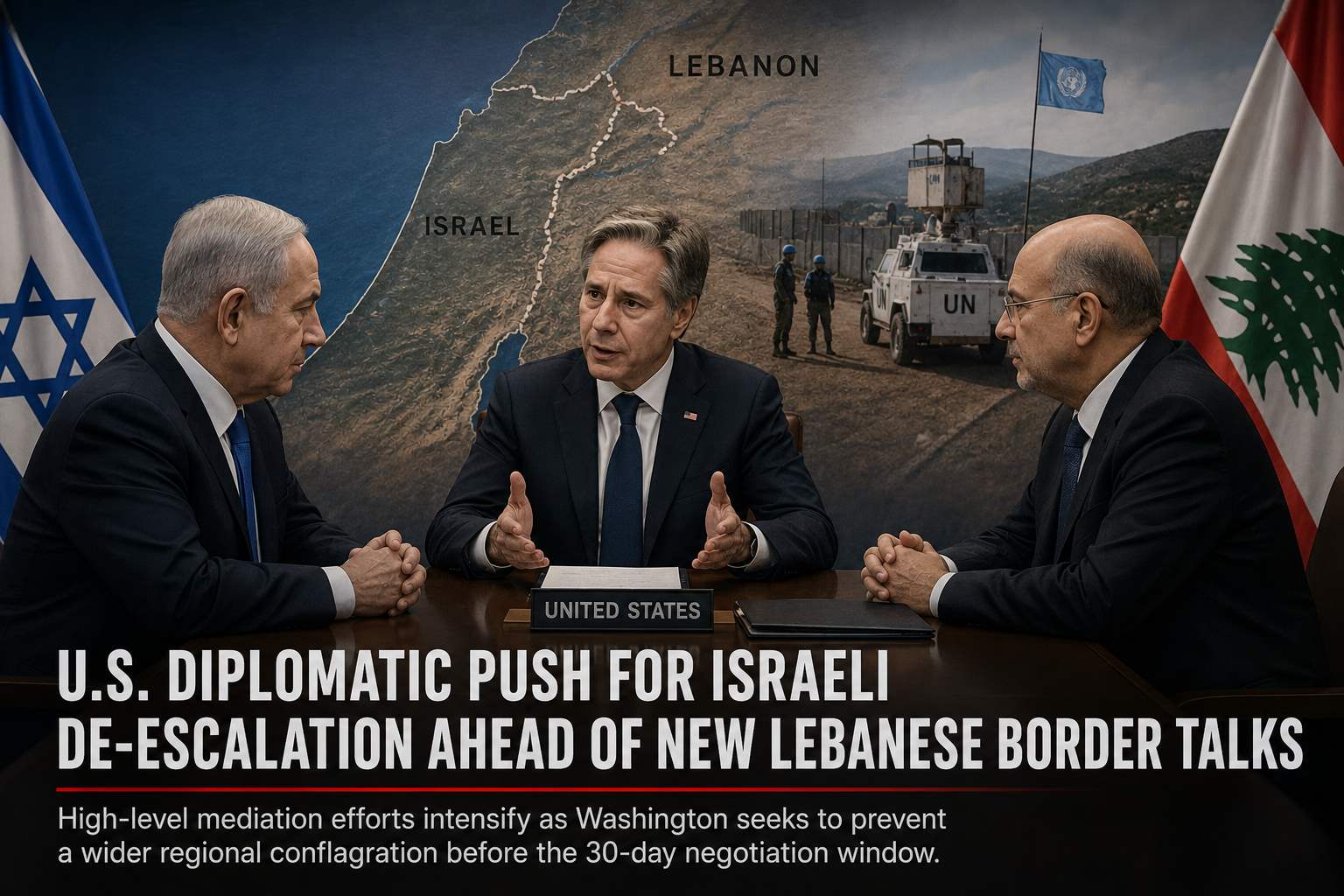
High-level mediation efforts intensify as Washington seeks to prevent a wider regional conflagration before the 30-day negotiation window.
May 8, 2026
Global War News Editorial
By Staff Writer, Global War News
United States diplomats have launched an urgent mediation circuit between Jerusalem and Beirut, aiming to secure a temporary cooling of hostilities before a new round of maritime and land border negotiations. The push comes as the Biden-Trump transition framework enters its most sensitive phase, with American officials attempting to stabilize the “Northern Front” to prevent a collapse of the broader regional ceasefire currently being reviewed in Tehran.
According to reports from the Associated Press and Reuters, U.S. special envoys arrived in the region on Wednesday to present a “de-confliction roadmap.” The proposed plan reportedly calls for a 10-kilometer withdrawal of heavy tactical assets from the Blue Line, the unofficial border between Israel and Lebanon, in exchange for a temporary cessation of Israeli overflights.
Mediation Amid Kinetic Friction
The diplomatic surge follows a period of significant military friction. While a month-long truce has largely held in the Persian Gulf, the Israel-Lebanon border has seen sporadic exchanges of fire. According to a statement from the Lebanese Ministry of Foreign Affairs, Beirut is prepared to engage in the talks provided they are based on the full implementation of UN Resolution 1701.
In Israel, the security cabinet has reportedly discussed the U.S. proposal, though no official acceptance has been announced. As reported by Haaretz, Israeli officials have expressed skepticism regarding the ability of the Lebanese Armed Forces to effectively police the buffer zone without continued international oversight. This lack of consensus highlights the fragility of the peace process even as high-level mediators express optimism about avoiding a total war.
Regional Strategic Implications
The U.S. effort is not occurring in a vacuum. Analysts note that stabilizing Lebanon is a prerequisite for the success of the broader U.S.-Iran peace proposal currently on the table in Tehran. If the Lebanese border remains active, the risk of an unintended escalation drawing in regional proxies remains high.
Observers note that the involvement of France and Qatar in the logistical planning of these talks suggests a coordinated international effort to provide Lebanon with the economic incentives necessary for cooperation. According to data from the World Bank, the Lebanese economy remains in a state of hyper-fragility, and the promise of offshore energy exploration, linked to successful border demarcation—serves as a primary diplomatic lever for Western mediators.
Analysis: The 30-Day Window
The current diplomatic push is operating under a strict 30-day timeline. Washington is keen to secure a “framework of understanding” before the current regional memorandum expires. This raises questions about whether a lasting settlement can be reached or if the mediators are simply “buying time” to manage the transition of power in the United States and the subsequent shift in Middle East policy.
From a strategic perspective, the primary challenge remains the verification of de-escalation. Unlike formal state-to-state treaties, border stability in this region often relies on the behavior of non-state actors. It remains unclear whether the central government in Beirut can provide the guarantees Jerusalem demands, or if the U.S. will be forced to act as a permanent guarantor of the buffer zone.
Outlook
The next 72 hours are expected to be critical as the U.S. envoy moves from Jerusalem to Beirut to finalize the agenda for the border talks. While both sides have signaled a desire to avoid a full-scale war, the presence of unidentified drone activity and periodic artillery exchanges underscores the high stakes. The international community remains focused on whether this diplomatic push will result in a formal sit-down or if the talks will be overtaken by events on the ground.
Source Disclosure: Reporting from the Associated Press, Reuters, Haaretz, and the Lebanese National News Agency (NNA). Official statements from the U.S. State Department and the Lebanese Ministry of Foreign Affairs.
This article is based on publicly available reporting from named international news agencies and attributed official statements. All claims about ongoing events are attributed to their original sources. Analysis sections represent the editorial interpretation of reported facts and do not constitute advocacy for any party to the described conflict. AI tools may be utilized for image generation to assist in explaining complex concepts, as well as for refining grammar, spelling, and other linguistic enhancements. However, all original content is produced, fact-checked, and revised by the editorial team. This publication does not take political positions on active military conflicts.