
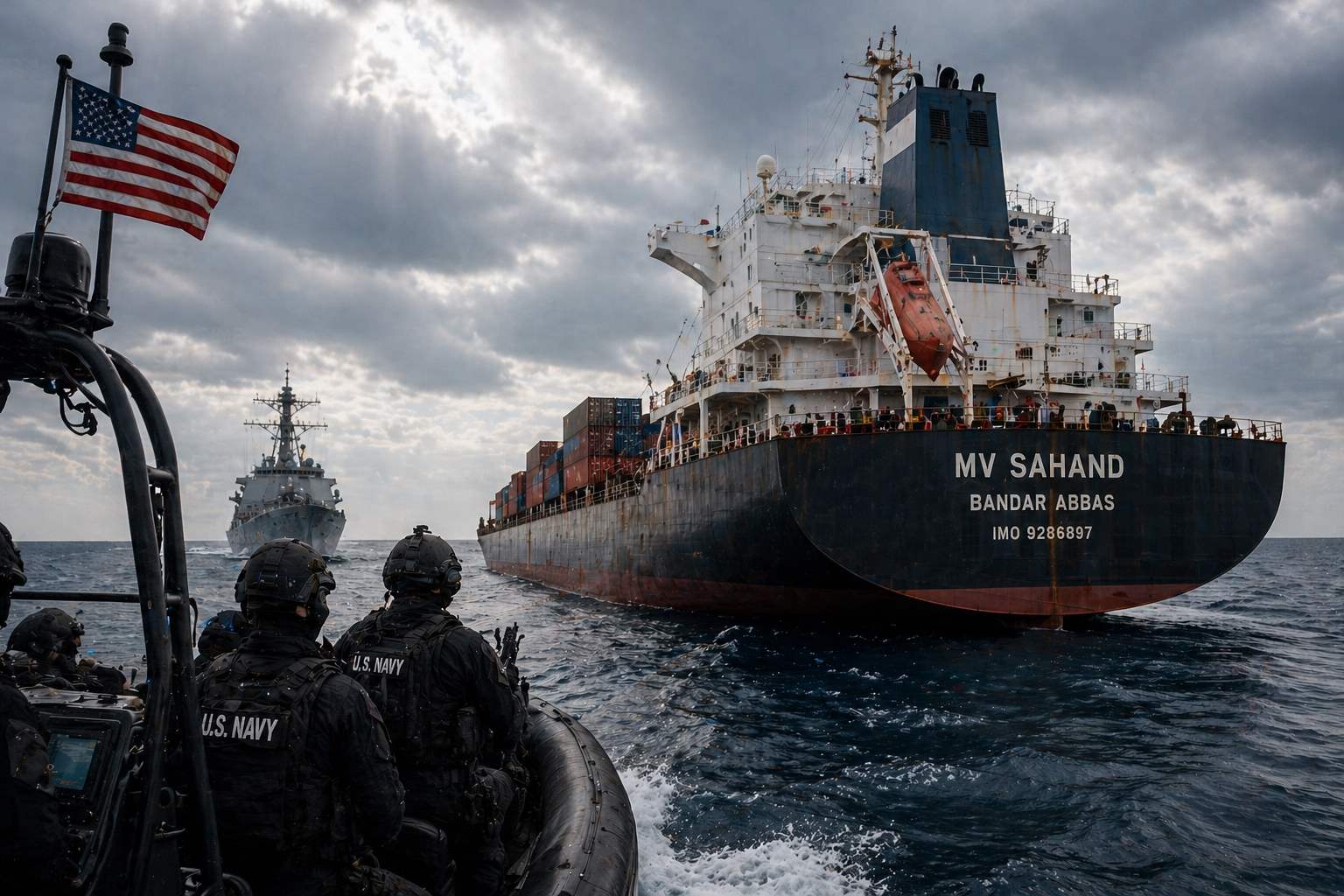
U.S. Navy intercepts the “MV Sahand” in the Gulf of Oman, citing violations of the dual-use technology embargo despite the ongoing ceasefire.
April 29, 2026
By Global War News Editorial
The United States Navy has intercepted and boarded an Iranian-flagged cargo vessel, the MV Sahand, in the international waters of the Gulf of Oman. The operation, conducted late Tuesday by elements of the U.S. 5th Fleet, marks the most significant maritime intervention since the Islamabad-brokered ceasefire was extended last week. The seizure has immediately triggered a diplomatic firestorm, with Tehran accusing Washington of a “provocative breach” of the truce.
U.S. Central Command (CENTCOM) stated publicly that the vessel was interdicted following “credible intelligence” suggesting the cargo included high-precision guidance components for ballistic missiles, which are currently under a strict international embargo. According to Navy spokesperson Captain Rick Chernitzer, the boarding was conducted “professionally and in accordance with international law” to prevent the proliferation of dual-use technologies during the sensitive negotiation period.
The Interception and Cargo Dispute
The MV Sahand was reportedly en route from Bandar Abbas to an undisclosed port in the Red Sea when it was shadowed and eventually boarded by a U.S. Navy Visit, Board, Search, and Seizure (VBSS) team. While CENTCOM has not yet released photos of the seized components, official statements indicate that the ship is being diverted to a regional port for a full technical inspection.
In response, the Iranian Ministry of Foreign Affairs issued a formal protest through the Swiss embassy, which represents U.S. interests in Tehran. Foreign Ministry spokesperson Nasser Kanaani stated that the vessel was carrying “legitimate humanitarian supplies and industrial spare parts” for civilian use. He warned that such “acts of piracy” by the U.S. Navy threaten the stability of the current ceasefire and may lead to “reciprocal measures” in the Persian Gulf.
Impact on Maritime Insurance and Trade
The seizure has sent immediate ripples through the global shipping industry, which had begun to see a slight stabilization in insurance premiums following the April 23 truce extension. Analysts note that the return to active ship seizures by the U.S. Navy complicates the risk assessment for commercial vessels operating near the Strait of Hormuz.
- Insurance Premiums: Maritime insurers in London reported a 15% uptick in “War Risk” surcharges for vessels transiting the Gulf of Oman following news of the MV Sahand seizure.
- Shipping Congestion: Reports from the Port of Fujairah indicate that several tankers have been instructed by their operators to hold positions outside the Gulf until the diplomatic fallout is clarified.
- Fuel Costs: While global oil prices did not see an immediate spike, energy analysts at Goldman Sachs suggested that a return to tit-for-tat maritime seizures could add a $5-to-$10 “geopolitical premium” to crude prices by the end of the week.
Analysis: The Conflict of Definition
Observers note that this incident highlights a critical flaw in the current ceasefire: the lack of a shared definition of “dual-use” goods. While the Trump administration views the interdiction as a defensive enforcement of pre-existing sanctions, Tehran views it as an act of war that nullifies the humanitarian spirit of the truce.
Analysts have suggested that the U.S. may be using these seizures as “negotiating leverage” to push Iran toward the “zero enrichment” mandate favored by Washington. However, this strategy carries the risk of a miscalculation. If the IRGC responds by seizing a Western-linked tanker in retaliation, the Islamabad peace process, currently the only viable diplomatic track, could collapse entirely. This raises questions about whether the U.S. Navy’s mandate to enforce sanctions is fundamentally at odds with the diplomatic objective of maintaining a stable ceasefire.
What to Watch
The primary indicator of escalation will be the Iranian naval response over the next 48 hours. If the IRGC Navy increases its “swarming” maneuvers around U.S. assets or commercial shipping, the truce may be effectively over. Furthermore, the outcome of the U.S. Navy’s technical inspection of the MV Sahand’s cargo will be vital. If the U.S. fails to produce evidence of prohibited military components, it will face significant diplomatic pressure from international mediators, including Pakistan and China, to release the vessel and offer guarantees against future seizures during the negotiation window.
Source Disclosure: This article is based on official statements from U.S. Central Command (CENTCOM), the Iranian Ministry of Foreign Affairs, and the U.S. 5th Fleet. Economic data and insurance assessments were sourced from Reuters, Lloyd’s List, and Bloomberg. Secondary reporting was provided by the Associated Press and Al Jazeera.
This article is based on publicly available reporting from named international news agencies and attributed official statements. All claims about ongoing events are attributed to their original sources. Analysis sections represent the editorial interpretation of reported facts and do not constitute advocacy for any party to the described conflict. AI tools may be utilized for image generation to assist in explaining complex concepts, as well as for refining grammar, spelling, and other linguistic enhancements. However, all original content is produced, fact-checked, and revised by the editorial team. This publication does not take political positions on active military conflicts.