
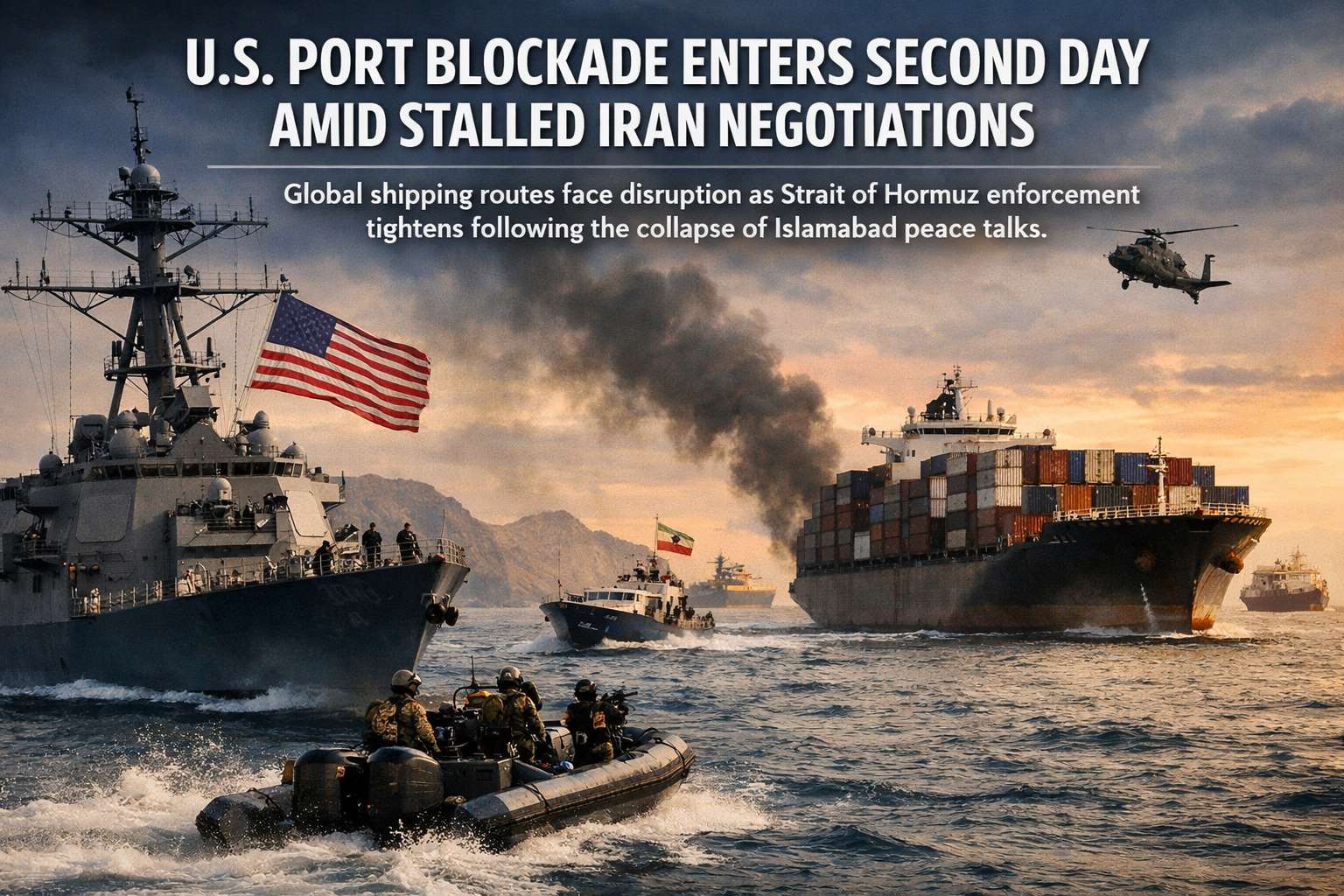
Global shipping routes face disruption as Strait of Hormuz enforcement tightens following the collapse of Islamabad peace talks.
Published: April 15, 2026
Last Updated: 10:15 AM
By Global War News Editorial
International maritime trade faced significant delays for a second consecutive day on Wednesday as U.S. Central Command (CENTCOM) maintained a strict enforcement of a port blockade in the Strait of Hormuz. The escalation follows the formal suspension of the Islamabad peace talks, which aimed to de-escalate tensions between Washington and Tehran.
According to official statements from the U.S. Department of Defense, the blockade is intended to “restrict the flow of illicit military materials” into the region. However, the move has triggered an immediate reaction in global energy markets, with Brent crude prices rising by approximately 4% in early morning trading.
The closure of the Islamabad summit, which involved mediators from Pakistan and Qatar, was confirmed by the Pakistani Foreign Ministry late Tuesday. In a public statement, officials noted that “fundamental disagreements regarding maritime sovereignty” led to an indefinite pause in negotiations.
Enforcement at the Strait
CENTCOM reported that naval assets have established a perimeter to inspect commercial vessels entering and exiting the Persian Gulf. According to a Reuters report, at least twelve oil tankers are currently anchored outside the strait, awaiting clearance.
While the U.S. maintains that the blockade is a targeted security measure, Iranian state media, IRNA, reported that the move is an “act of economic aggression.” The Iranian Ministry of Foreign Affairs stated that the blockade violates international maritime law, though these claims have not been adjudicated by an international tribunal.
Economic Consequences for South Asia
The disruption is already being felt in neighboring economies. Analysts from the World Bank have suggested that prolonged instability in the strait could lead to a sharp increase in transit costs for goods bound for South Asian ports.
In Sri Lanka and India, fuel importers have expressed concern over the reliability of upcoming shipments. According to data provided by the International Monetary Fund (IMF), a sustained blockade of this nature could impact regional GDP growth by as much as 0.5% over the next quarter if alternative routes are not secured.
Analysis: A New Phase of Pressure
The collapse of the Islamabad talks represents a significant shift from diplomacy toward physical containment. Observers note that by transitioning from sanctions to a direct naval blockade, the U.S. is testing the limits of “gray-zone” warfare—actions that fall short of open conflict but carry high economic stakes.
This raises questions about the long-term viability of international mediation. If the U.S. maintains this posture, the likelihood of a retaliatory response from Iranian naval forces increases, potentially turning a trade disruption into a direct military confrontation. However, it remains unclear whether either side is prepared for the domestic economic fallout that a full-scale closure of the strait would trigger.
What to Watch
The UN Security Council is expected to meet later today to discuss the legality of the maritime restrictions. Market participants will be closely monitoring the “Daily Tanker Tracking” reports for signs of a total halt in exports. For now, the focus remains on whether a third-party mediator, such as the European Union, will attempt to revive the stalled Islamabad framework.
Sources: U.S. Department of Defense (Official Statement), Pakistani Ministry of Foreign Affairs, Reuters, IRNA (Iranian State Media), International Monetary Fund (IMF), World Bank Economic Outlook.
This article is based on publicly available reporting from named international news agencies and attributed official statements. All claims about ongoing events are attributed to their original sources. Analysis sections represent the editorial interpretation of reported facts and do not constitute advocacy for any party to the described conflict. AI tools may be utilized for image generation to assist in explaining complex concepts, as well as for refining grammar, spelling, and other linguistic enhancements. However, all original content is produced, fact-checked, and revised by the editorial team. This publication does not take political positions on active military conflicts.