
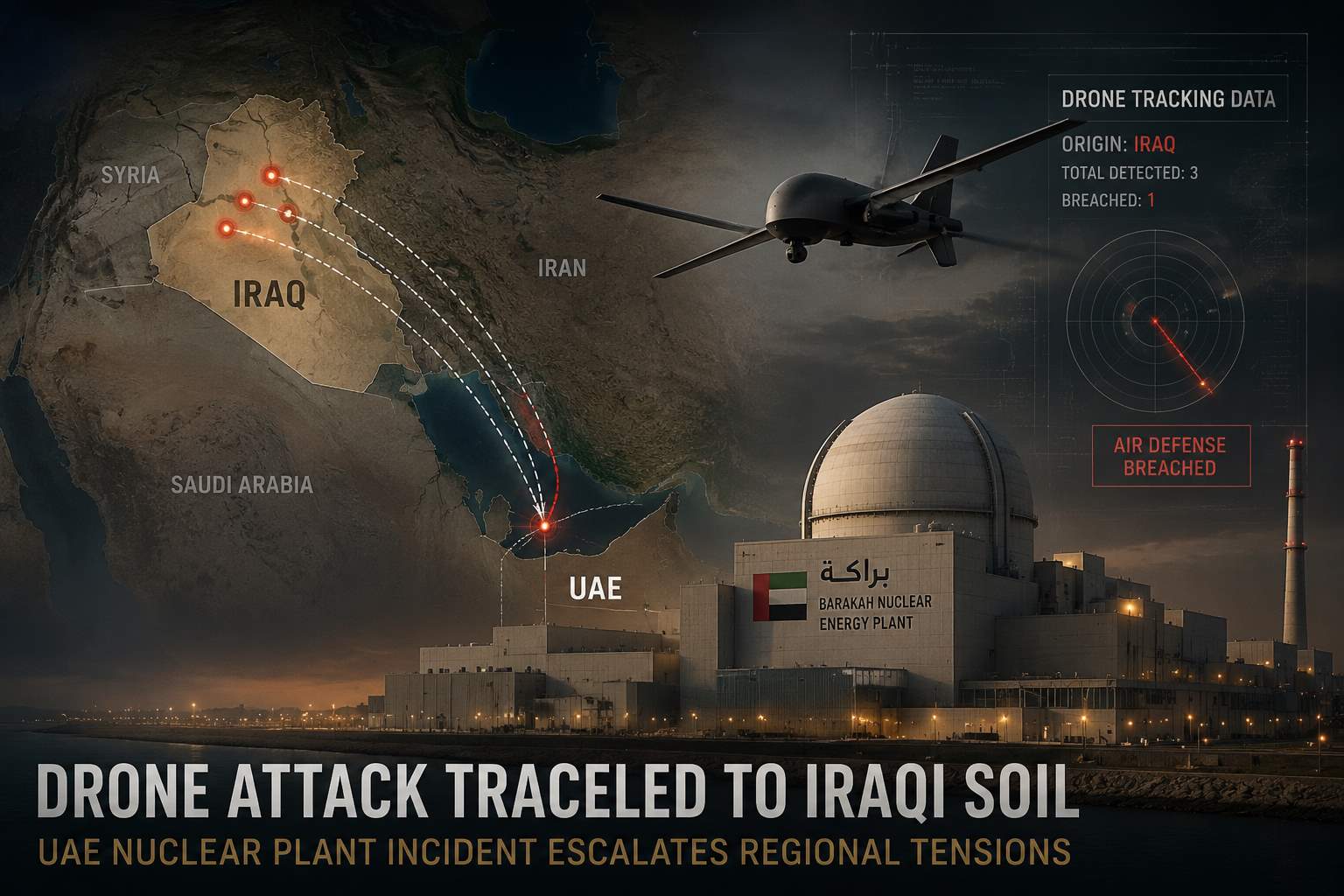
Technical tracking reveals three unmanned aircraft originated from Iraq, with one piercing air defenses to disable off-site power at the Arab world’s sole nuclear power station.
Published: May 21, 2026
By: Global War News Editorial
The Ministry of Defence of the United Arab Emirates has announced that technical tracking and radar monitoring have identified Iraqi territory as the origin of a coordinated drone assault against the Barakah Nuclear Power Plant.
The announcement, released on Tuesday evening, heightens international concern regarding the reach of non-state actors in the Middle East. The attack occurred on the morning of Sunday, May 17, and targeted the $20 billion facility in Abu Dhabi’s western Al Dhafra region, marking the first time a commercial nuclear facility in the Arab world has sustained physical impact during active regional hostilities.
The Infiltration and Immediate Operational Fallout
According to the Emirati defense ministry’s official briefing, a total of three low-flying loitering munitions crossed into UAE airspace from its western borders. While multi-layered air defense systems intercepted two of the inbound drones, a third penetrated the perimeter defenses and struck an external auxiliary electrical generator located just outside the inner containment wall.
The kinetic impact triggered a significant fire in the switchyard area. This sector routes electrical currents in and out of the station.
While the UAE Federal Authority for Nuclear Regulation quickly confirmed that the strike caused zero casualties and zero radioactive material leakage, the tactical disruption was considerable. The strike successfully severed vital off-site electrical power lines connected to Reactor Unit No. 3.
The loss of external power forced station engineers to isolate the affected unit and activate emergency diesel backup generators for approximately 24 hours to maintain critical core cooling operations. On Monday, the International Atomic Energy Agency verified that off-site power grids had been restored, allowing the reactor to transition off emergency backup systems.
Diplomatic Confrontation at the United Nations
The UAE has framing the cross-border escalation as a severe violation of international law. Addressing an emergency session of the United Nations Security Council in New York, the UAE Permanent Representative to the UN, Mohamed Abushahab, stated that the strike must not be viewed as an isolated incident.
Abushahab described the operation as part of a wider regional pattern in which persistent cross-border attacks by a single state and its armed proxies have pushed the region toward dangerous confrontation. While Emirati officials stopped short of naming specific Iraqi militias, security analysts note that Iraq hosts several heavily armed, pro-Iranian paramilitary factions that have repeatedly claimed strikes against regional targets since the conflict erupted.
The strike has drawn condemnation from international bodies. International Atomic Energy Agency Director General Rafael Grossi issued a warning to the UN Security Council, emphasizing that disabling the main electrical lines to a nuclear facility dramatically increases the probability of a reactor core meltdown.
The diplomatic reactions crossed traditional geopolitical divides:
- The United Nations Watchdog: Director Grossi stated that nuclear installations important for safety must never be targeted by military activity.
- The People’s Republic of China: China’s UN envoy expressed great concern, urging absolute restraint to avoid a broader ecological and regional disaster.
- The Russian Federation: Russia’s UN ambassador characterized strikes on peaceful nuclear facilities in any nation as categorically unacceptable.
Context: The Vulnerability of Critical Supply Chains
The current conflict began on February 28, 2026, following direct joint military engagements involving the United States, Israel, and Iran. While a United Nations-backed ceasefire agreement enacted on April 8 successfully reduced high-intensity state-on-state combat, regional proxy groups have continued to utilize low-cost unmanned aircraft to inflict economic damage.
| Metric / Facility Detail | Operational Value | Strategic Context |
| Barakah Power Capacity | ~25% of UAE national grid | Supplies 57% of domestic household electricity |
| Financial Valuation | $20 Billion USD | Developed via South Korean technology partnership |
| Total Conflict Strikes | Approximately 3,000 | Cumulative drones/missiles launched toward UAE in 11 weeks |
| Current Restored Status | 100% off-site power restored | Unit 3 returned to stable grid power within 24 hours |
The targeting of the Al Dhafra facility matches a published list of high-value economic targets circulated by semi-official Iranian media outlets in March, which explicitly identified Gulf energy infrastructure as legitimate points of leverage. Since the war began 11 weeks ago, tracking logs indicate that nearly 3,000 drones and missiles have been launched toward the UAE, aimed predominantly at inflating the geopolitical costs of the conflict for the United States and its regional trade allies.
The vulnerability of these hubs has left deep marks on global markets; repairs to the UAE’s largest natural gas processing plant, which was hit twice last month, are projected to extend into next year.
What to Watch Next
The primary focus is now on Baghdad, where the Iraqi government faces intense diplomatic pressure to restrain non-state groups operating within its borders. Iraqi officials have issued statements rejecting the use of their territory to launch attacks on neighboring states, but the central government’s actual command over these decentralized factions remains limited.
Meantime, the UAE foreign ministry has stated that it reserves its full, sovereign, legitimate, diplomatic, and military rights to respond to hostilities. Observers are closely monitoring whether Abu Dhabi will choose to execute covert retaliatory strikes against proxy assets in Iraq, a move that could disrupt the fragile April 8 truce and trigger a renewed cycle of asymmetric warfare across the Persian Gulf.
Source Disclosure Note: This report is based on official technical tracking statements issued by the United Arab Emirates Ministry of Defense, statements from the UAE Federal Authority for Nuclear Regulation, and transcripts from the United Nations Security Council emergency session, including testimonies by Ambassador Mohamed Abushahab and IAEA Director General Rafael Grossi. Additional details were gathered from the international news agencies Associated Press, Reuters, and Agence France-Presse, alongside reporting from The Guardian, The Japan Times, and Kurdistan24.
This article is based on publicly available reporting from named international news agencies and attributed official statements. All claims about ongoing events are attributed to their original sources. Analysis sections represent the editorial interpretation of reported facts and do not constitute advocacy for any party to the described conflict. AI tools may be utilized for image generation to assist in explaining complex concepts, as well as for refining grammar, spelling, and other linguistic enhancements. However, all original content is produced, fact-checked, and revised by the editorial team. This publication does not take political positions on active military conflicts.