


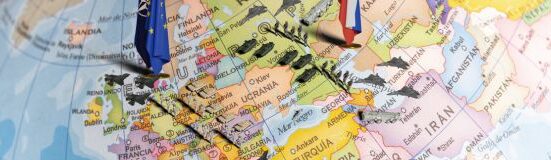


This week could prove pivotal for the war in Ukraine, with two sets of urgent talks taking place in Paris and Riyadh. As global powers scramble for a resolution, the stakes are high, and Ukraine finds itself notably absent from both discussions.
Monday: European Leaders Meet in Paris
The UK
Sir Keir Starmer aims to act as a bridge between European leaders and Donald Trump’s White House, which is pressing Europe to boost its defense spending. Starmer’s offer to deploy UK troops in Ukraine reflects his commitment to preventing another Russian invasion and securing a lasting peace deal.
Though the UK government once insisted that Ukraine should dictate the terms of any peace agreement, that stance appears to be shifting. The new US administration has signaled that returning to Ukraine’s 2014 borders is unrealistic, prompting Starmer to encourage other European nations to offer similar military commitments.
Domestically, however, debate continues over the UK’s defense budget. Labour has pledged to increase spending from 2.3% of GDP to 2.5%, though without a clear timeline. Defense officials argue that such a rise is increasingly urgent.
Germany
Chancellor Olaf Scholz’s presence in Paris, despite Germany’s upcoming national election, signals the country’s alarm over Trump’s approach to Ukraine. While Germany’s political elite remains steadfast in supporting Ukraine, there’s a clear reluctance to discuss sensitive issues like higher NATO spending or German peacekeeping forces — at least until after the election.
Over the past three years, Germany has reduced its dependence on Russian energy and significantly increased defense spending, though this shift has come at a high economic cost, contributing to the collapse of the German government.
Poland
As a key logistics hub for aid to Ukraine, Poland remains adamant that Russia cannot be allowed to win the war, viewing European security as hanging in the balance. Prime Minister Donald Tusk has urged Europe to spend heavily on defense now, warning that failing to do so could lead to a far more expensive and devastating war.
While Poland agrees with the US on boosting defense budgets, officials have been cautious about the prospect of sending Polish troops to Ukraine to enforce any ceasefire, ruling it out for now.
The Nordic and Baltic Countries
Denmark, the sole Nordic nation at the Paris talks, will also represent the interests of its Baltic neighbors, Estonia, Latvia, and Lithuania — countries acutely aware of their vulnerability to Russian aggression. Danish Prime Minister Mette Frederiksen has not ruled out sending peacekeeping troops to Ukraine but insists that it’s too early to make a definitive commitment.
France
French President Emmanuel Macron convened Monday’s meeting to help Europe coordinate its response to Washington’s shifting stance on Ukraine. French officials stress that the gathering is not a “summit” but a crucial step toward building European unity and preparing a possible peacekeeping force.
French leaders, wary of American geopolitical maneuvering, fear being sidelined by a Trump-Putin axis that could abandon Europe’s interests. Former Prime Minister Dominique De Villepin has called for a “Europe-wide state of emergency,” accusing Trump of attempting to dominate global affairs without principles or respect.
Tuesday: Russia and the US in Saudi Arabia
Russia
Russian Foreign Minister Sergei Lavrov is set to meet with US Secretary of State Marco Rubio in Riyadh, with Moscow’s priorities clearly defined: recognition of Russian-occupied Ukrainian territories, lifting of Western sanctions, and denying Ukraine’s NATO membership request.
Moscow sees little point in engaging with Europe, preferring direct dialogue with the US, which Putin blames for instigating the war. Whether Russia is willing to compromise remains uncertain.
The US
Although Rubio and Special Envoy Steve Witkoff will lead the American delegation, the real driving force behind the US position is Donald Trump, monitoring negotiations from his Florida estate.
Trump’s immediate goal is to halt the fighting, while his longer-term vision appears to involve reducing US involvement in Ukraine, even suggesting that Kyiv offer rare minerals as compensation for American support. However, Trump has yet to articulate a clear post-war vision, raising concerns among European allies.
Despite assurances that Ukraine and Europe will be included in future talks, the optics of excluding Ukraine from these initial discussions have triggered alarm across the continent.
Not at the Talks: Ukraine
For Ukrainians, the absence of their representatives from these critical negotiations feels eerily familiar. The country insists on a peace agreement that includes a full withdrawal of Russian troops, including from Crimea and the separatist-held regions of Donetsk and Luhansk.
Many Ukrainians fear that any deal made without their direct involvement could echo the failed agreements of 2014 and 2015, which only paved the way for the current full-scale invasion.
As President Volodymyr Zelensky succinctly stated: “Ukraine regards any talks about Ukraine without Ukraine as such that have no result, and we cannot recognise… agreements about us without us.”
Conclusion
This defining week of diplomacy highlights deep divisions over how to end the war in Ukraine. As global powers gather in Paris and Riyadh, Ukraine remains sidelined but resolute, determined to shape its own future — even as others negotiate its fate.
Source: https://www.bbc.com/news/articles/cwypy119yzno