


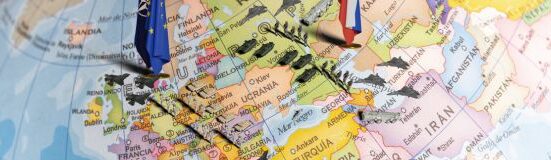


The war in Ukraine, which began with Russia’s full-scale invasion in February 2022, has seen a series of intense battles, shifting front lines, and a resilient Ukrainian defense. As the conflict enters its third year, both sides continue to engage in fierce combat, with significant developments on the ground that have reshaped the course of the war.
Ukraine’s Bold Counter-Offensive into Russia
In early August 2024, Ukrainian forces launched a surprise counter-offensive, advancing up to 18 miles (30 km) into Russia’s Kursk region. This bold move caught Russian forces off guard and led to the evacuation of nearly 200,000 people from the border areas. Ukrainian top commanders claimed control over 1,200 square kilometers of Russian territory, including 93 villages, forcing Russia to declare a state of emergency in the Kursk and Belgorod regions.
This counter-offensive serves dual purposes: pressuring Russia to redeploy its forces from the eastern front, thereby relieving the embattled Ukrainian defenses, and strengthening Ukraine’s position in potential peace negotiations.
Russian Incursion North of Kharkiv
In May 2024, Russian forces launched a significant ground assault, crossing the border north of Kharkiv, Ukraine’s second-largest city. This operation resulted in the seizure of several villages and the displacement of thousands of civilians. The attack stretched Ukraine’s front-line defenses and marked one of the most substantial Russian offensives since the war began.
The timing of this incursion coincided with a temporary halt in U.S. military aid to Ukraine, due to a deadlock in Congress. However, by late April, the U.S. approved a $61 billion aid package, providing Ukraine with critical missiles, artillery, and air-defense systems. Despite the intensity of Russian attacks, including the use of glide bombs, Kharkiv has remained beyond the reach of Russian artillery.
Russia’s Slow but Steady Advance in the East
While Ukraine made gains to the north, Russian forces have been slowly grinding forward in the east, particularly in the contested regions of Donetsk and Luhansk. Eastern Ukraine has been a battleground since 2014, and Russia’s manpower advantage has allowed it to make incremental advances, often at great human cost. Western officials estimate that around 1,200 Russian soldiers were killed or wounded daily in May and June 2024.
Recently, Russian forces captured the small town of Niu-York, northwest of Donetsk, prompting Ukraine to evacuate the city of Pokrovsk. This advance marks a significant change in control in the region, as Russian forces push closer to key Ukrainian-held areas.
The Battle for Bakhmut and Surrounding Areas
The areas around Bakhmut remain one of the war’s most fiercely contested zones. Despite Ukrainian efforts to gain ground around Chasiv Yar, located on higher ground west of Bakhmut, Russian forces have made further advances, keeping the region a flashpoint in the ongoing conflict.
A War of Attrition: Two and a Half Years of Fighting
Russia’s invasion of Ukraine began with a series of missile strikes on cities across the country on February 24, 2022. Russian ground troops quickly moved in, capturing large areas and threatening major cities, including Kyiv. However, strong Ukrainian resistance, coupled with logistical challenges and poor morale among Russian troops, stalled the advance.
Ukraine’s effective use of Western-supplied weapons, such as the Nlaw anti-tank system, turned the tide in several key battles. By October 2022, Russian forces had withdrawn from the north, abandoning their efforts to capture Kyiv. The following month, Ukraine reclaimed the southern city of Kherson.
Since then, the conflict has largely centered on eastern Ukraine, where Russian forces have slowly gained ground but at a tremendous cost. Western estimates suggest that Russia has lost at least 50,000 troops, with the true number likely much higher.
As the war drags on, both sides continue to suffer significant losses, and the prospect of a resolution remains uncertain. The situation on the ground remains fluid, with each side vying for control over strategic territories in a conflict that has already claimed countless lives and displaced millions.