
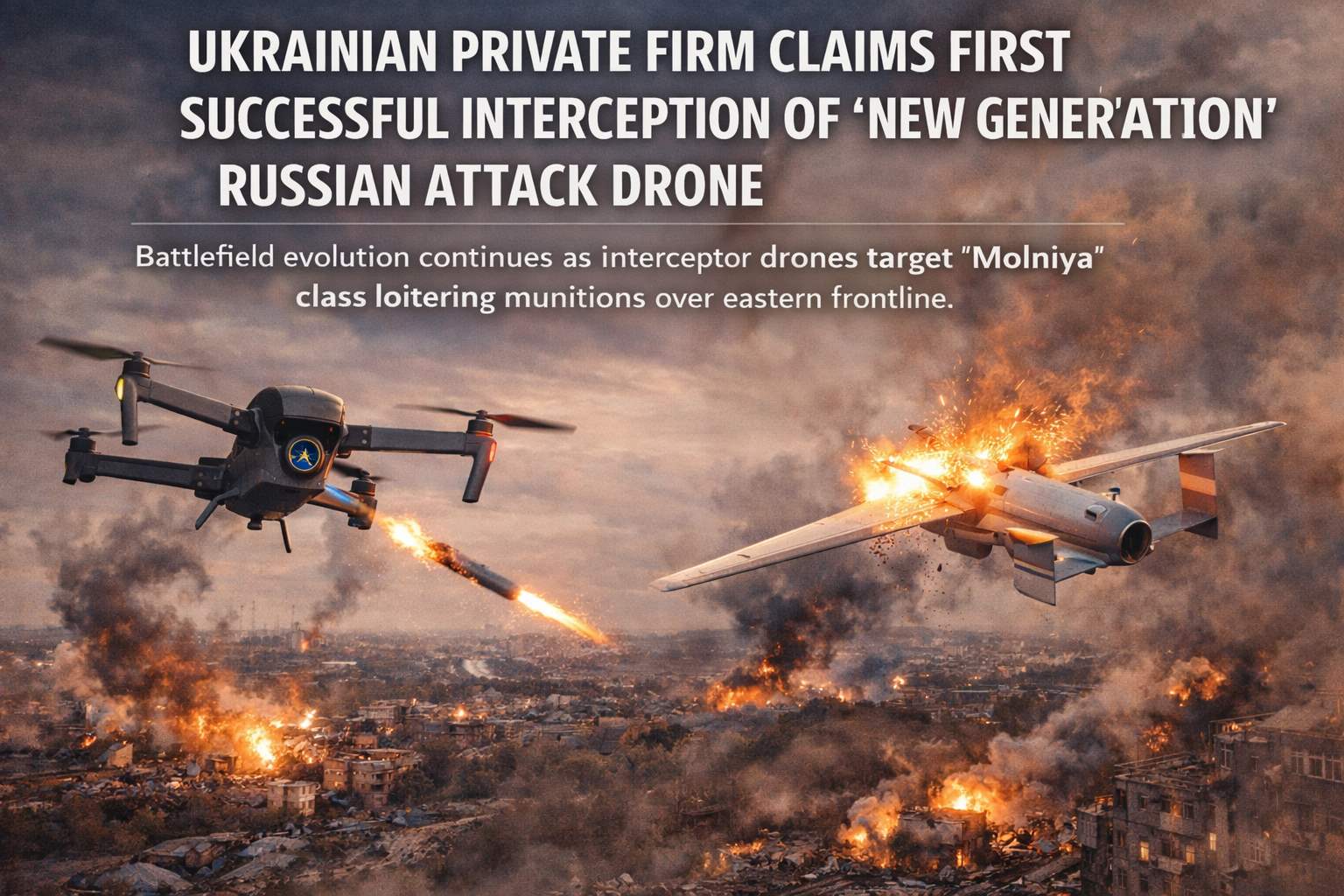
Battlefield evolution continues as interceptor drones target “Molniya” class loitering munitions over eastern frontline.
April 15, 2026
Last Updated: 11:30 AM
By Staff Writer, Global War News
A private Ukrainian defense contractor has reported the first successful mid-air interception of a Russian “Molniya” (Lightning) class drone, marking a potential shift in the technological contest for low-altitude airspace. The firm, specializing in First-Person View (FPV) interceptor technologies, stated that the engagement occurred over the Donetsk region during a localized offensive.
According to a press release from the contractor, the “Molniya” represents a new generation of Russian loitering munitions characterized by its simplified aerodynamic design and reliance on low-cost, off-the-shelf components. While the claim of a successful interception has been widely circulated on Telegram channels associated with the Ukrainian military, it has not yet been independently verified by international observers or official Ministry of Defense channels.
The Rise of the “Molniya” Class
The “Molniya” drone has emerged as a distinct threat in recent months. Analysts note that unlike the more sophisticated “Lancet” munitions, which use complex optical tracking, the “Molniya” appears designed for high-volume production and use in swarms.
Reports from the Associated Press suggest that the drone utilizes a pusher-propeller configuration and a basic airframe that is difficult to detect with traditional radar systems due to its small size and wood-or-plastic construction. In a statement last week, a spokesperson for the Russian Ministry of Defense referred to the deployment of “new, cost-effective strike solutions” on the frontline, though they did not name the “Molniya” specifically.
Technological Response: The Interceptor Race
The interception was reportedly carried out by a modified Ukrainian “interceptor drone,” a high-speed quadcopter designed to physically collide with or detonate near enemy aircraft. This development highlights a rapidly closing loop between the introduction of a new weapon and the deployment of its countermeasure.
According to a report by Janes Defense Weekly, the cost of an interceptor drone is frequently a fraction of the cost of the munition it destroys. This creates a favorable economic ratio for the defending party. However, independent military experts caution that the success of a single interception does not necessarily indicate a systemic solution to the “Molniya” threat, particularly if deployed in large numbers.
Analysis: The “Low-Cost” War of Attrition
The introduction of the “Molniya” and its subsequent interception by private-sector hardware points to a fundamental change in modern warfare: the democratization of high-precision strikes. When attack drones become as cheap as artillery shells, traditional air defense systems—which utilize missiles costing hundreds of thousands of dollars—become economically unsustainable.
Observers note that this “cat-and-mouse” game is increasingly driven by private firms and volunteer groups rather than traditional state-owned defense giants. This raises questions about the long-term standardization of military equipment. While these private innovations allow for rapid adaptation on the battlefield, it remains unclear whether these decentralized solutions can be scaled to protect wider civilian infrastructure or larger troop concentrations.
What to Watch
The primary focus for military analysts in the coming weeks will be whether the “Molniya” drones begin to utilize automated target recognition (ATR) to bypass electronic warfare jamming. On the defensive side, the success of private Ukrainian firms in this interception may lead to increased government contracting for specialized anti-drone units. Both sides continue to prioritize the “electronic frontier,” where the war is won or lost in the software code governing these small, lethal aircraft.
Sources: Associated Press, Janes Defense Weekly, Ukrainian Ministry of Defense (General Statement), Russian Ministry of Defense (Official Remarks), Reuters reporting on frontline tech.
This article is based on publicly available reporting from named international news agencies and attributed official statements. All claims about ongoing events are attributed to their original sources. Analysis sections represent the editorial interpretation of reported facts and do not constitute advocacy for any party to the described conflict. AI tools may be utilized for image generation to assist in explaining complex concepts, as well as for refining grammar, spelling, and other linguistic enhancements. However, all original content is produced, fact-checked, and revised by the editorial team. This publication does not take political positions on active military conflicts.