
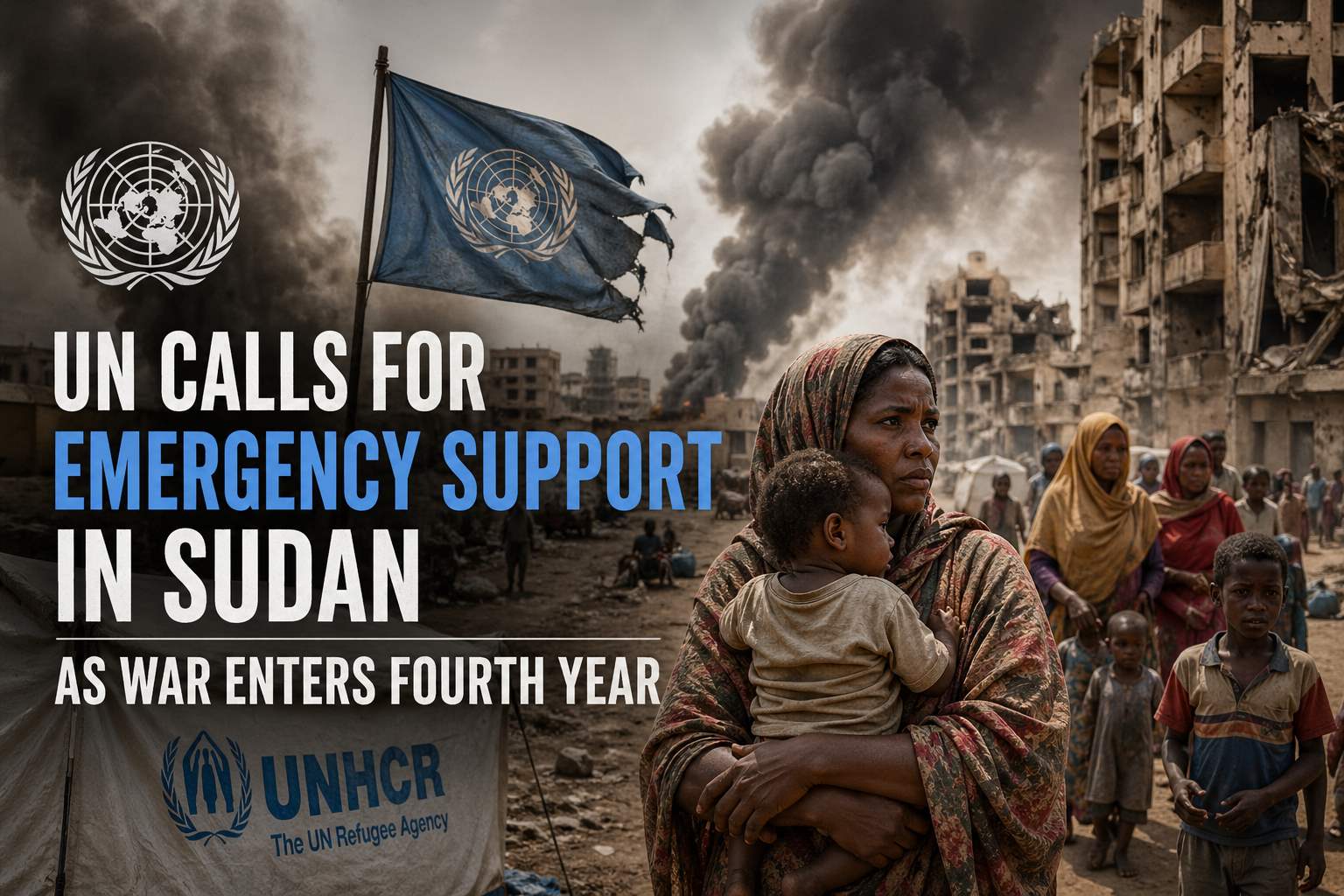
Human rights groups issue an urgent plea for intervention following reports of systematic violence and a “protection crisis” in Khartoum.
April 30, 2026
By Global War News Editorial
The United Nations and leading humanitarian organizations have issued an urgent appeal for international intervention as the conflict in Sudan officially enters its fourth year. The milestone follows three years of devastating warfare between the Sudanese Armed Forces (SAF) and the paramilitary Rapid Support Forces (RSF), a conflict that has created what the UN describes as the world’s largest displacement and humanitarian crisis.
In a series of briefings this week, the UN High Commissioner for Human Rights, Volker Türk, expressed “shock” at accounts of extreme brutality emerging from the capital, Khartoum, and the Darfur region. According to the Office of the United Nations High Commissioner for Human Rights (OHCHR), investigators have documented a surge in atrocity crimes, including systematic torture, gang rape, and ethnic targeting.
Humanitarian agencies are currently seeking $1.6 billion to support nearly 6 million people who have fled to neighboring countries, while an estimated 34 million people inside Sudan remain in desperate need of aid. Despite the scale of the emergency, the 2026 Sudan Regional Refugee Response Plan remains severely underfunded, receiving only a fraction of the necessary resources to sustain life-saving operations.
Systematic Violence and the Collapse of Infrastructure
The third anniversary of the war, marked on April 15, 2026, has seen no let-up in hostilities. Reports from Khartoum-based civil society groups, such as the SEEMA Centre for the Protection of Women and Children, indicate that violence is being used as a weapon of control against local communities.
“The violations are severe, torture, rape, and other forms of sexual violence affecting women, men, and children,” stated Dr. Nahid Jibrallah, director of the SEEMA Centre. She further noted that human rights defenders, doctors, and lawyers have become direct targets of the warring factions, creating a “protection crisis” for those attempting to provide aid.
The physical infrastructure of the country has reached a breaking point. According to the World Health Organization (WHO):
- 70% of health facilities in conflict-affected areas are currently non-functional.
- 21 million people lack access to basic health services.
- Malnutrition levels have surpassed famine thresholds in parts of Darfur and Kordofan.
The Humanitarian “Funding Crunch”
While the need for assistance has reached unprecedented levels, the international response is struggling to keep pace. The UN Refugee Agency (UNHCR) reported that available funding per refugee per month dropped to just $4 in 2025, down from $11 at the start of the conflict.
The IOM’s 2026 Crisis Response Plan for Sudan warns that the destruction of “objects essential for survival”—including markets, water systems, and medical centers—amounts to violations of international humanitarian law. UN Fact-Finding Missions have concluded that both the SAF and RSF have committed acts that may amount to war crimes, including arbitrary detention and indiscriminate attacks on civilian zones.
Analysis: A Conflict “Out of the Spotlight”
As Sudan enters its fourth year of war, the most significant challenge remains the relative silence of the international community. While other global conflicts dominate the headlines, Sudan’s crisis has expanded in a vacuum of diplomatic attention. The fragmentation of peace efforts and the persistent absence of accountability mechanisms have allowed both the SAF and RSF to operate with increasing impunity.
Observers note that the current phase of the conflict is characterized by “progressive externalization,” where the destabilizing effects of the war—including mass migration and the spread of infectious diseases—are beginning to overwhelm the public services of neighboring Egypt, Chad, and Ethiopia. The “last window” for a diplomatic resolution may rely on whether international donors can pivot from temporary emergency aid to a decisive political framework that addresses the root causes of the military rivalry.
What to Watch For
- UNHCR Special Call: The outcome of the special emergency application call for victims of torture in Sudan.
- Disease Outbreaks: Monitoring the spread of cholera and malaria, which have surged following the collapse of water and sanitation systems.
- Accountability Measures: Potential new sanctions from the African Union or the UN targeting leaders of factions identified in the latest Fact-Finding Mission reports.
Source Disclosure: This report is based on official news releases and briefings from the UN High Commissioner for Human Rights (OHCHR), the World Health Organization (WHO), UNHCR, UNICEF, and the International Organization for Migration (IOM). Additional reporting was provided by ReliefWeb and the SEEMA Centre for the Protection of Women and Children.
This article is based on publicly available reporting from named international news agencies and attributed official statements. All claims about ongoing events are attributed to their original sources. Analysis sections represent the editorial interpretation of reported facts and do not constitute advocacy for any party to the described conflict. AI tools may be utilized for image generation to assist in explaining complex concepts, as well as for refining grammar, spelling, and other linguistic enhancements. However, all original content is produced, fact-checked, and revised by the editorial team. This publication does not take political positions on active military conflicts.