
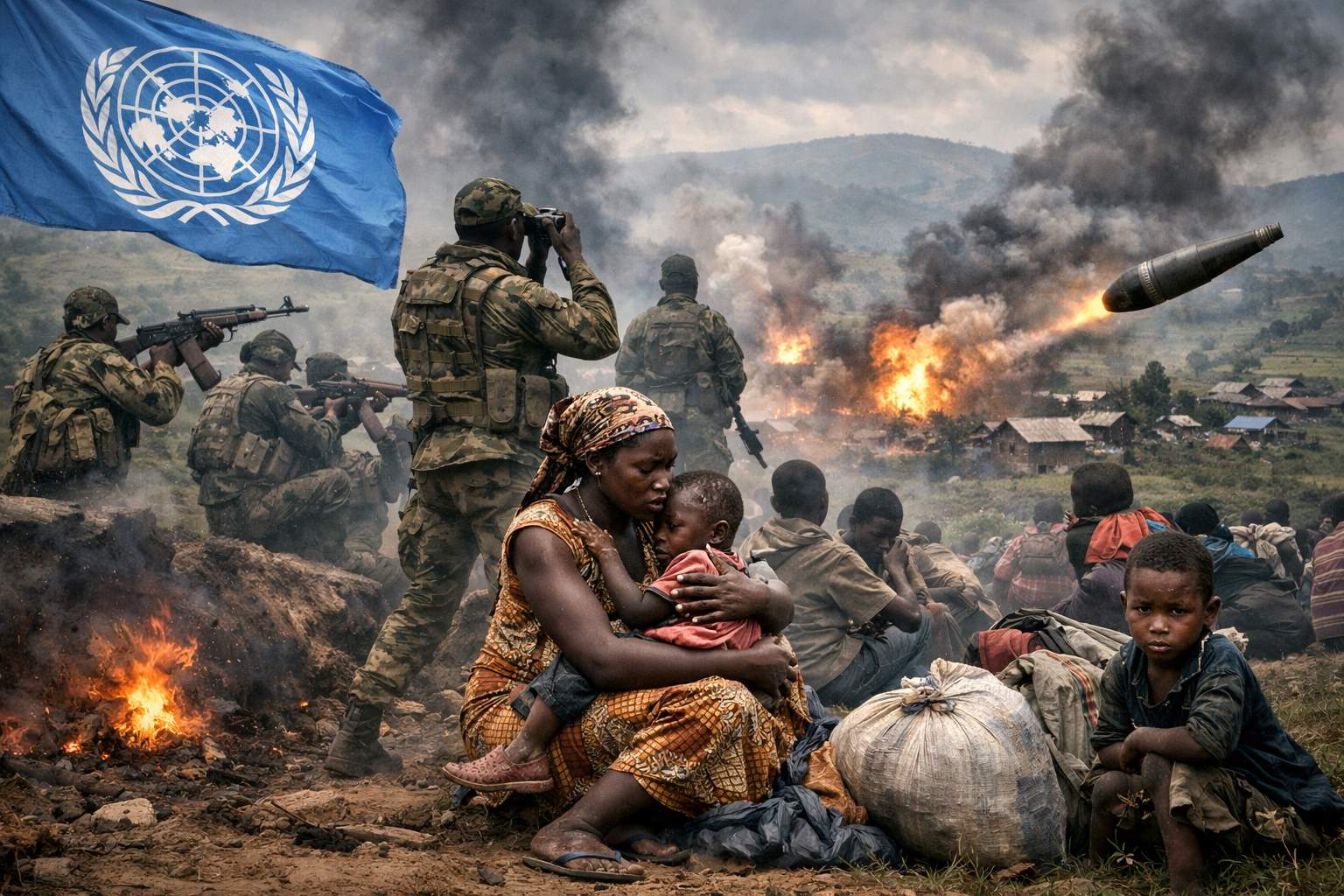
Official appeal highlights “catastrophic” humanitarian risks as M23 movements and cross-border shelling disrupt regional stability.
May 5, 2026
By Global War News Editorial
The United Nations Special Envoy for the Great Lakes region has issued an urgent appeal for an immediate cessation of hostilities in the eastern Democratic Republic of the Congo (DRC) following a sharp escalation in border skirmishes over the weekend. In an official statement released Tuesday, the Envoy warned that the renewed kinetic activity between the Congolese military (FARDC) and the M23 insurgent group threatens to dismantle the fragile Luanda and Nairobi peace frameworks.
The UN appeal follows reports of heavy artillery fire near the border town of Bunagana and the strategic hub of Sake. According to MONUSCO, the UN peacekeeping mission in the DRC, “indiscriminate shelling” has struck areas densely populated by internally displaced persons (IDPs). The Special Envoy stated that the international community “cannot stand by” as regional tensions between the DRC and Rwanda escalate, following attributed claims of cross-border incursions.
Context and Background
The eastern DRC has been plagued by cycles of violence for over three decades, driven by competition over mineral resources and deep-seated ethnic and political grievances. The M23, a rebel group that the DRC government and UN experts have frequently alleged is supported by neighboring Rwanda—a claim Kigali consistently denies—resumed major operations in late 2021.
The humanitarian situation in North Kivu province is currently categorized by the UN as one of the world’s most neglected crises. There are currently over 7 million internally displaced people across the DRC, with approximately 2.5 million in North Kivu alone. The geography of the conflict, characterized by steep volcanic terrain and limited road infrastructure, makes the delivery of aid exceptionally difficult once major transit routes like the Goma-Sake road are contested.
Analysis: The Failure of Regional Buffer Mechanisms
The Special Envoy’s call for de-escalation underscores a growing concern among analysts regarding the breakdown of regional mediation. Observers note that the withdrawal of the East African Community Regional Force (EACRF) in late 2023 and its replacement by the Southern African Development Community (SADC) mission (SAMIDRC) has not yet stabilized the frontlines.
Analysis suggests that the M23 has shifted toward a “siege tactic,” attempting to isolate the provincial capital of Goma by cutting off its primary supply arteries. This strategy places immense pressure on the Congolese government to engage in direct negotiations—a move Kinshasa has resisted, citing the group’s alleged foreign backing. The “internationalization” of the conflict, involving SADC troops and alleged regional interference, raises the risk of a broader interstate confrontation. Without a renewed commitment to the Luanda process, which emphasizes the withdrawal of foreign-backed elements and the cantonment of rebels, the conflict appears to be entering a phase of entrenched attrition where civilian populations bear the brunt of the tactical stalemate.
Current Status and Outlook
As of May 5, reports from local civil society groups in Goma indicate that while the city remains under government control, the sounds of heavy weaponry are audible from the western front. The UN High Commissioner for Refugees (UNHCR) has reported that an additional 30,000 people have fled toward South Kivu in the last 72 hours. While the UN Special Envoy continues to seek a high-level meeting between regional heads of state, the immediate outlook remains volatile. Relief agencies are warning that fuel and food prices in Goma have risen by 50% due to the blockade of northern supply routes, heightening the risk of a secondary urban humanitarian crisis.
Source Disclosure: This article is based on official statements from the UN Special Envoy for the Great Lakes, operational updates from MONUSCO, reporting from Agence France-Presse (AFP) and Reuters, and humanitarian data from the UNHCR and the Norwegian Refugee Council.
This article is based on publicly available reporting from named international news agencies and attributed official statements. All claims about ongoing events are attributed to their original sources. Analysis sections represent the editorial interpretation of reported facts and do not constitute advocacy for any party to the described conflict. AI tools may be utilized for image generation to assist in explaining complex concepts, as well as for refining grammar, spelling, and other linguistic enhancements. However, all original content is produced, fact-checked, and revised by the editorial team. This publication does not take political positions on active military conflicts.