
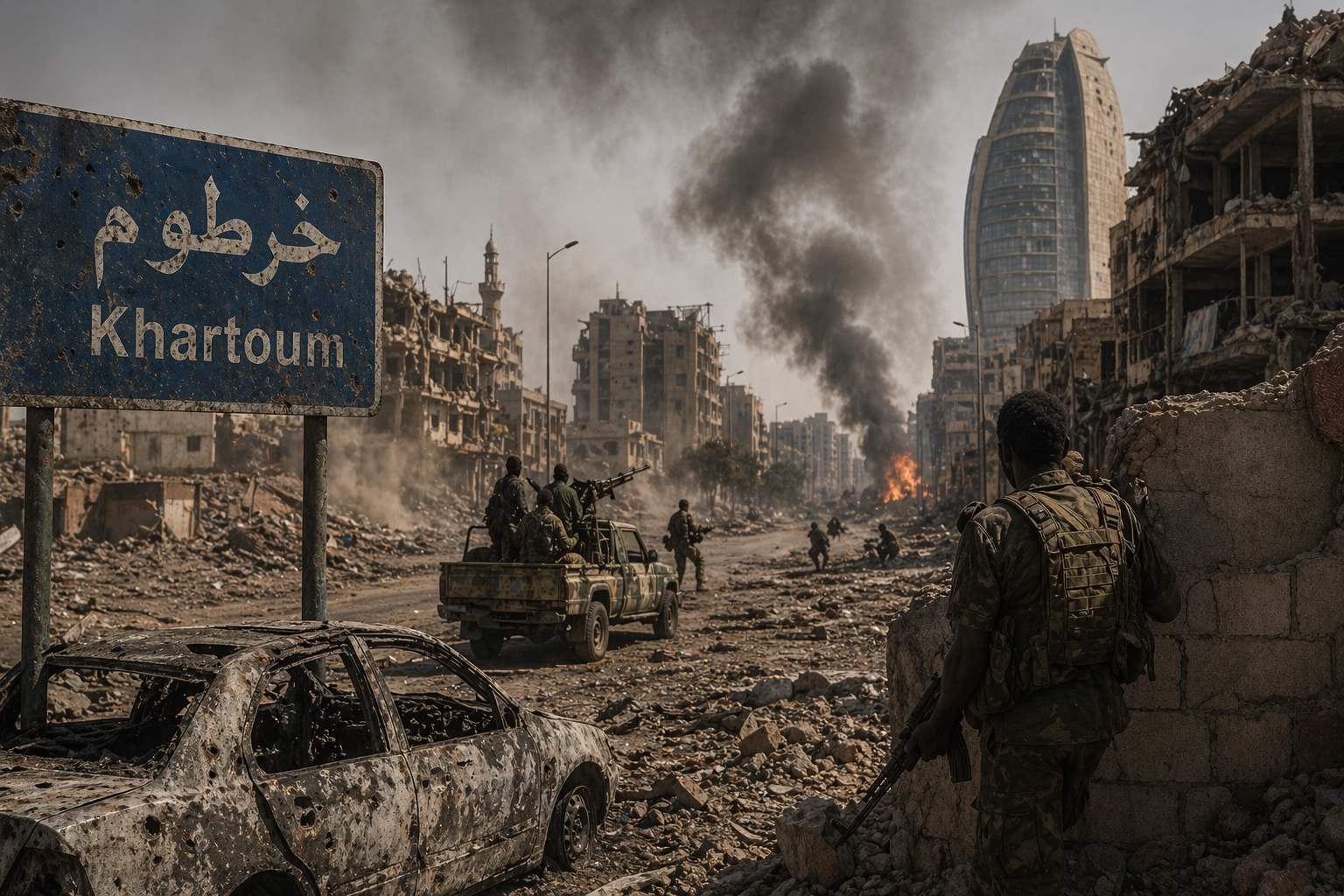
Renewed shelling and street-level engagements reported in the capital’s central districts as diplomatic efforts to extend the ceasefire falter.
April 23, 2026
Last Updated: April 23, 2026
By Global War News Editorial
Heavy fighting has resumed across Khartoum and its twin cities of Omdurman and Bahri, marking a violent end to a 72-hour temporary truce that had offered a brief reprieve to trapped civilians. According to reports from the Associated Press, the sounds of heavy artillery and fighter jets returned to the capital’s skyline early Thursday morning, with the most intense combat centered around the General Command of the Sudanese Armed Forces (SAF).
The collapse of the truce follows a series of reciprocal accusations between the SAF and the paramilitary Rapid Support Forces (RSF), each claiming the other utilized the lull to reposition troops and equipment. According to a statement from the Sudanese Doctors’ Union, the renewal of hostilities has once again paralyzed the city’s remaining functional hospitals, with several medical facilities in the Al-Amarat neighborhood reportedly caught in the crossfire.
Shift Toward Neighborhood-Level Warfare
The current escalation indicates a shift from strategic site defense to house-to-house urban combat. According to reporting from Reuters, the RSF has maintained its presence in high-density residential areas, using civilian dwellings as defensive positions. In response, the SAF has reportedly increased its use of aerial bombardment and drone strikes to target RSF supply lines within the city.
Eye-witness accounts gathered by the BBC describe a “scorched-earth” environment in central Khartoum. Residents reported that the central market and several administrative buildings have sustained significant fire damage. The UN Integrated Transition Assistance Mission in Sudan (UNITAMS) stated that the lack of “safe corridors” has made it impossible to evacuate the wounded or deliver emergency food rations to districts that have been under siege for weeks.
Impact on Essential Infrastructure
The intensification of fighting has dealt a severe blow to the city’s already fragile utility networks. According to official data from the Khartoum State Water Corporation, shelling has damaged a primary pumping station in North Bahri, leaving approximately 600,000 residents without access to running water.
Furthermore, the Sudanese Electricity Distribution Company reported that a major transformer in the industrial zone was struck during an overnight artillery exchange. Analysts note that the prolonged loss of power and water in an urban environment with temperatures exceeding 40°C (104°F) creates a secondary humanitarian crisis that could lead to a mass exodus of the remaining population toward the border with Egypt or South Sudan.
Analysis: The Failure of Short-Term Truces
The repeated collapse of temporary ceasefires raises questions about the efficacy of current mediation strategies. Observers note that without an independent monitoring mechanism on the ground, “humanitarian truces” are frequently viewed by combatants as tactical opportunities rather than genuine steps toward peace.
“We are seeing a pattern where truces are used to resupply ammunition rather than evacuate civilians,” says a regional security analyst. “In a dense urban environment like Khartoum, the military advantage often lies with whichever side can consolidate control over key intersections and bridges during these pauses.”
Economically, the continued destruction of Khartoum, the nation’s financial and industrial heart, suggests a total contraction of the Sudanese economy. According to World Bank projections, the country’s GDP is expected to shrink by an additional 15% this year if the capital remains a primary battleground, as trade routes to the Red Sea remain severed.
What to Watch For
As reported by Al Jazeera, international mediators from the African Union and the IGAD regional bloc are attempting to convene an emergency session to establish a more permanent “cessation of hostilities” agreement. However, the lack of a clear unified command within the warring factions complicates the enforcement of any potential deal.
The focus now turns to the outskirts of the city. If the SAF succeeds in cutting off the RSF’s supply routes from the western Darfur region, the combat in Khartoum may intensify further as the paramilitary forces find themselves increasingly cornered within the urban sprawl. Conversely, if the RSF maintains its hold on the bridges connecting Omdurman and Khartoum, the city faces a protracted war of attrition.
Sources: This article is based on reporting and official statements from the Associated Press, Reuters, the BBC, Al Jazeera, the Sudanese Doctors’ Union, and the United Nations (UNITAMS).
This article is based on publicly available reporting from named international news agencies and attributed official statements. All claims about ongoing events are attributed to their original sources. Analysis sections represent the editorial interpretation of reported facts and do not constitute advocacy for any party to the described conflict. AI tools may be utilized for image generation to assist in explaining complex concepts, as well as for refining grammar, spelling, and other linguistic enhancements. However, all original content is produced, fact-checked, and revised by the editorial team. This publication does not take political positions on active military conflicts.