
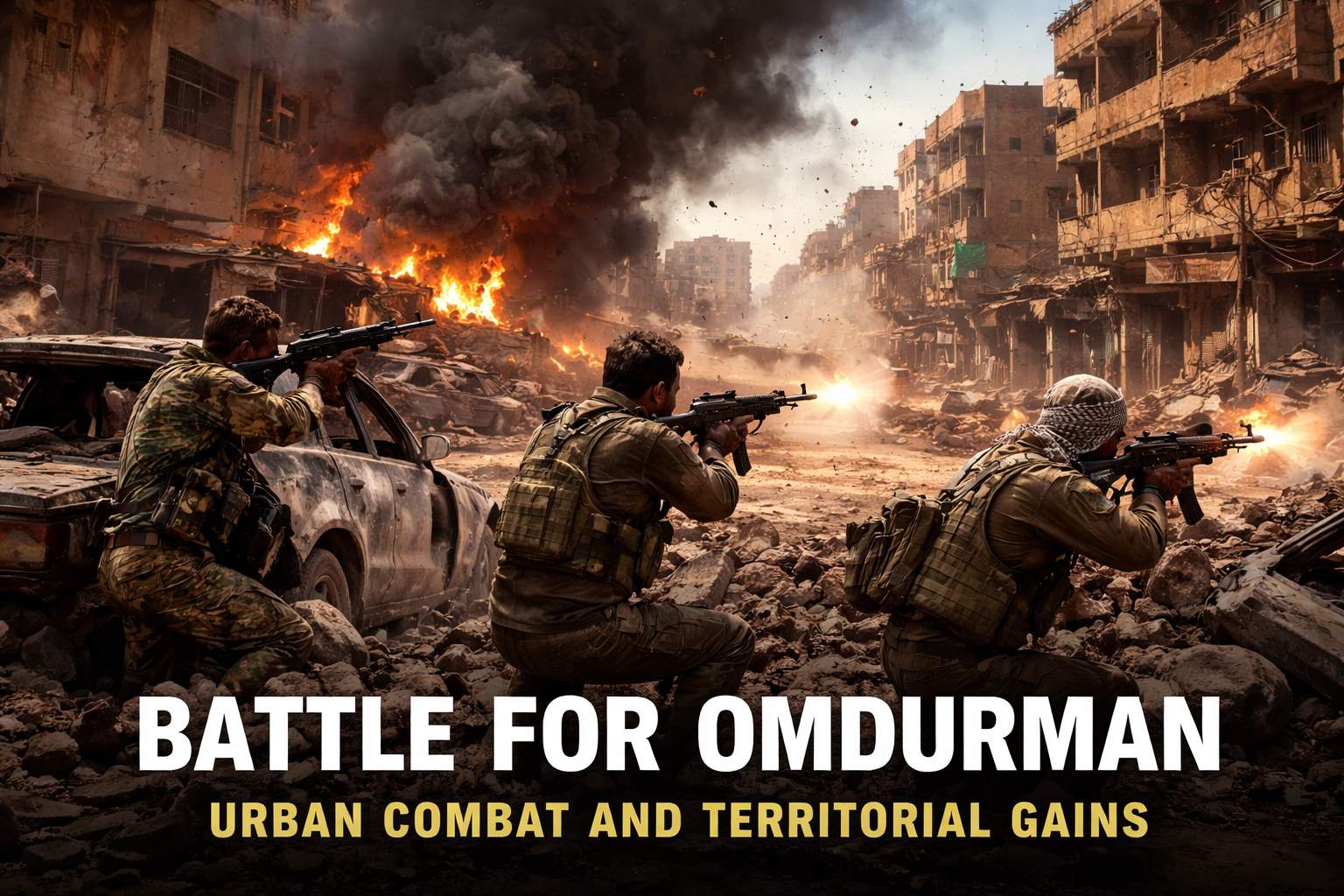
Conflicting reports from the Sudanese capital suggest a fluid frontline as both sides contest residential and commercial districts.
April 27, 2026
Last updated: April 27, 2026
By Global War News Editorial
Recent reports from the Sudanese capital indicate an intensification of urban combat in Omdurman, the nation’s most populous city. Over the last forty-eight hours, the Sudanese Armed Forces (SAF) and the Rapid Support Forces (RSF) have issued conflicting claims regarding territorial control in the central and northern districts. While the SAF has reported “significant progress” in clearing residential blocks near the Al-Thawra neighborhoods, the RSF maintains that it has repelled these advances and continues to hold strategic positions near the Omdurman bridgeheads.
Verifying these claims remains a significant challenge for international observers. According to reporting from Reuters and Al Jazeera, the density of the urban environment and the frequent disruption of telecommunications have created a “fog of war” that obscures the true extent of territorial shifts. Independent analysts utilizing satellite imagery have noted increased fire signatures and structural damage near the National Broadcasting Corporation building, suggesting that the most intense fighting is concentrated around state-controlled infrastructure.
Background: The Strategic Key to Khartoum
Omdurman, situated on the west bank of the Nile, is a critical component of the tripartite capital region alongside Khartoum and Khartoum North. Since the conflict began in April 2023, the city has served as the SAF’s primary gateway for reinforcements arriving from the north and west of the country.
By early 2026, the battle for Omdurman has transitioned into a grueling street-by-street struggle. Unlike the early months of the war, which were characterized by rapid mechanized movements, current operations are defined by sniper positions, improvised explosive devices (IEDs), and the use of residential villas as fortified outposts. This shift has made the city almost entirely uninhabitable for the remaining civilian population.
Economic Impact: The Erasure of the Middle Class
The economic consequences of the prolonged battle for Omdurman are profound, affecting both local survival and regional trade.
- Commercial Ruin: Omdurman was historically the commercial heart of Sudan, housing the country’s largest traditional markets and wholesale distribution centers. According to a recent assessment by the Sudanese Economists Association, approximately 85% of the city’s small and medium-sized enterprises have been looted or destroyed, effectively erasing decades of middle-class wealth.
- Infrastructure Degradation: The contest for the city’s bridges, the Al-Shuhada and Old Omdurman bridges—has led to significant structural damage. The World Bank estimates that the cost of restoring basic utility services (water and electricity) to Omdurman alone will require billions in international aid, a prospect that remains unlikely without a sustained ceasefire.
- Supply Chain Collapse: As the primary transit point for goods coming from the Port of Sudan toward the western provinces, the paralysis of Omdurman has created a “supply desert” in Kordofan and Darfur. Local prices for basic grains in these regions have reportedly increased by over 400% since the start of the year.
Analysis: The Stalemate of Attrition
The current claims of territorial gains are best understood as tactical maneuvering within a broader strategic stalemate. For the SAF, securing Omdurman is essential to maintaining its legitimacy as a governing force and protecting its logistical “umbilical cord” to the northern states. For the RSF, holding ground in Omdurman prevents the SAF from consolidating control over the capital region and maintains pressure on the military’s leadership.
Observers note that neither side appears to have the manpower or technical superiority to achieve a total clearing of the city. Instead, the “territorial gains” often represent the capture of a single street or a cluster of buildings, which may change hands several times in a week. This type of warfare is maximize in its destructiveness while being minimize in its strategic resolution. The UN has warned that the continued use of heavy artillery in densely populated neighborhoods constitutes a potential violation of international humanitarian law, though both parties continue to attribute civilian harm to the opposing force.
Current Status and Outlook
As of Monday, local activists and “emergency rooms” report that heavy shelling has resumed in the vicinity of the Al-Nau hospital, one of the few remaining functional medical facilities in the city. The SAF has reportedly deployed new drone units in an attempt to pinpoint RSF snipers, while the RSF has reinforced its positions in the southern neighborhoods.
The outlook for May remains bleak. Without a significant diplomatic breakthrough in the Saudi-US-led Jeddah talks, Omdurman is likely to remain a fractured city. The primary indicator for the coming weeks will be whether either side can successfully secure and hold the major bridges over the Nile; until then, Omdurman remains a battlefield where “victory” is measured in ruins rather than governance.
Sources:
- Reporting from Reuters, Al Jazeera, and Sudan Tribune (April 24–27, 2026).
- Satellite imagery analysis provided by independent conflict monitors.
- Sudanese Economists Association quarterly impact report (Q1 2026).
- UN OCHA Sudan Situation Report (April 2026).
- Official social media communiqués from the Sudanese Armed Forces and Rapid Support Forces.
This article is based on publicly available reporting from named international news agencies and attributed official statements. All claims about ongoing events are attributed to their original sources. Analysis sections represent the editorial interpretation of reported facts and do not constitute advocacy for any party to the described conflict. AI tools may be utilized for image generation to assist in explaining complex concepts, as well as for refining grammar, spelling, and other linguistic enhancements. However, all original content is produced, fact-checked, and revised by the editorial team. This publication does not take political positions on active military conflicts.